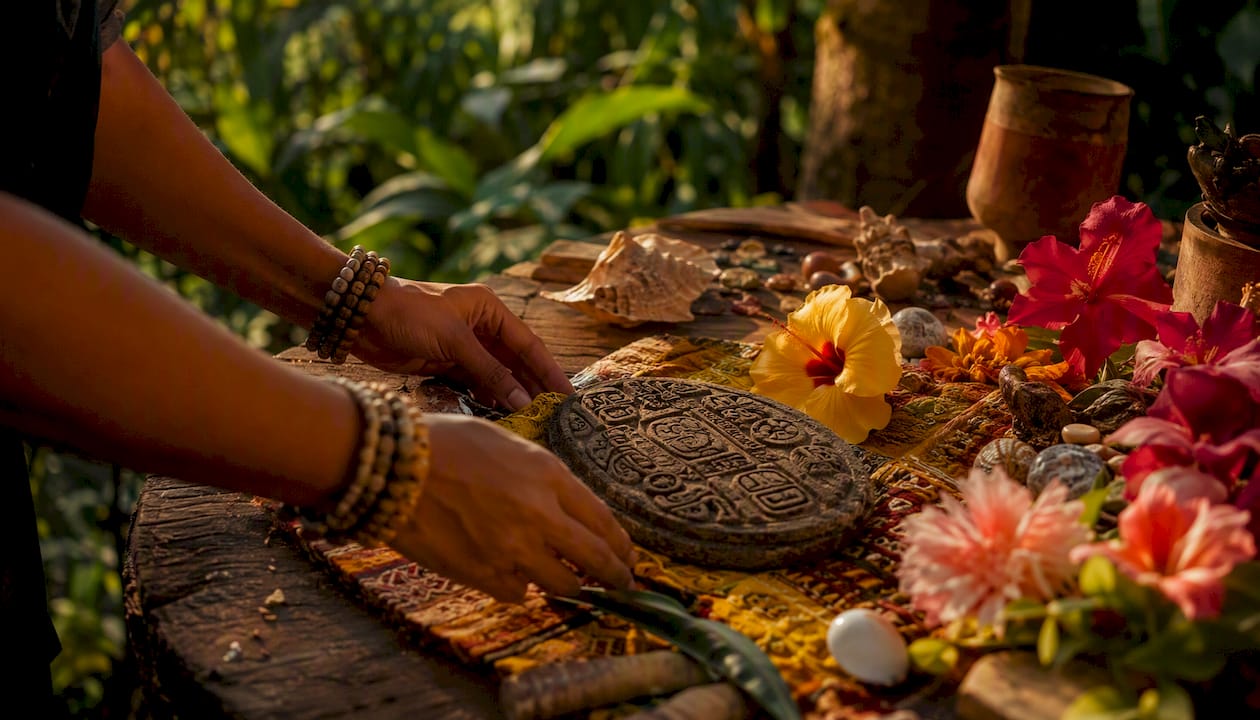
The 260-day calendar, known to the Maya as the Tzolk’in and to the Aztec as the tonalpohualli, is a ritual and divinatory cycle built from 13 numbers paired with 20 named days, producing 260 unique day combinations that governed birth naming, divination, agricultural timing, and ceremony across Mesoamerica. According to Britannica, this cycle functioned as the primary tool for reading fate and scheduling sacred life. It was not a solar calendar and tracked no seasons. Its purpose was entirely ritual.
Two lines tell the essential story. First: the Tzolk’in governed the most intimate moments of human life, from the name a child received at birth to the day a community planted its maize. Second: the system is not purely ancient. Inscriptions at San Bartolo date its use to at least the 3rd century BCE, and Aj k’ij (Day Keepers) in the Guatemalan highlands still consult it today.
Key Takeaways
The 260-day calendar (Tzolk’in) is a ritual cycle of 13 numbers paired with 20 day signs, producing 260 unique days that governed divination, naming, and ceremony across Mesoamerica and continues in living practice today.
| Point | Details |
|---|---|
| Core structure | 13 numbers × 20 day signs = 260 unique days; no combination repeats within the cycle. |
| Origin debate | Malmström’s 1973 zenithal-sun hypothesis, Olmec/Izapa evidence, and mathematical arguments each explain part of the data but none is fully settled. |
| Ritual functions | Used for birth naming, divination, maize planting timing, ceremony scheduling, and warfare decisions across Mesoamerican cultures. |
| Living tradition | Ajq’ijab’ (Day Keepers) in the Guatemalan highlands actively maintain the Chol Q’ij today, with apprenticeships organized around the 260-day cycle. |
| Mymayansign | The free Mayan sign calculator at Mymayansign identifies your Tzolk’in day sign and Galactic Tone from your birth date as an educational starting point. |
Table of Contents
- Quick facts about the 260-day calendar system
- How the 260-day cycle is structured: day signs, numbers, and trecenas
- Where did the 260-day calendar come from? Origin theories and evidence
- How the 260-day calendar was used historically
- How the 260-day calendar relates to the Haab and the Long Count
- How to read and convert a Tzolk’in date
- Where the 260-day calendar survives today
- How scholars reconstruct the 260-day calendar
- Why the 260-day calendar still matters
- Your Tzolk’in day sign is waiting for you
- Sources
Quick facts about the 260-day calendar system
The structure is elegant in its simplicity. Thirteen numbers cycle continuously against twenty named days, like two interlocking gears. Because 13 and 20 share no common factor, the gears only realign after exactly 260 rotations, producing 260 distinct day identities before any combination repeats.
- Core formula: 13 × 20 = 260 unique days
- Maya name: Tzolk’in (also spelled Tzolkin); K’iche’ variant: Chol Q’ij
- Aztec name: Tonalpohualli
- Primary functions: Divination, birth naming, ritual scheduling, agricultural timing
- Still practiced: Guatemalan highlands (K’iche’, Kaqchikel, Mam communities), parts of Veracruz, Oaxaca, and Chiapas
- Earliest evidence: Architectural alignments suggesting use by ca. 1100 BCE; written day signs at San Bartolo, 3rd century BCE
- Origin theories: Malmström’s zenithal-sun hypothesis (latitude ~15°N); Olmec/Izapa origin; mathematical/ritual-number explanation
- Relationship to other calendars: Pairs with the 365-day Haab to form the 52-year Calendar Round (18,980 days); embedded within the Long Count for multi-century chronology
260 = 13 × 20. Every day in the cycle carries a number from 1 to 13 and one of 20 named signs. No two days in the 260-day span share the same combination.
How the 260-day cycle is structured: day signs, numbers, and trecenas
The Living Maya Time resource at the Smithsonian’s NMAI describes the Tzolk’in as two interlocking cycles: a sequence of twenty named days and a sequence of thirteen numbers, running simultaneously and independently. Picture two gears meshing. One has 13 teeth, the other 20. They only return to the same starting position after 260 steps.
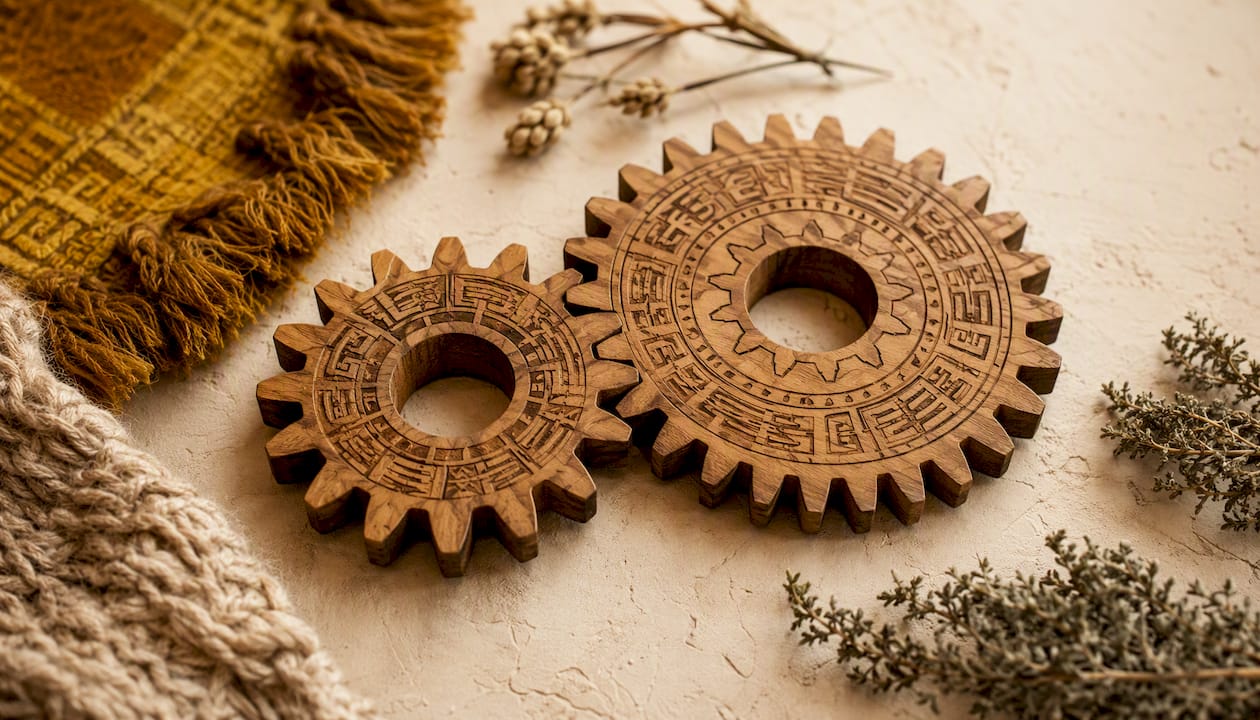
Each of the 20 day signs carries its own symbolic identity, linked to deities, animals, natural forces, and human qualities. The table below lists all 20 signs with their scholarly transliterations and core symbolic meanings.
| # | Day Sign (Yucatec/K’iche’) | Symbolic Meaning |
|---|---|---|
| 1 | Imix / Imox | Primordial water, crocodile, chaos |
| 2 | Ik’ / Iq’ | Wind, breath, spirit |
| 3 | Ak’bal / Aq’ab’al | Darkness, dawn, the underworld |
| 4 | K’an / K’at | Maize, abundance, the net |
| 5 | Chikchan / Kan | Serpent, life force, sky |
| 6 | Kimi / Kame | Death, transformation, ancestors |
| 7 | Manik’ / Kej | Deer, grace, the forest |
| 8 | Lamat / Q’anil | Rabbit, Venus, fertility |
| 9 | Muluk / Toj | Water, rain, offering |
| 10 | Ok / Tz’i’ | Dog, loyalty, justice |
| 11 | Chuwen / B’atz’ | Monkey, artistry, time itself |
| 12 | Eb’ / E | Road, grass, the path of life |
| 13 | B’en / Aj | Reed, authority, the home |
| — | Ix / I’x | Jaguar, earth magic, feminine power |
| 15 | Men / Tz’ikin | Eagle, vision, the sky |
| — | Kib’ / Ajmaq | Owl, wisdom, forgiveness |
| — | Kab’an / No’j | Earth, thought, movement |
| 18 | Etz’nab’ / Tijax | Flint, obsidian, sacrifice |
| — | Kawak / Kawoq | Storm, rain, community |
| 20 | Ajaw / Ajpu | Sun, lord, the hero |
A trecena is a 13-day period named after its first day sign. The trecena of 1 Imix, for example, runs from 1 Imix through 13 B’en, after which the number resets to 1 while the day sequence continues with Ix. Each trecena carries the energetic signature of its opening day and was consulted by priests and Day Keepers when scheduling ceremonies or reading a person’s fate. The trecena of 1 Ajaw, which opens on the day of the Sun Lord, was considered especially powerful for ritual and royal proclamation. You can explore your own birth trecena to see which 13-day window shaped your entry into the world.
Pro Tip: Spelling varies significantly between linguistic traditions. K’iche’ Maya texts use Iq’, Kej, and B’atz’, while Yucatec texts use Ik’, Manik’, and Chuwen for the same signs. When reading scholarly sources, check which tradition the author follows before assuming two names refer to different days. The FAMSI calendrics resource provides clear cross-references between regional orthographies.
Where did the 260-day calendar come from? Origin theories and evidence
No single origin theory commands universal agreement, and that honest uncertainty is part of what makes the scholarship so alive.
Malmström’s zenithal-sun hypothesis is the most cited astronomical explanation. In a 1973 paper in Science, Vincent H. Malmström proposed that the 260-day interval corresponds to the period between successive zenithal passages of the sun at approximately 15°N latitude, a region that includes the Izapa area on the Pacific coast of southern Mexico. At that latitude, the sun passes directly overhead twice a year, and the interval between those passages in one direction is close to 260 days. The hypothesis is geographically specific and astronomically coherent, but critics note that the calendar appears across regions far from 15°N, which complicates a single-origin claim.
The Olmec/Izapa argument places the calendar’s origin among the earliest complex societies of Mesoamerica. Archaeological alignments and inscriptions at sites including Oxtotitlán and Monte Albán suggest the system was in use well before the Classic Maya period. The San Bartolo murals, dated to the 3rd century BCE, contain day signs that confirm the calendar was already formalized by that point. Earlier architectural alignments push the probable origin back to around 1100 BCE, though written confirmation at that depth remains elusive.
The mathematical and ritual-number explanation argues that 13 and 20 were independently sacred in Mesoamerican cosmology: 13 for the layers of the heavens, 20 for the base of the vigesimal (base-20) counting system. Their product, 260, may have been recognized as cosmologically complete rather than derived from any single astronomical observation. Anthony Aveni, one of the leading scholars of Mesoamerican astronomy, has argued that the 260-day cycle resonates with multiple natural periods, including the human gestation cycle of approximately nine months, Venus synodic periods, and eclipse intervals, suggesting the number may have been recognized as a convergence point rather than derived from one source.
Key archaeological timeline:
- Ca. 1100 BCE: Architectural alignments at early Mesoamerican sites suggest the 260-day cycle was already in use
- 3rd century BCE: Day signs appear in the San Bartolo murals, the earliest unequivocal written evidence
- Monte Albán inscriptions: Confirm the calendar’s spread across Oaxacan cultures in the pre-Classic period
- 1973: Malmström publishes his zenithal-sun hypothesis in Science, sparking ongoing debate
Scholarly debate is healthy here. Each theory explains some of the data but not all of it. The astronomical argument fits the geography of Izapa but not the broader distribution. The mathematical argument explains cultural adoption but not initial invention. The gestation hypothesis is intriguing but difficult to test archaeologically. What all three share is a recognition that 260 was not an arbitrary number.
How the 260-day calendar was used historically
The ritual calendar touched nearly every dimension of Mesoamerican life. Its applications were not abstract. They were woven into the most concrete decisions a person or community could make.
The Britannica entry on the Maya calendar identifies the core functions clearly: divination, birth naming, agricultural scheduling, and ritual timing. Each deserves a closer look.
- Divination and fate-reading: A person’s birth day sign was understood as a map of their character and destiny. A child born on 1 Ajaw carried the energy of the Sun Lord; one born on 1 Kimi faced the transformative power of death and rebirth. Priests consulted the day sign and its trecena position to advise on marriage, travel, and enterprise.
- Naming at birth: Across Maya and Aztec cultures, a child’s name was often derived directly from their birth day sign. The day was not just a label but a living identity, a Nawal, that accompanied the person through life.
- Agricultural timing: Maize planting, the most sacred agricultural act in Mesoamerica, was scheduled in consultation with the 260-day cycle. Specific day signs were considered auspicious for planting, harvesting, and offering ceremonies tied to the milpa.
- Ritual and ceremonial scheduling: Temple dedications, royal accessions, and warfare were timed to fall on days whose signs amplified the intended outcome. A battle launched on a day of the Serpent (Chikchan) carried different energy than one begun on the day of the Deer (Manik’).
- Initiation of Day Keepers: Aj k’ij apprentices in the Guatemalan highlands undergo training organized around the 260-day cycle itself, with initiation ceremonies timed to specific trecenas.
This is the aspect of the Tzolk’in that most surprises people encountering it for the first time. It was not a passive record of time. It was an active cosmological instrument. The NMAI’s Living Maya Time project documents contemporary Ajq’ijab’ (Day Keepers) in Guatemala who continue these practices, conducting ceremonies on specific Tzolk’in days and advising community members on auspicious timing for major life decisions.
How the 260-day calendar relates to the Haab and the Long Count
The Tzolk’in did not operate in isolation. It was one gear in a larger system, and understanding how the gears mesh clarifies why Mesoamerican calendrics are so precise.
The Haab is a 365-day solar calendar divided into 18 months of 20 days each, plus a 5-day period called Wayeb’. It tracked the approximate solar year and governed agricultural seasons. Alone, it could not identify a specific ritual day. Paired with the Tzolk’in, it could.
When a Tzolk’in date and a Haab date are combined, the result is a Calendar Round date. Because 260 and 365 share no common factor other than 5, the combined cycle takes 18,980 days (52 solar years) before the same Tzolk’in/Haab pairing recurs. A Calendar Round date like “4 Ajaw 8 Kumk’u” identifies a unique day within any 52-year span. For most practical and ritual purposes, 52 years was enough precision.
Key distinctions to keep clear:
- The Tzolk’in (260 days) tracks ritual and divinatory time; it has no months or seasons
- The Haab (365 days) tracks the approximate solar year; it has named months but no ritual day signs
- The Calendar Round (18,980 days / 52 years) is the smallest unit where a specific Tzolk’in + Haab pairing repeats
- The Long Count extends chronology across centuries by counting days from a fixed mythological starting point (commonly correlated to August 11, 3114 BCE in the Gregorian calendar using the GMT correlation)
One common error worth correcting: the 260-day cycle is not a “year.” Calling it the “Mayan year” misrepresents its function. It is a ritual cycle, not a solar one. The Haab is the closer analog to a year, and even it is not astronomically precise enough to be a true solar year.
How to read and convert a Tzolk’in date
Reading a Tzolk’in date is straightforward once you understand the two-part structure: a number from 1 to 13 and one of the 20 day signs. The date “8 Lamat,” for example, means the number 8 paired with the day sign Lamat (Rabbit/Venus). That combination appears once in every 260-day cycle.
To follow the sequence forward from any date:
- Identify the current number and day sign (e.g., 8 Lamat).
- Advance the number by 1 (8 becomes 9) and advance the day sign by 1 in the sequence (Lamat becomes Muluk).
- The next day is 9 Muluk.
- When the number reaches 13, the next day resets to 1 while the day sign continues advancing.
- When the day sign reaches Ajaw (position 20), it wraps back to Imix while the number continues.
- After 260 steps, both cycles return to their starting combination simultaneously.
For a worked example: if today is 1 Imix, the sequence runs 1 Imix, 2 Ik’, 3 Ak’bal, 4 K’an, 5 Chikchan, 6 Kimi, 7 Manik’, 8 Lamat, 9 Muluk, 10 Ok, 11 Chuwen, 12 Eb’, 13 B’en, then 1 Ix (the number resets, the day sign continues). The FAMSI calendrics resource provides complete sequencing tables and worked conversion examples for anyone who wants to verify specific dates.
For converting a Gregorian birth date to its Tzolk’in equivalent, online calculators are the most practical tool. Mymayansign’s free Mayan sign calculator identifies your day sign and Galactic Tone instantly from your birth date. You can also check today’s Tzolk’in day sign and tone to see the living cycle in real time.
Pro Tip: When converting ancient inscription dates to Gregorian equivalents, scholars must specify which correlation constant they use. The GMT (Goodman-Martínez-Thompson) correlation is the most widely accepted, but different correlations can shift an absolute date by years. For modern birth date conversions, the GMT correlation is standard and consistent across reputable calculators. For ritual practice within living Maya communities, always verify with community-verified sources rather than relying solely on any online tool.
Where the 260-day calendar survives today
The Tzolk’in is not a relic. In the Guatemalan highlands, it is a living system consulted for naming, ceremony, and community decision-making. The survival is remarkable given five centuries of colonial suppression, forced conversion, and cultural disruption.
Modern regions where the 260-day cycle remains active:
- Guatemalan highlands: K’iche’, Kaqchikel, Mam, and Tz’utujil communities maintain the Chol Q’ij (the K’iche’ name for the 260-day cycle) with active Day Keeper lineages
- Veracruz and Oaxaca (Mexico): Some Totonac and Zapotec communities retain versions of the cycle, though practice is less continuous than in Guatemala
- Chiapas (Mexico): Tzotzil and Tzeltal Maya communities preserve elements of the calendar in ceremonial life
The Aj k’ij (singular) or Ajq’ijab’ (plural) are the trained specialists who carry this knowledge. Their apprenticeship is organized around the 260-day cycle itself. Ethnographic accounts describe initiates undergoing approximately nine months of training, a period that maps directly onto one full Tzolk’in round, before receiving their ceremonial bundle and the authority to conduct readings and ceremonies. The Living Maya Time resource documents this practice with ethnographic depth.
Contemporary tensions exist. Some evangelical Christian communities in Guatemala have actively discouraged Tzolk’in practice, viewing it as incompatible with Christian faith. Yet the calendar has proven resilient, partly because Day Keepers have adapted their practice to coexist with other belief systems rather than positioning the two as mutually exclusive.
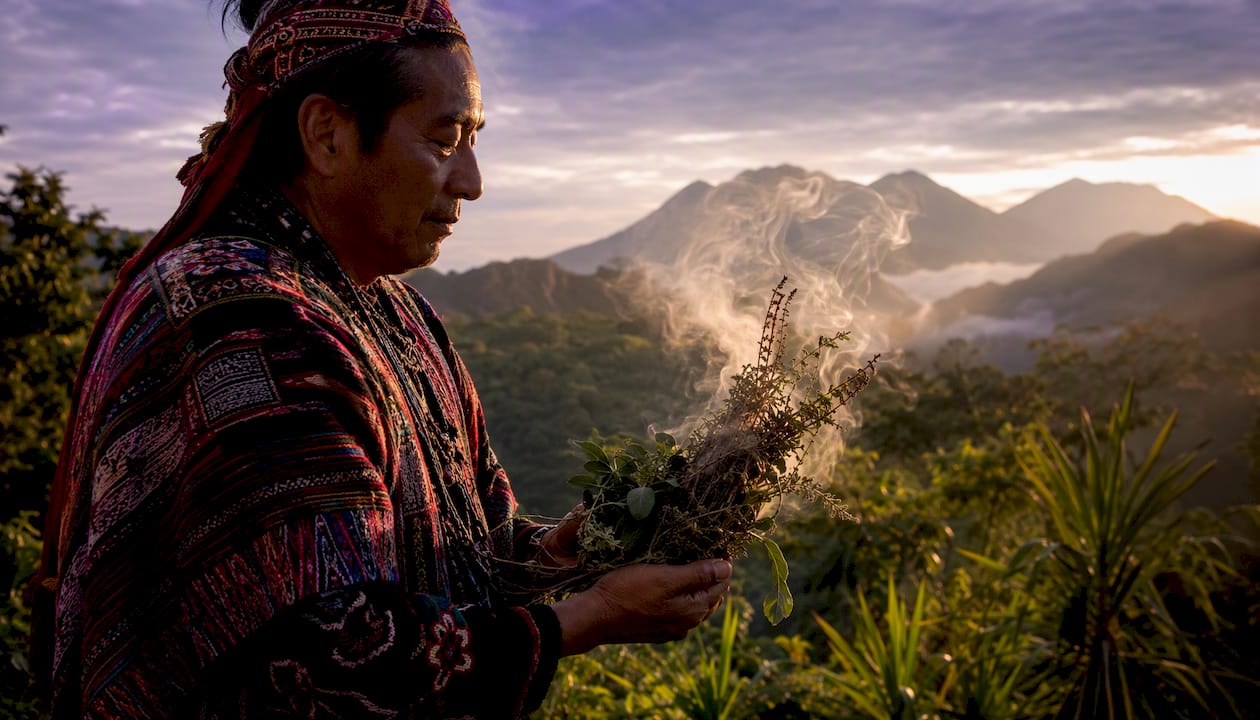
For readers who want to learn more with cultural respect intact, museum programs at the Smithsonian’s National Museum of the American Indian and community-led workshops organized by Maya cultural organizations offer grounded, community-verified engagement. The summer solstice and other seasonal turning points also offer a natural entry point for understanding how indigenous peoples read energetic windows in the annual cycle.
How scholars reconstruct the 260-day calendar
The evidence base for the Tzolk’in is unusually rich for an ancient system, drawing from at least four distinct source types that scholars cross-check against one another.
Inscriptions and murals: The San Bartolo murals (3rd century BCE) contain day signs that confirm the calendar’s formalized use in the pre-Classic period. Stelae at Monte Albán and across the Maya lowlands record Calendar Round dates that allow scholars to reconstruct the sequencing with high confidence.
Architectural alignments: Horizon alignments at Izapa and other sites show that buildings were oriented to mark the sun’s zenithal passages, providing physical evidence for the astronomical observations that may have generated the 260-day count.
Codices: Post-Contact manuscripts, including the Dresden, Madrid, and Paris codices, contain detailed almanacs organized around the Tzolk’in. These documents survived the colonial period and provide the most complete written record of day sign associations, deity correspondences, and ritual instructions.
Living ethnography: The continuous practice of Ajq’ijab’ in Guatemala provides a living check on scholarly reconstructions. When an ethnographic account of a ceremony aligns with what a codex prescribes for that day sign, the convergence strengthens both sources.
Dating methods include archaeological stratigraphy, radiocarbon dating of organic materials associated with inscribed objects, and stylistic analysis of glyph forms. The Library of Congress Kislak collection holds digitized primary materials, including codex pages and mural documentation, that researchers use for visual corroboration.
The Foundation for the Advancement of Mesoamerican Studies (FAMSI) maintains one of the most accessible technical archives for calendrical research, and the Smithsonian’s NMAI provides museum-quality explainers that bridge academic and public understanding.
Why the 260-day calendar still matters
What strikes me most about the Tzolk’in is not its antiquity. It is its persistence. A system that survived colonial suppression, forced conversion, and the near-total destruction of its written record is not merely a historical curiosity. It is evidence of something that resists erasure because it answers a need that no external force could fully extinguish: the need to locate oneself in time with meaning.
The 260-day cycle treats each day as a living entity with its own character, obligations, and gifts. That framing is not primitive. It is a sophisticated response to the human experience of time as qualitative rather than merely quantitative. Modern calendars tell you what day it is. The Tzolk’in tells you what kind of day it is. For millions of people across Mesoamerica, that distinction was, and remains, the more useful information.
Respectful engagement with this tradition means approaching it as a living cultural system, not a curiosity to be extracted and repurposed. The Ajq’ijab’ who carry this knowledge are not historical figures. They are contemporary people maintaining a practice that belongs to their communities. Learning from the Tzolk’in is most meaningful when it deepens respect for those communities rather than replacing their authority with a personal interpretation.
Your Tzolk’in day sign is waiting for you
The 260-day cycle is not only a subject of scholarly study. It is a mirror. Every person alive today was born on a specific Tzolk’in day, carrying the energetic signature of that day sign and its Galactic Tone into their life.
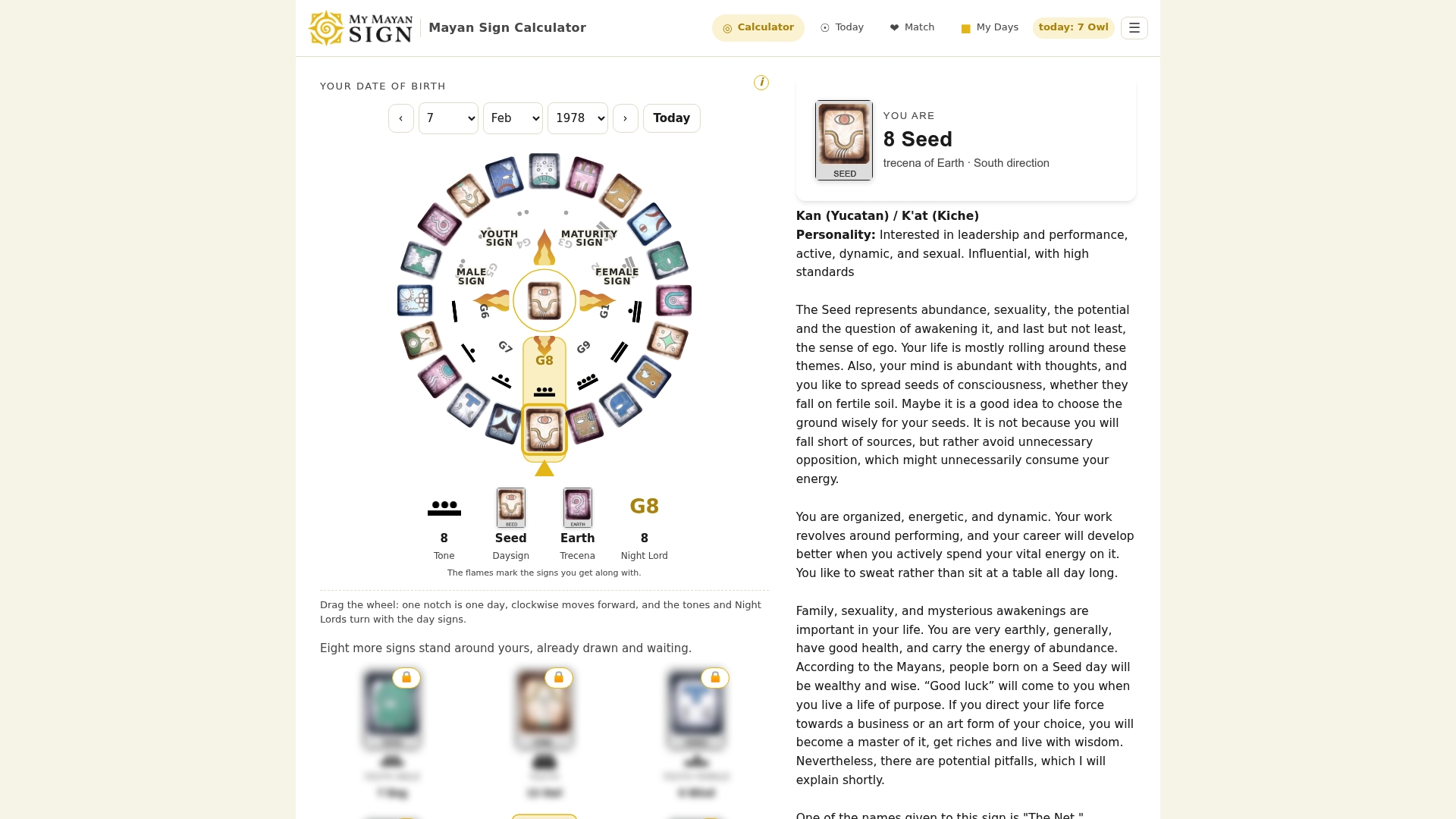
Mymayansign makes that discovery immediate and free. Enter your birth date into the Mayan sign calculator and receive your day sign, Galactic Tone, and a short interpretation grounded in Maya cosmology. For readers who want to go deeper, the Mayan astrology explained guide walks through the full interpretive framework, from day sign meanings to trecena context to compatibility. Paid reports extend that reading into a detailed personal profile. A short disclaimer worth stating plainly: online calculators are educational tools. For ritual practice within a living Maya tradition, community-verified knowledge from trained Ajq’ijab’ is the appropriate authority.
Sources
- Maya calendar | System, Mesoamerica, & Astronomy | Britannica
- The Calendar System | Living Maya Time
- Origin of the Mesoamerican 260-Day Calendar
- Mesoamerican calendrics | FAMSI
- Library of Congress resource (Kislak materials)
- The Mesoamerican Calendar: Ancient Shared Time Keeping — ThoughtCo
Recommended
- Tzolkin Birthday – MyMayanSign
- Mayan Astrology Blog | Day Signs, Tzolkin & Calendar
- Day Out of Time Meaning: What It Is and How to Observe
- Your Mayan Birthday Calendar: Find Your Maya Day Sign