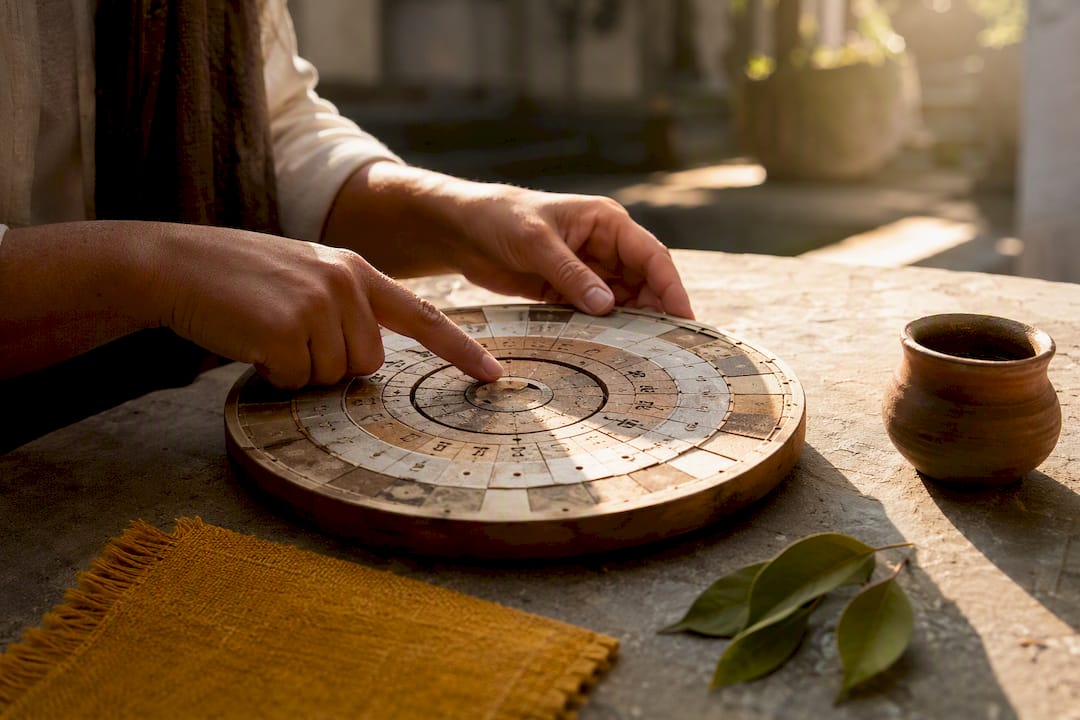
To follow the Tzolk’in, track the day’s kin, its number paired with its day name, each morning, and use that kin as a short prompt for reflection or a small intention. You find today’s kin through a calculator like Mymayansign’s daily calendar, a tool used by many but not linked to an official source, then spend a minute journaling before choosing one action that fits the day’s energy. The steps that follow show you how to find your own birth kin, read the pattern behind it, and build this into something you actually keep doing.
TL;DR:
- The daily kin is easily accessible via online tools or manual counting, with the cycle repeating every 260 days and no repeats within that period.
- Checking today’s kin takes less than a minute and should be followed by journaling a brief reflection and a small action aligned with the day’s energy.
- Building a routine of morning and evening check-ins over a thirteen-day trecena helps establish a consistent rhythm and reveals pattern shifts.
- The Tzolk’in calendar operates independently from the solar year, with 260 days divided into unique combinations of twenty day names and thirteen numbers.
- The most effective practice involves starting simple, with consistent daily checks, rather than memorizing all elements or overcomplicating the process.
Table of Contents
- How Do I Find My Tzolk’in Birth Kin?
- How Does the 260-Day Tzolk’in Cycle Work?
- How Do You Track Today’s Tzolk’in Day?
- How Can You Apply the Tzolk’in to Daily Planning?
- Tzolk’in vs. Haab: What’s the Difference?
- Why Trust This Guide on Following the Tzolk’in
- What Actually Makes This Practice Stick
- Start Following the Tzolk’in Today
- Where to Verify These Facts and Learn More
- Sources
- FAQ
How Do I Find My Tzolk’in Birth Kin?
Your birth kin is the number and day name assigned to your birth date inside the 260-day count. Think of it as your personal doorway into the calendar. Every date you were ever born on lines up with exactly one of the 260 possible combinations, and that combination doesn’t repeat again for another 260 days.
You have two ways to find it.
- Count it by hand. This takes longer but shows you the mechanics. Mayan daykeepers count forward from a known reference date, cycling through the thirteen numbers and twenty day names in tandem, so a full walk-through of the math belongs in a dedicated guide like this mayan numerology breakdown.
Here’s a worked example. Someone born on June 15, 1990 lands on 8 Eagle in the MyMayanSign GMT 584283 count, one of the 260 unique pairings. That kin does not change. It’s fixed to that calendar date the way a Western zodiac sign is fixed to a birth month, except the Tzolk’in cycle is far shorter and far more granular.
Once you know your birth kin, write it down somewhere you’ll actually see it. A sticky note on your desk, a note in your phone, whatever sticks. You’ll refer back to it constantly once you start comparing it to the day’s kin, which is where the real daily practice begins.
How Does the 260-Day Tzolk’in Cycle Work?
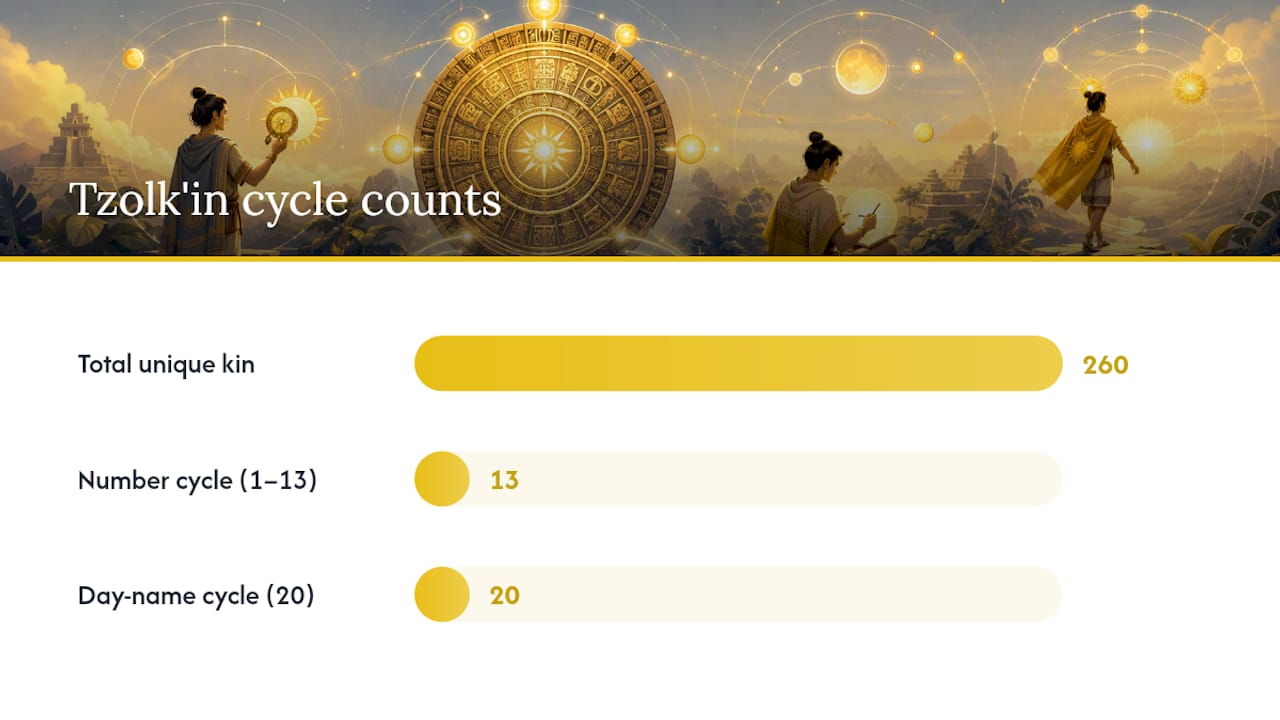
Twenty day names combine with thirteen numbers to produce a cycle of distinct days, forming the core calculation behind the calendar. The multiplication of 20 by 13 results in 260, reflecting the full cycle length in days. No day repeats its exact number and name combination until the full cycle completes, which is why the Tzolk’in functions as a self-contained ritual calendar rather than a solar one.
The cycle runs through pairs of numbers from 1 to 13 and day names among twenty possibilities, cycling sequentially so that each unique combination appears once per full cycle.
A “trecena” is a thirteen-day stretch where the number counts up from 1 to 13 against a shifting set of day names. Once a trecena ends, a new one begins at 1 again, paired with the next day name in the twenty-name sequence. Living Maya communities in the Guatemalan highlands still use this structure today, and trained daykeepers, known as Aj Q’ij, continue to consult the calendar for ceremony and guidance, a tradition the Smithsonian’s National Museum of the American Indian documents as active rather than historical.
How Do You Track Today’s Tzolk’in Day?
Checking today’s kin takes under a minute once you know where to look. Mymayansign’s daily Tzolk’in page updates automatically, showing the current kin number, day name, and a short interpretation. Printed Tzolk’in wheels and standalone sign calculators are available, though some prefer live daily pages for convenience, without implying these tools are official or universally standardized.
Once you have the day’s kin, a three-step routine turns that information into something useful.
- Check the kin. Look it up first thing, before your day fills with other input.
- Journal two or three lines. Note what the day’s theme suggests and how it might show up in your actual schedule.
- Pick one micro-action. Something small and specific, not a vague resolution. If the day’s energy leans toward communication, that might mean sending the email you’ve been avoiding.
This looks different depending on what’s in front of you. At work, a kin associated with structure might prompt you to finally organize that backlog of tasks. In creative projects, a kin tied to movement or transformation might nudge you to start a piece you’ve been circling for weeks. In relationships, a reflective kin might be the day you finally have the conversation you’ve postponed.
Pro Tip: Keep your journaling to the same three lines every day: what the kin suggests, how it shows up today, and the one action you’re taking. Consistency in the format matters more than the length of what you write.
A few pitfalls trip up beginners. Treating the kin as a fixed prediction rather than a lens for reflection tends to backfire. Sources caution that contemporary uses of the calendar vary widely by community, so avoid treating any single interpretation as universal or definitive. Approach it as a practice you’re learning, not a system you’ve mastered on day one.
How Can You Apply the Tzolk’in to Daily Planning?
The Tzolk’in works best as a rhythm you build into your existing routine, not a separate ritual bolted onto your day. Morning and evening check-ins anchor that rhythm without demanding much time.
A simple morning template: check the kin, write one line on what it suggests, and write one line on your intention for the day. An evening template mirrors it: one line on what actually happened, one line on how it connected (or didn’t) to the day’s kin. Over a week, these short entries start to reveal patterns you’d otherwise miss.
Planning around a thirteen-day trecena gives you a natural container for a focused intention. Here’s how that might look:
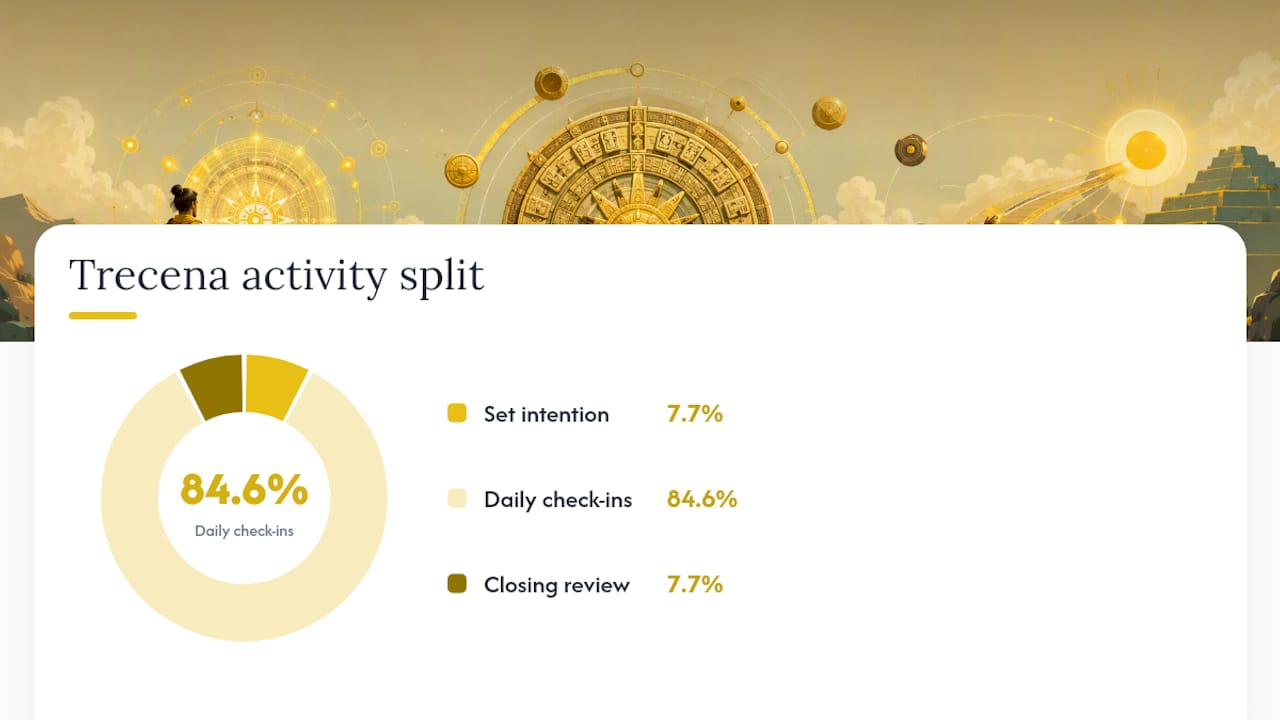
- Day 1 of the trecena: Set a single intention tied to the trecena’s opening theme, something concrete you want to move forward.
- Days 2 through 12: Check in daily, noting where the day’s kin supports or complicates your intention.
- Day 13: Close the cycle with a short review. What shifted? What would you carry into the next trecena?
Stretch that same reflection out to a full 260-day cycle and you get something closer to a seasonal review, a chance to look back at four months of entries and notice bigger arcs.
One note on respect: this calendar remains a living tradition, not a historical artifact you’re borrowing. Contemporary Tzolk’in practice varies significantly by community, and daykeepers train for years to interpret it with real depth. Treat your own daily practice as personal reflection, and look to the Smithsonian’s Living Maya Time for a deeper, more rigorous cultural grounding.
Tzolk’in vs. Haab: What’s the Difference?
“Tzolk’in” is pronounced [t͡sol ˈkʼin], roughly “sole keen” with a sharp stop before the final syllable. The Merriam-Webster entry traces it to Yucatec Maya, combining “tzol” (to order or count) and “k’in” (day), so the name itself translates to “the count of days.” Among the K’iche’ Maya, the same calendar goes by Cholq’ij.
- The Tzolk’in runs 260 days and functions as the ritual, divinatory calendar.
- The Haab runs 365 days and tracks the solar year, closer to a civil calendar.
- Together, the Tzolk’in and Haab interlock into the Calendar Round, a combined cycle that lasts 52 years, or 18,980 days.
That 52 year figure explains why some sources describe the ancient Maya calendar system as operating on a generational scale rather than a purely daily one.
Why Trust This Guide on Following the Tzolk’in
Mymayansign builds its personalized Mayan astrology reports around exactly this calendar system, calculating a person’s zodiac sign, Galactic Tone, and Tree of Life directly from their birth date. That work requires getting the underlying mechanics right, the same twenty day names and thirteen tones explained above, before any interpretation can be trusted.
The site’s educational content goes deeper than a single calculator result. Its Mayan numerology explainer walks through how a birth date converts into a kin, and its Tzolk’in-specific guide covers the calendar’s structure in more depth than a quick lookup tool can offer on its own. That combination, a working calculator paired with explanatory writing grounded in the same 20 by 13 structure the Smithsonian documents, is what separates a reliable resource from a novelty app.
This article draws on museum and dictionary sourcing rather than unverified commercial claims, and it was edited under Mymayansign’s editorial perspective, credited at the close of this piece. Readers who want a second opinion on any interpretation should cross-reference the Smithsonian’s Living Maya Time project, which remains one of the more rigorous public resources on the subject.
What Actually Makes This Practice Stick
Most guides to the Tzolk’in front load complexity: full glyph charts, lengthy trecena tables, dense cosmological explanations before you’ve even found your own kin. That order gets it backward. The people who stick with this practice start simple, checking one number and one day name each morning, and let the depth come later, once the habit is already built.
The conventional advice treats the calendar like a text to study. I’d argue it works better as a habit to run, closer to a one-line journal than a research project. A trecena gives you a built-in checkpoint every thirteen days, which is a shorter feedback loop than most people give their New Year’s resolutions.
What gets overrated is memorizing all twenty day names before you start. What gets underrated is the discipline of checking the same source at the same time every day. A live daily page removes the excuse of manual counting errors, and that small reduction in friction is often the entire difference between a practice that lasts a year and one that fades after a week.
Start with your kin. Check today’s. Compare the two. Everything else builds from there.
— Fatih
Start Following the Tzolk’in Today
You’ve now got the mechanics: 20 day names, 13 tones, 260 unique combinations, and a three-step routine that turns that structure into something you actually use. The gap between understanding the Tzolk’in and following it daily comes down to one thing: having a fast, reliable way to check the kin without doing the math yourself every morning.
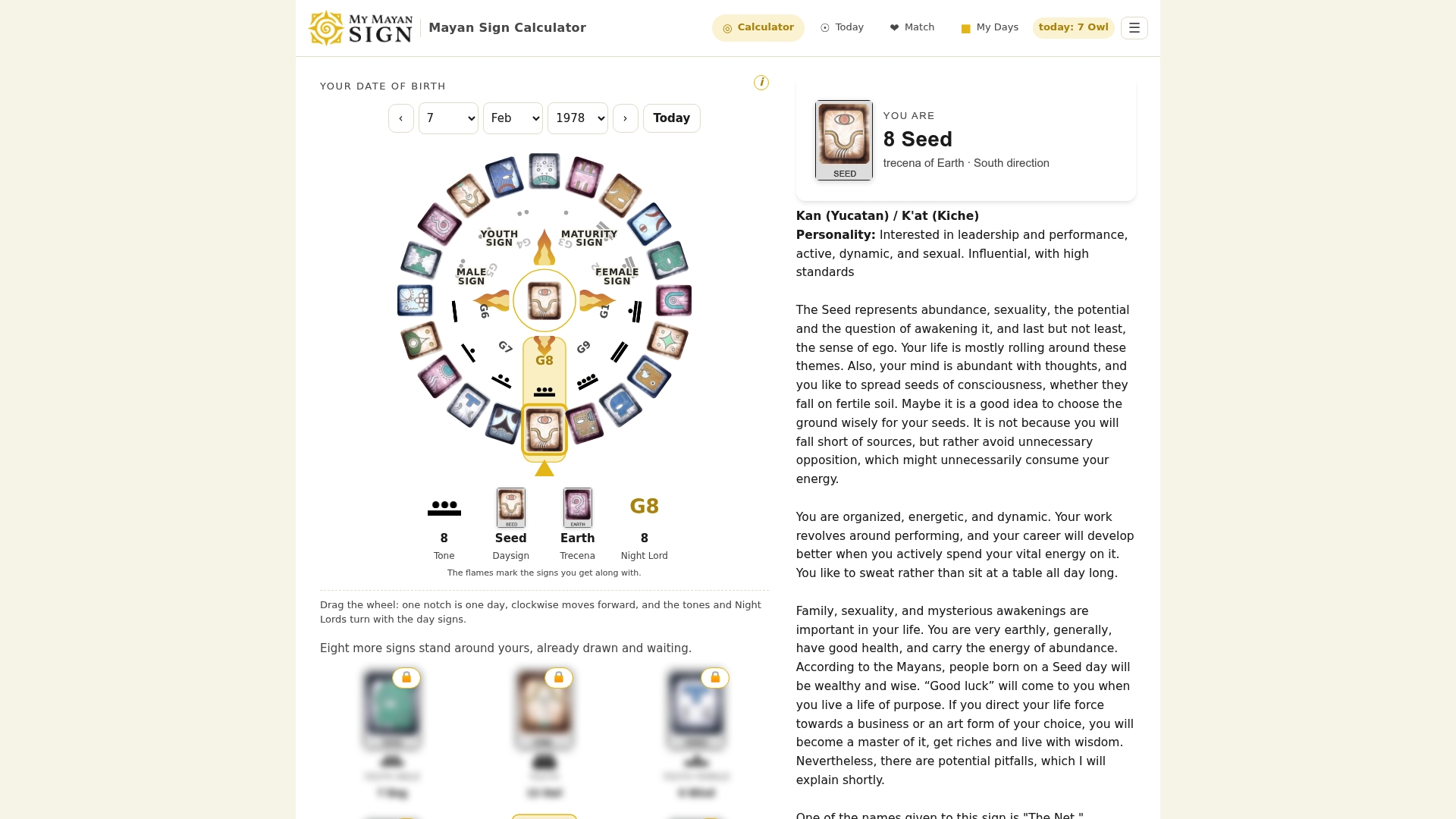
That’s what Mymayansign’s tools are built for. Start with the Mayan Sign Calculator to find your birth kin in seconds, then bookmark the daily Tzolk’in page to check today’s day name and tone each morning. If you want the practice to go deeper, a personalized reading through Mayan Astrology Explained walks through your zodiac sign, Galactic Tone, and Tree of Life in one place, and the Daily Mayan Wisdom subscription sends the day’s kin straight to you, so the routine runs itself instead of relying on memory. Find your birth kin now and see where today’s day name lines up with it.
Where to Verify These Facts and Learn More
The mechanics and cultural context in this guide draw on sources built for accuracy, not SEO traffic. Use these if you want to go further:
- The Smithsonian’s Living Maya Time project covers the Tzolk’in and Haab calendar system in detail, with direct ties to the National Museum of the American Indian.
- Merriam-Webster’s entry on “Tzolkin” confirms pronunciation and traces the word’s Yucatec Maya origin.
- The Wikipedia overview of the Tzolk’in offers a useful academic summary, including notes on its continued use among contemporary Maya communities.
Sources
- Tzolkin Definition & Pronunciation | Merriam-Webster
- The Calendar System | Living Maya Time (Smithsonian/NMAI)
- Tzolk’in — Wikipedia
FAQ
How many days are in the Tzolk’in calendar?
The Tzolk’in runs 260 days, formed by combining 20 day names and 13 numbers. It’s a separate cycle from the 365-day Haab, which tracks the solar year.
How do you pronounce “Tzolk’in”?
It’s pronounced t͡sol ˈkʼin, roughly “sole keen” with a short stop at the end. The word comes from Yucatec Maya terms meaning “count” and “day.”
What is the difference between Tzolk’in and Haab?
The Tzolk’in is a 260-day ritual and divinatory calendar, while the Haab is a 365-day solar calendar closer to a civil year. Together they interlock into the 52-year Calendar Round.
What does “Tzolk’in” actually mean?
It translates to “the count of days,” from “tzol” (order or count) and “k’in” (day) in Yucatec Maya. Among the K’iche’ Maya, the same system is called Cholq’ij.
How do I find my personal Tzolk’in kin?
Enter your birth date into a calculator such as Mymayansign’s tool, which returns your kin number, day name, and a short interpretation. You can also count it manually using the twenty day names and thirteen numbers described in this guide.
Recommended
- Tzolkin Explained: The 260-Day Calendar of the Maya
- The 260-Day Calendar (Tzolk’in): How It Works and Why It Mattered
- Start Respectfully: Mayan Astrology for Beginners with Free Sign Calculator
- Kin Number Meaning: Your Complete Tzolkin Guide