
Say “tsol‑KEEN” and you’re already close. Merriam‑Webster renders it as ˈ(t)sȯlˌkēn, with the weight on that first syllable and a clean “ts” cluster up front, not a soft “z.” Spanish speakers and those following the apostrophe spelling, Tzolk’in, often add a faint pause before the final vowel, a small echo of the word’s Mayan origin. Everything below breaks that down sound by sound.
TL;DR:
- The “tz” cluster in Tzolkin is pronounced as “ts,” not “z” or “s,” and requires effort to produce accurately without flattening it.
- Spanish pronunciation preserves the “ts” sound, with shorter vowels and a crisper “in” ending, often including the glottal stop marked by the apostrophe.
- The most common English spelling is Tzolkin, but the academic form Tzolk’in with an apostrophe better indicates the glottal stop, which may or may not be pronounced.
- Listening to native speakers via online clips helps master the precise pronunciation and distinguish regional and dialectical variations.
- Correct pronunciation shows cultural respect, especially since Tzolkin is a living calendar term used by Maya communities today.
Table of Contents
- What Is the Correct Tzolkin Pronunciation in English?
- How Does the Spanish Pronunciation of Tzolkin Differ?
- Tzolkin, Tzolk’in, or Tsolkin: Which Spelling Should You Use?
- Quick Drills to Lock In the Sound
- How Does Tzolkin Compare to Other Mayan Calendar Words?
- Why Getting This Word Right Matters More Than People Think
- Go Deeper Into the Tzolkin and Your Own Day Sign
- Where These Pronunciations Come From
- Sources
- FAQ
What Is the Correct Tzolkin Pronunciation in English?
The word comes to English by way of Yucatec Maya, and dictionaries have settled on a fairly consistent shape for it. Merriam‑Webster’s entry gives the IPA as ˈ(t)sȯlˌkēn, which looks intimidating until you take it apart piece by piece.
Here’s what each symbol is telling you:
- ˈ marks primary stress, so the emphasis lands on the first syllable, not the second.
- (t)s is a single consonant cluster, closer to the “ts” in “cats” than to a plain “s” or “z.”
- ȯ is an open “o” sound, like the vowel in “law” or “caught,” not a short “ah.”
- kēn finishes the word with a long “ee” sound, rhyming with “keen” or “seen.”
Put together, that gives you “TSOL‑keen,” with a slightly rounded vowel in the middle syllable. Older transcriptions in the Oxford English Dictionary show a British variant closer to “trawl‑kin,” which tells you dialect has always shaped this word a little differently depending on who’s saying it.
The trouble spot for most English speakers is that opening cluster. It’s tempting to flatten “tz” into a simple “z” or “s,” but that loses the texture the spelling is built to capture. Try touching your tongue to the roof of your mouth for the “t” and releasing directly into the “s,” almost like you’re saying “cats” without the “ca.”
Pro Tip: Treat the dictionary IPA as your anchor, not a suggestion. When two spellings of a word feel like they should sound different, the phonetic transcription is the tiebreaker.
For real spoken examples rather than a printed symbol, YouGlish’s collection of Tzolkin clips pulls from actual video and audio, so you can hear the word in context instead of isolation. HowToPronounce offers shorter, single-click recordings that work well for quick repetition.
How Does the Spanish Pronunciation of Tzolkin Differ?
Spanish shifts a few things, mostly in vowel color and in how firmly that consonant cluster gets pronounced. Spanish Wiktionary’s entry lists a pronunciation closer to “tsol‑KEEN” as well, but Spanish vowels tend to be shorter and purer than their English counterparts. Where English speakers might drift toward a diphthong on that final “een,” Spanish keeps it tight and single-toned.
A few patterns worth practicing:
- The “tz” stays a hard, front-of-mouth “ts,” with less softening than casual English speech tends to allow.
- The “o” is a pure, short vowel, similar to the “o” in “solo,” without the rounding English speakers often add.
- The final “in” stays crisp, more like the “een” in “Berlin” than the drawn-out “een” in “green.”
Then there’s the apostrophe form, Tzolk’in, which shows up often in academic and Mayan-language sources. That mark signals a glottal stop, a brief catch in the throat between the “k” and the “i,” similar to the pause in the middle of “uh‑oh.” Some practitioners pronounce that gap deliberately, treating it as part of the word’s authentic sound. Many English and Spanish speakers smooth it away for the sake of fluency, and both choices are common enough that neither is wrong on its own.
A short drill for Spanish speakers: say “tsol,” pause a beat, then add “keen,” keeping each syllable equally weighted before you speed up the pace.
Tzolkin, Tzolk’in, or Tsolkin: Which Spelling Should You Use?
All three spellings point to the same word, and the differences come down to transliteration habits rather than separate pronunciations.
- Tzolkin is the most common English rendering, said “TSOL‑keen,” and it’s the form Merriam‑Webster and most general dictionaries list first.
- Tzolk’in carries the apostrophe that marks the glottal stop, favored in academic writing and by sources closer to Mayan-language orthography.
- Tsolkin drops the “z” entirely and shows up in casual or simplified writing, though it undersells the consonant cluster the original spelling is built to preserve.
The variation exists because Mayan languages were transliterated into Latin script by different scholars at different times, and no single system ever became universal. That’s not a flaw in the word. It’s just what happens when a language crosses alphabets.
So which one should you use? If you’re writing for an academic or cultural audience, Tzolk’in with the apostrophe signals more care. If you’re speaking casually or writing for general readers, Tzolkin without the mark is perfectly standard and widely understood.
Pro Tip: If you’re unsure whether to include the glottal stop when speaking, default to leaving it out in casual conversation and adding it back in when you’re specifically discussing Mayan calendar systems or speaking with someone versed in the language. Neither choice is disrespectful, but context should guide it.
Quick Drills to Lock In the Sound
Reading about pronunciation only gets you so far. The word settles into muscle memory after a few short, focused sessions.
- Isolate the cluster. Say “ts” on its own, ten times, until it comes out clean and unforced, without sliding into a plain “s.”
- Split the word. Practice “tsol” alone, then “keen” alone, each five times, before joining them into “tsol‑keen.”
- Shadow real speakers. Play a clip from YouGlish, pause after each instance, and repeat it back immediately, matching rhythm and stress.
- Record and compare. Say the word into your phone, then play it next to a dictionary clip. The gap between the two tells you exactly what to adjust.
A few habits make this stick faster:
- Practice for five to ten minutes at a time rather than one long session.
- Repeat across three or four separate days instead of cramming it into one sitting.
- Pick one accent, English or Spanish, to model at a time. Mixing reference accents tends to blur your own pronunciation rather than sharpen it.
By the end of a few short sessions, the word should feel automatic rather than something you’re reconstructing symbol by symbol.
How Does Tzolkin Compare to Other Mayan Calendar Words?
Tzolkin isn’t the only Mayan term that trips up English and Spanish speakers, and comparing it to its neighbors makes the pattern easier to spot. Haab’, the 365-day solar calendar that runs alongside the Tzolkin, carries a similar glottal stop at the end, marked by that apostrophe, and gets flattened to a simple “hahb” in most casual English speech. Katun, a unit of roughly 20 years in the Long Count system, follows the same stress pattern as Tzolkin, with emphasis on the second syllable: “kah‑TOON.”
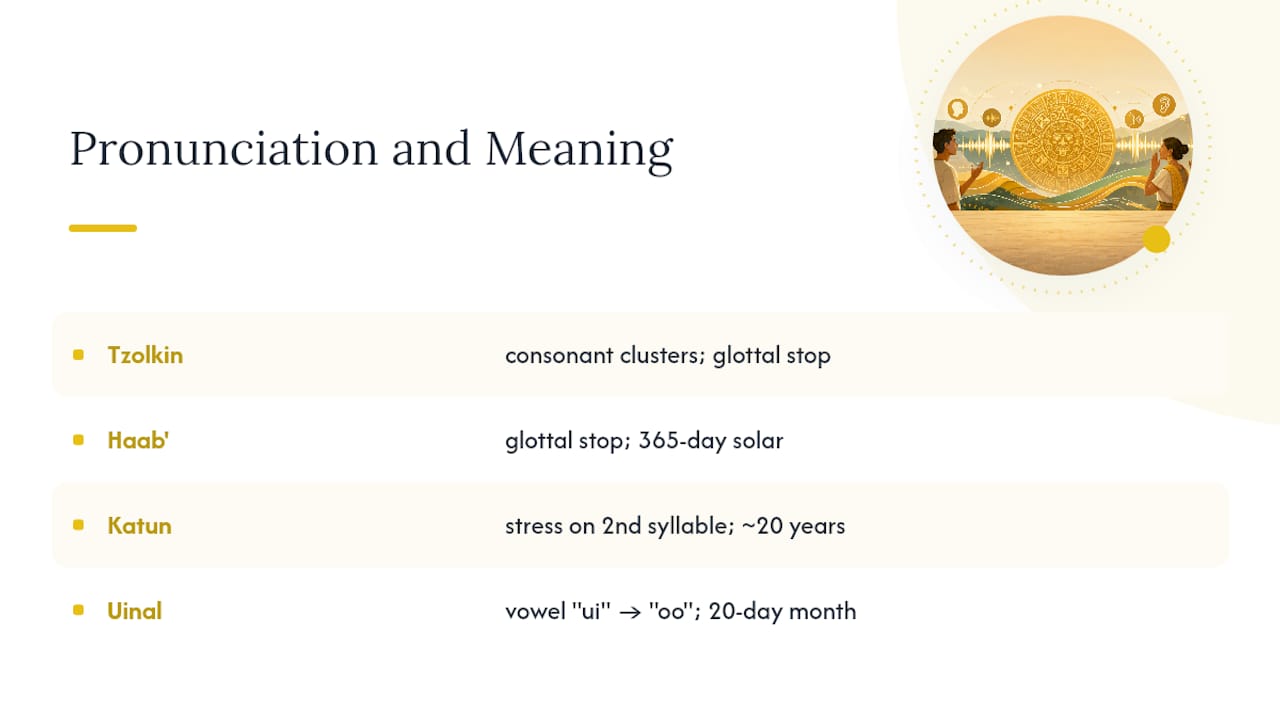
Uinal, a 20-day month within the Haab’, shows how vowel clusters get simplified in English. Its “ui” sound, closer to a quick “wee” in the original, often collapses into a flatter “oo” sound for non-native speakers. Compare that to Tzolkin’s own vowel handling, and a pattern emerges: Mayan words frequently carry consonant clusters and glottal stops that English speech doesn’t naturally reach for, which is exactly why so many of these terms get simplified the same way.
The common thread across all of them is the glottal stop. Once you can produce that catch in “Tzolk’in,” you’ll recognize the same mechanism in “Haab’” and other Mayan terms that carry an apostrophe, which makes each new word easier to approach than the last.
Why Getting This Word Right Matters More Than People Think
Pronunciation guides usually treat accuracy as a courtesy. With Mayan terms, it’s closer to a form of respect for a living culture, not a dead one. Tzolkin isn’t an artifact word. It names a calendar system still used by Maya communities today, and the language it comes from has its own internal logic around sounds like the glottal stop that English transliteration often erases.
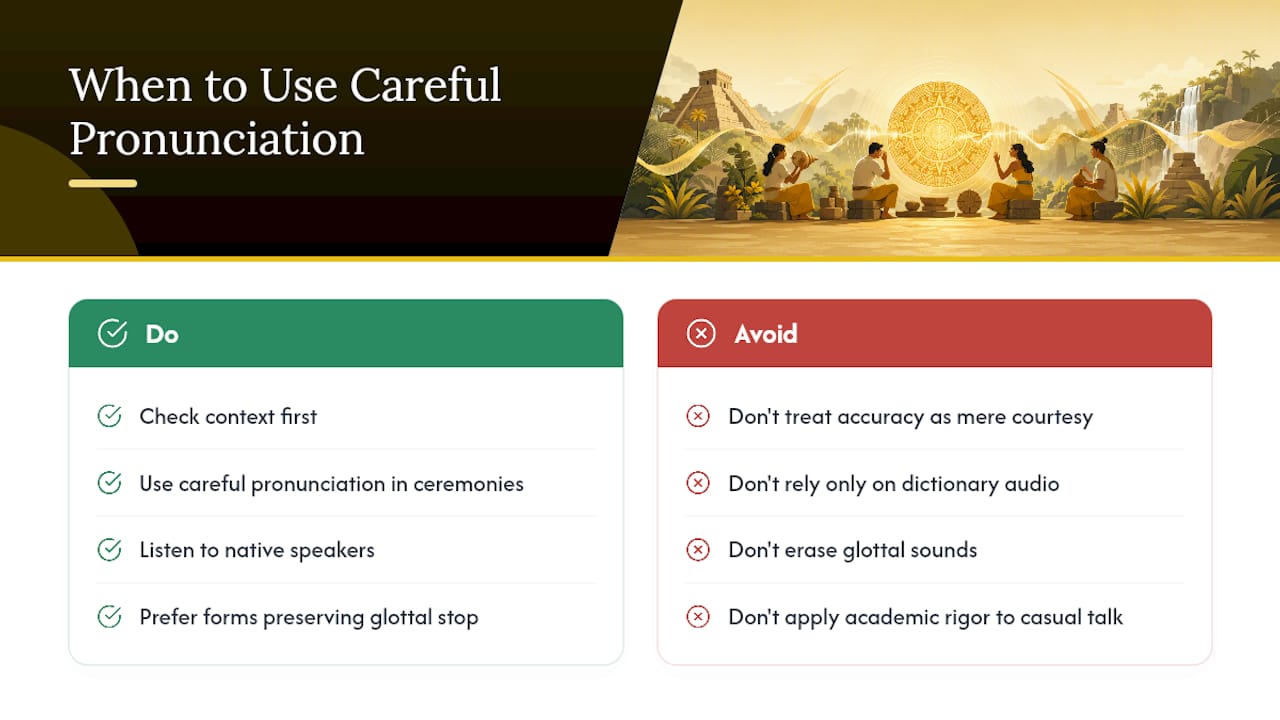
That doesn’t mean casual speakers need academic precision every time the word comes up. A dinner-table conversation about your day sign doesn’t call for the same rigor as a classroom or a ceremonial context. What it does call for is knowing the difference, and choosing the more careful pronunciation when the setting asks for it. This distinction is central to introducing readers to Mayan astrology, because the words carry the culture, not just the meaning behind them.
Where possible, listen to native or fluent speakers rather than relying only on dictionary audio. The gap between a transcription and a living voice is often where the real texture of the word lives.
— Fatih
Go Deeper Into the Tzolkin and Your Own Day Sign
Now that the word itself is settled, the calendar behind it is worth exploring. A detailed Tzolkin explained page walks through the full 260-day cycle the word names, including how its twenty day-signs and thirteen tones combine to shape a personal reading.
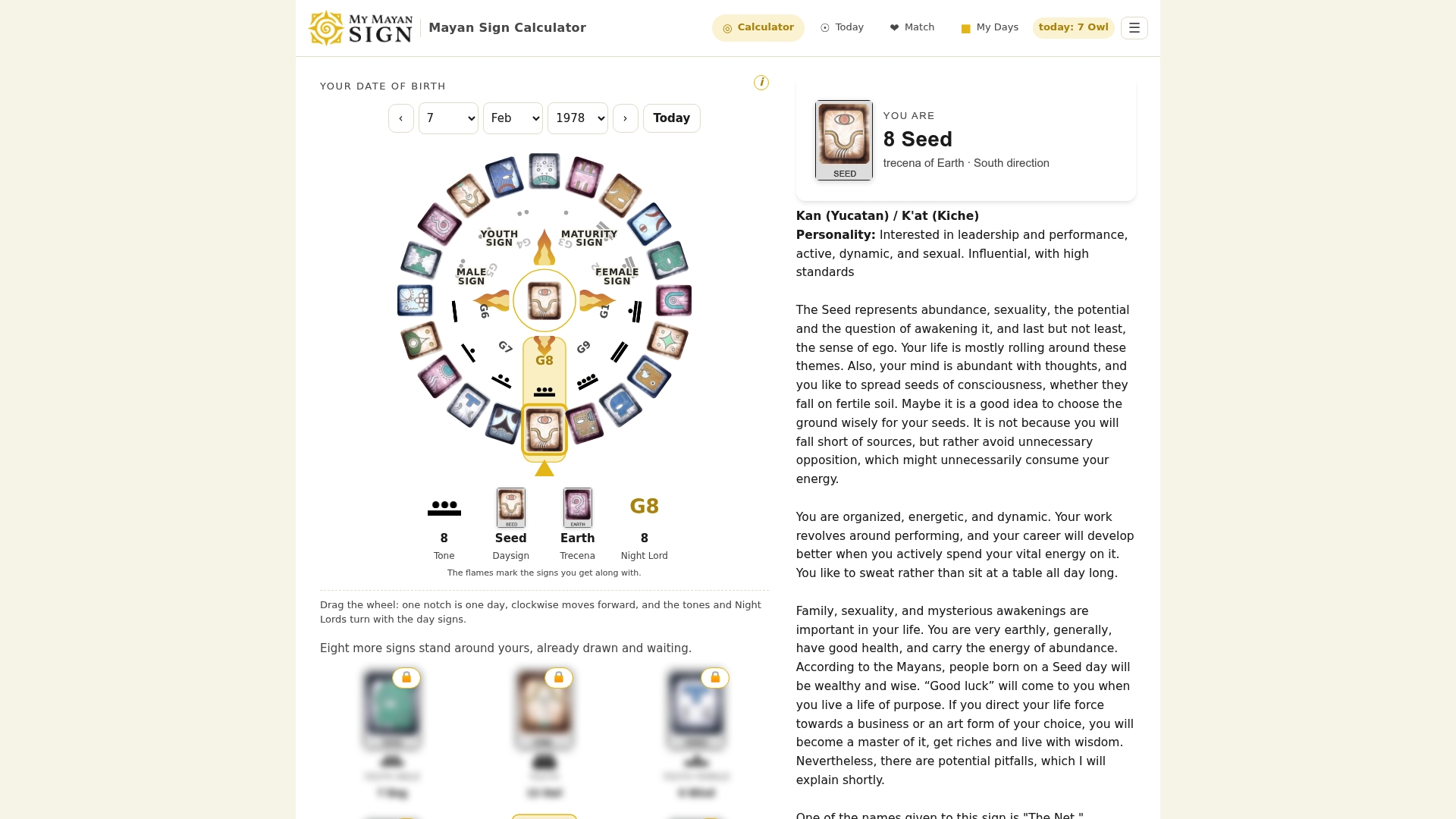
If you want to see how the Tzolkin applies to your own birth date rather than just the word in the abstract, the free Mayan sign calculator turns any date into a day sign and tone in seconds. From there, Mymayansign’s guide to Mayan astrology covers the full picture: your sign, your Galactic Tone, and how the Tzolkin’s rhythm connects to a personalized reading. Enter your birth date and see what your own chart reveals.
Where These Pronunciations Come From
Every pronunciation in this guide traces back to a checkable source, not a guess.
- Merriam‑Webster supplies the primary IPA transcription and the standard dictionary definition.
- YouGlish offers real, spoken clips pulled from video, useful for hearing natural variation.
- English Wiktionary and Spanish Wiktionary list alternate transcriptions and transliteration notes across both languages.
- HowToPronounce rounds things out with user-recorded audio in both English and Spanish.
Listening across two or three of these sources, rather than trusting just one, is the fastest way to hear how much the pronunciation shifts by region and speaker.
Sources
- TZOLKIN Definition & Meaning – Merriam‑Webster
- 6 pronunciations of Tzolkin in English — YouGlish
- tzolkin — Wiktionary (English)
FAQ
How Do You Pronounce Tzolkin?
Say “tsol‑KEEN,” with stress on the first syllable and a firm “ts” sound at the start. Merriam‑Webster’s IPA, ˈ(t)sȯlˌkēn, confirms this as the standard English rendering.
What Does Tzolkin Mean?
Tzolkin refers to the 260-day sacred calendar used in Maya cosmology, built from twenty day-signs combined with thirteen numbered tones. You can read more about its structure and cultural context or explore your own day sign with Mymayansign’s calculator.
What Sound Does “Tz” Make?
The “tz” cluster sounds like “ts” in “cats,” not a soft “z” or plain “s.” Keeping the “t” audible before the “s” is what separates an accurate pronunciation from a flattened one.
How Do You Pronounce “Xolo”?
“Xolo” is pronounced “SHOH‑loh,” with the “x” taking a “sh” sound, a common pattern in words borrowed from Nahuatl rather than Maya languages. It’s a separate word from Tzolkin, though both get mispronounced for similar reasons: unfamiliar consonant clusters at the start.
Is Tzolk’in With an Apostrophe Pronounced Differently?
The apostrophe marks a glottal stop between the “k” and “i,” a brief catch in the throat that some speakers include and many English speakers omit. Both versions are widely understood, and the apostrophe is more common in academic or Mayan-language-influenced writing.
Recommended
- Tzolkin Explained: The 260-Day Calendar of the Maya
- Start Respectfully: Mayan Astrology for Beginners with Free Sign Calculator
- Mayan Sign Calculator (Fast)