A trecena is a 13-day period inside the 260-day Mesoamerican ritual calendar, known as the tonalpohualli or Tzolkin. The full cycle is made up of multiple trecenas, and each one opens with a specific day sign and carries its own governing energy and patron deity. Diviners once used trecenas to time ceremonies and read fortune; today, Mymayansign uses the same structure to add depth to your personal birth reading.
TL;DR:
- Your birth trecena influences your emotional and mythological backdrop, adding patron deities and themes that shape your core character beyond your Day Sign.
- The 20 trecenas each have an associated deity and traditional character, with opening signs like Crocodile, Deer, or Jaguar corresponding to specific archetypes.
- Practitioners historically used trecenas to time rituals, rituals, and life events, adjusting timing based on auspicious or adverse cycles within the 260-day calendar.
- Modern uses include personal self-reflection, compatibility analysis, and calendar tools that simplify calculation but still emphasize the interconnectedness of sign, tone, and trecena.
- The term trecena is a colonial invention, derived from Spanish, not a native Maya or Aztec word, representing a 13-day period originally named by its opening day or associated deity.
Table of Contents
- How Trecenas Structure the 260-Day Calendar
- Your Birth Trecena: How It Colors Your Day Sign
- The 20 Trecenas: Opening Signs, Deities, and Traditional Character
- How Day-Sign Readers Used Trecenas in Ritual Life
- Beyond the Deity: What Each Trecena Actually Feels Like
- Aztec and Maya Approaches: Same Structure, Different Emphasis
- Trecenas in Daily Life: Agriculture, Ceremony, and Social Timing
- Trecenas in Modern Spiritual Practice
- What the Trecena Gets Wrong in Popular Astrology
- Calculate Your Birth Trecena and See What It Adds to Your Reading
- Sources
How Trecenas Structure the 260-Day Calendar
The math behind the tonalpohualli is elegant once you see it: 20 day signs multiplied by 13 numbers equals 260 days. Each day carries both a sign (like Jaguar, Deer, or Wind) and a number from 1 to 13. When you group the calendar into chunks of thirteen consecutive days, you get 20 trecenas, and each one always opens on “day 1” of whatever sign happens to fall there.
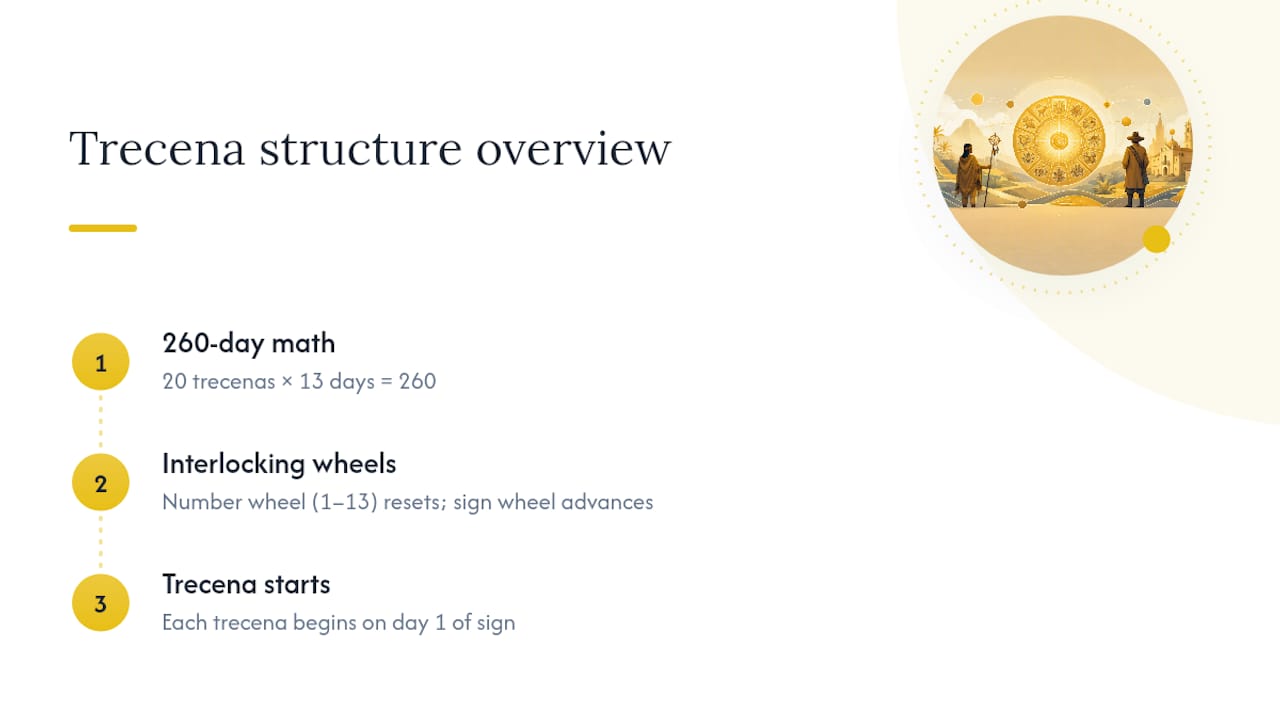
Picture a wheel of day signs turning inside a wheel of numbers, like two interlocking gears. Every 13 days, the number resets to one, but the day sign keeps advancing, so the sign that opens each trecena shifts every time. This structure is documented in the tonalpohualli’s formal calendar mechanics, which describes how the 260-day cycle divides cleanly into these 20 named periods.
The Maya called this calendar the Tzolkin; the Aztec called it the tonalpohualli, meaning roughly “count of days.” Both cultures used the identical 260-day arithmetic. The terminology differs by language and region, but the underlying structure, the gears turning inside each other, stays constant across Mesoamerica. You can see this arithmetic play out on any given date through a tool like today’s Tzolkin day sign and tone.
Your Birth Trecena: How It Colors Your Day Sign
Think of your Day Sign, your Nawal, as your core character. Your Galactic Tone is your rhythm, the way that character moves through the world. Your birth trecena is something else entirely: it’s the room your character was born into, the emotional and mythological backdrop that colors everything else in the reading.
A birth trecena adds a patron energy to your Day Sign, an additional deity archetype and thematic tone that traditional readings layer on top of your core sign. Scholars researching the tonalpohualli have noted that day sign, tone, trecena, and patron deity were always meant to be read together, since treating any single element in isolation misrepresents how the calendar was actually used in traditional divination.
Here’s what that looks like in practice:
- A person with the Deer sign born in a trecena opened by Jaguar carries a different emotional undercurrent than a Deer born in a trecena opened by Reed, even though the core Deer traits (gentleness, alertness, community focus) stay the same.
- Two people can share an identical Day Sign and Tone, yet their birth trecenas can point them toward very different life themes, one leaning toward introspection, the other toward leadership or conflict navigation.
If you want to see exactly where your birth date lands inside this 13-day framework, your Galactic Tone reading and your birth trecena both walk you through the calculation without requiring you to do the arithmetic by hand.
The 20 Trecenas: Opening Signs, Deities, and Traditional Character
Codices and later chroniclers left behind a fairly consistent record of which deity presides over each trecena, though you’ll find some regional variation depending on which colonial source you consult. The conventional pairings of trecenas with day signs and deities come primarily from these compiled sources, and later ethnographic summaries filled in interpretive gaps where the original texts were ambiguous or damaged.
| # | Opening Day Sign | Commonly Cited Deity | Traditional Character |
|---|---|---|---|
| 1 | Cipactli (Crocodile) | Tonacatecuhtli | Auspicious, associated with creation |
| — | Ocelotl (Jaguar) | Tezcatlipoca | Mixed, tied to conflict and self-reflection |
| — | Mazatl (Deer) | Tlaloc | Auspicious, linked to rain and sustenance |
| — | Xochitl (Flower) | Huitzilopochtli | Mixed, associated with war and vitality |
| 5 | Acatl (Reed) | Tezcatlipoca / Itztlacoliuhqui | Adverse, linked to judgment |
| — | Miquiztli (Death) | Tonatiuh | Mixed, solar and mortal themes |
| — | Ozomatli (Monkey) | Patecatl | Auspicious, playful and creative |
| 8 | Cuetzpalin (Lizard) | Tezcatlipoca | Mixed, transformation themes |
| 9 | Ollin (Movement) | Xolotl | Adverse, associated with upheaval |
| 10 | Itzcuintli (Dog) | Mictlantecuhtli | Mixed, loyalty and mortality |
| — | Tochtli (Rabbit) | Mayahuel | Auspicious, abundance themes |
| — | Atl (Water) | Xiuhtecuhtli | Mixed, purification and fire |
| 13 | Malinalli (Grass) | Tepeyollotl | Adverse, endurance under pressure |
| — | Coatl (Serpent) | Chalchiuhtlicue | Mixed, associated with fertility |
| — | Ehecatl (Wind) | Chantico | Mixed, communication themes |
| 16 | Calli (House) | Tonatiuh | Auspicious, domestic stability |
| — | Cuauhtli (Eagle) | Xipe Totec | Mixed, renewal and sacrifice |
| — | Cozcacuauhtli (Vulture) | Itzpapalotl | Adverse, associated with endings |
| — | Tecpatl (Flint) | Chalchiuhtotolin | Mixed, sharp judgment |
| 20 | Quiahuitl (Rain) | Tlaloc | Auspicious, closing the cycle |
These attributions come from a patchwork of colonial codices and post-conquest ethnography, so treat any single-source list, including this one, as a starting reference rather than an unquestionable canon.
How Day-Sign Readers Used Trecenas in Ritual Life
Long before anyone called this system a “trecena,” specialized readers known as tonalpouhque interpreted the calendar for their communities. Their job was practical: figure out which days were auspicious for which activities, and warn families away from dangerous timing. Research into tonalpouhque ritual practice describes how these readers timed naming and bathing ceremonies for newborns based partly on the trecena in which the birth fell.

If a child was born on a day considered adverse within an adverse trecena, the tonalpouhque didn’t simply proceed with the ceremony as scheduled. Instead, they would often delay the naming or bathing ritual, selecting a corrective, more auspicious date within the same cycle. This wasn’t superstition for its own sake. It was a structured, socially trusted system for managing risk and meaning at pivotal life moments.
Beyond birth rites, trecenas shaped decisions about marriage timing, market days, and agricultural work. A farmer consulting a tonalpouhque before planting wasn’t asking a vague question. He was asking which specific window inside the 260-day cycle carried the right energy for that labor. Modern revivalist and New-Age practitioners have adapted this same logic, though usually with far less ceremonial weight than it once carried.
Beyond the Deity: What Each Trecena Actually Feels Like
The deity attached to a trecena tells you who’s presiding, but it doesn’t tell you the texture of the thing. Traditional interpretation goes further, assigning each 13-day span a thematic arc, almost like a short story with a beginning, tension, and resolution.
A trecena opening with Ocelotl (Jaguar), for instance, tends to carry themes of internal conflict and hard self-examination, fitting for a period governed by Tezcatlipoca, a deity associated with mirrors, fate, and moral ambiguity. Compare that to a trecena opening with Tochtli (Rabbit), governed by Mayahuel, which leans toward abundance, fertility, and social ease. The difference isn’t just cosmetic. It shapes what kind of undertakings a diviner would recommend during each window.
Some trecenas carry a building energy, intensifying as the days pass toward a climax around day 9 or 10, a pattern some contemporary practitioners liken to a narrative arc. Others feel more static, holding a steady tone from open to close. This is where the calendar stops being pure arithmetic and starts functioning as a genuine interpretive language, one where number, sign, and deity combine into something closer to a mood than a fact.
Reading a trecena well means resisting the urge to reduce it to a single keyword. “Auspicious” or “adverse” is a starting point, not the whole picture.
Aztec and Maya Approaches: Same Structure, Different Emphasis
The Aztec and Maya both ran their societies on the identical 260-day mathematical structure, but they didn’t use it identically. This is one of the more interesting wrinkles in the historical record, and it’s easy to miss if you only skim summary lists.
Aztec sources, largely preserved through Nahuatl-speaking chroniclers working with Spanish friars, emphasize the trecena’s connection to specific patron deities from the Aztec pantheon: Tezcatlipoca, Tlaloc, Xiuhtecuhtli, and others. The tonalpohualli in this tradition leaned heavily on state and priestly divination, tied closely to imperial ritual calendars and temple observances in Tenochtitlan.
Maya sources, by contrast, often frame the Tzolkin less around named deities in the Aztec sense and more around day-sign qualities themselves, with regional variation between highland and lowland traditions influencing which associations took hold. Contemporary Maya daykeepers in Guatemala, for instance, still practice active Tzolkin divination today, a living tradition rather than a purely historical one, whereas Aztec calendrical practice was disrupted more completely by colonization.
Both systems agree on the underlying arithmetic and on the basic idea that trecenas group day signs into meaningful narrative chunks. Where they diverge is emphasis: Aztec sources lean mythological and priestly, Maya tradition leans experiential and communal. Neither approach is more “correct.” They’re two branches of the same Mesoamerican calendrical root, shaped by different histories.
Trecenas in Daily Life: Agriculture, Ceremony, and Social Timing
For traditional Mesoamerican communities, the trecena wasn’t an abstract astrological concept. It was a practical scheduling tool woven into ordinary decisions the way a modern person might consult a planting almanac or a lunar calendar.
Farmers timed planting and harvest activities around trecenas considered favorable for growth and rain, often those governed by deities like Tlaloc. A trecena opening with an adverse day sign might prompt a community to delay a major undertaking, whether that was breaking ground on a building or setting a wedding date, until a more favorable window opened in the next cycle.
Markets, too, ran on calendrical rhythm. Certain trecenas were considered better suited to trade and exchange, tied to prosperity-linked deities, while others were treated more cautiously. Social events like marriage negotiations followed similar logic: families would consult a day-sign reader before setting a date, weighing not just the individual day but the trecena surrounding it.
This wasn’t rigid fatalism. The calendar offered guidance, not commandment. A family facing an adverse trecena for a planned event had options: wait for a better window, perform corrective rituals, or proceed with appropriate caution. The trecena functioned the way a farmer’s forecast functions today, as useful information for planning, not an unbreakable decree. That practical, advisory spirit is exactly what carries forward into how trecenas get used now.
Trecenas in Modern Spiritual Practice
Contemporary Mayan-astrology communities have adapted the trecena into frameworks that feel more accessible to people raised on Western astrology. One common approach treats the birth trecena the way a Western reading might treat a moon sign, an additional layer of emotional and thematic context sitting alongside the core Day Sign.
Some modern practitioners describe the trecena using a “wavespell” analogy, borrowed loosely from newer New-Age calendar systems, to help readers unfamiliar with Mesoamerican cosmology grasp the idea of a 13-day thematic arc without needing a background in Nahua religion. It’s a simplification, but a useful one for a first encounter with the concept.
Online calendar tools have also made trecena awareness far more accessible than it was even a generation ago. Public-facing portals like Aztec and Maya calendar tools now map any Gregorian date to its corresponding tonalli and trecena, letting curious readers check “what trecena is today” the way they might check a horoscope.
For personal growth work, people use their birth trecena as a lens for self-reflection: what patron energy shaped the backdrop of their arrival, and how might that context explain recurring emotional themes in their life. It’s not a substitute for the deeper scholarly record, but as an entry point into Mesoamerican cosmology, it does real work in making an ancient system feel personally relevant again.
What the Trecena Gets Wrong in Popular Astrology
Most popular astrology content treats the trecena as a keyword generator: pick your birth window, get a one-line trait, move on. That approach isn’t wrong exactly, but it flattens a system that was always meant to be read in combination. The tonalpohualli’s day sign, tone, trecena, and patron deity were interdependent variables, not four separate horoscopes stacked on top of each other.
The bigger gap I see in conventional treatments is a lack of honesty about sourcing. Most of what circulates online about deity attributions traces back through Sahagún and Durán, filtered through centuries of translation and reinterpretation. That doesn’t make the information useless. It means readers deserve to know they’re looking at a colonial-era record of indigenous practice, not a direct transcript of it.
What should you prioritize if you’re trying to understand your own birth trecena? Start with the combination, not the isolated fact. Your Day Sign tells you who you are; your trecena tells you what backdrop shaped that character. Read them together, and be skeptical of any source that offers a single adjective as the whole story. The calendar deserves more nuance than that, and so do you.
— Fatih
Calculate Your Birth Trecena and See What It Adds to Your Reading
Curiosity about your birth trecena doesn’t have to stay theoretical. Mymayansign turns the calendar mechanics covered above into a personal reading in three simple steps: enter your birth date, receive your Day Sign, Galactic Tone, and birth trecena, then choose whether to unlock a full expanded report.
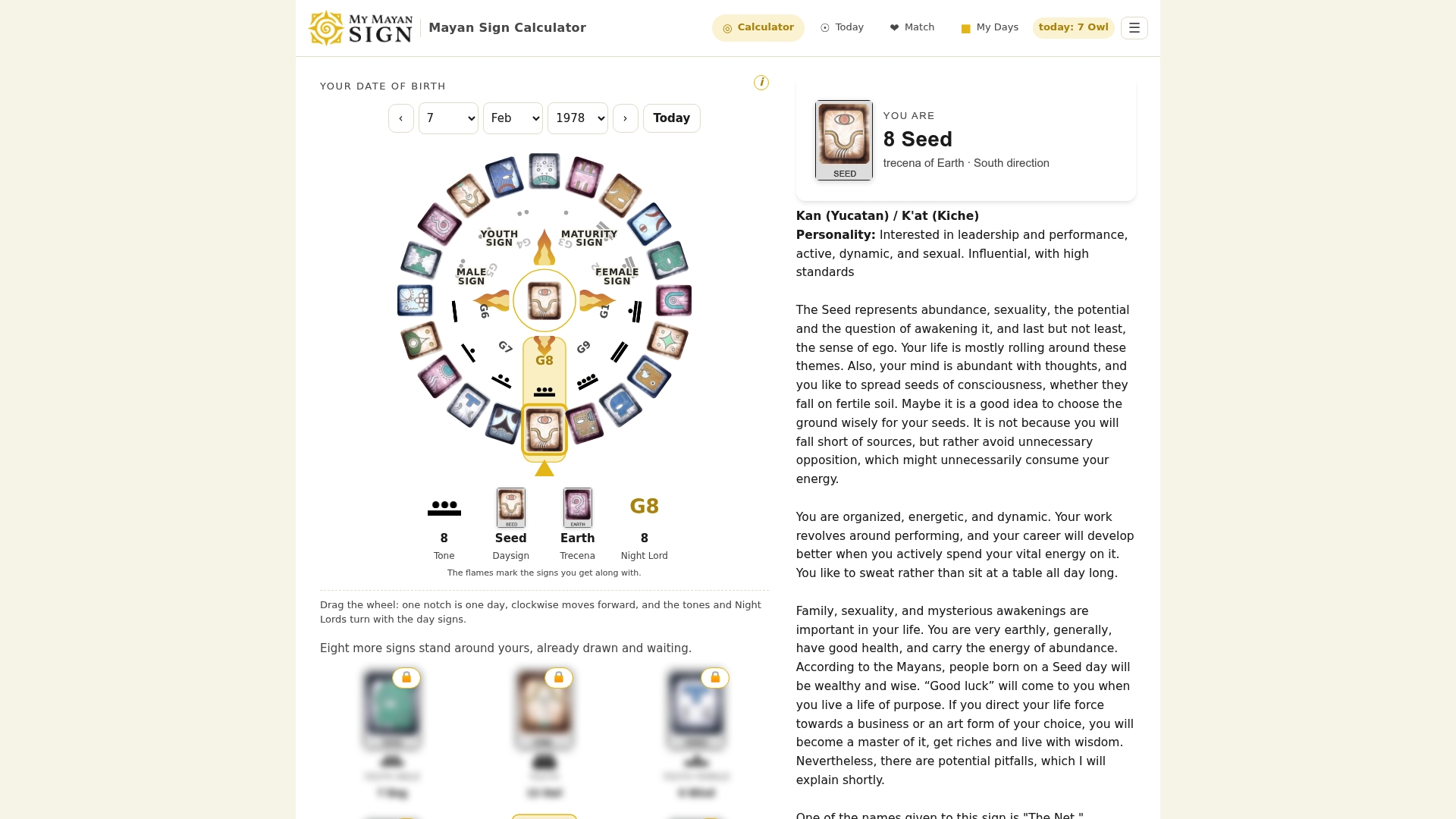
The free calculation gives you the basics. The paid report goes further, interpreting how your Day Sign, Tone, and trecena interact rather than listing them separately, plus compatibility insights and a personalized daily calendar built around your specific combination. That interaction reading is where the real value sits, since a Day Sign read in isolation tells you far less than the same sign read against its governing trecena and patron energy.
Pro Tip: When you read your expanded report, pay attention to how the trecena’s deity theme shows up in the interpretation of your Tone, not just your Day Sign. That layered reading is where traditional divination actually lived.
Start with the Mayan sign calculator to see your Day Sign and Tone, then explore your birth trecena in full or read more about what Mayan astrology reveals before deciding on the expanded report.
Sources
Here’s something that surprises most readers: the word “trecena” isn’t Maya or Aztec at all. It comes from the Spanish word trece, meaning thirteen, and it was a label applied by colonial chroniclers trying to translate an unfamiliar calendar system into their own vocabulary. The etymology of trecena traces directly back to this colonial-era naming convention rather than to any Nahuatl or Yucatec Mayan root.
What did the original sources call these periods instead? Typically, nothing so abstract. Nahuatl references usually named a 13-day period by its opening day, something like “ce cipactli” (one crocodile), rather than reaching for a standalone category word. The structural “week” concept itself appears to be a colonial interpretive layer laid over indigenous practice rather than a term the Aztec or Maya used themselves.
Friar Bernardino de Sahagún, one of the most consequential chroniclers of Nahua life, documented these thirteen-day groupings extensively in the 16th century. His work, alongside that of Diego Durán, shaped how later scholars would name and organize the calendar, which is worth remembering whenever you read a modern list of trecena meanings: you’re reading a text built on a translation layered over translations.
Recommended
- Mayan Calendar Today: Today’s Tzolkin Day Sign, Tone & Meaning
- Your Galactic Signature Meaning: Decode Your Cosmic Identity