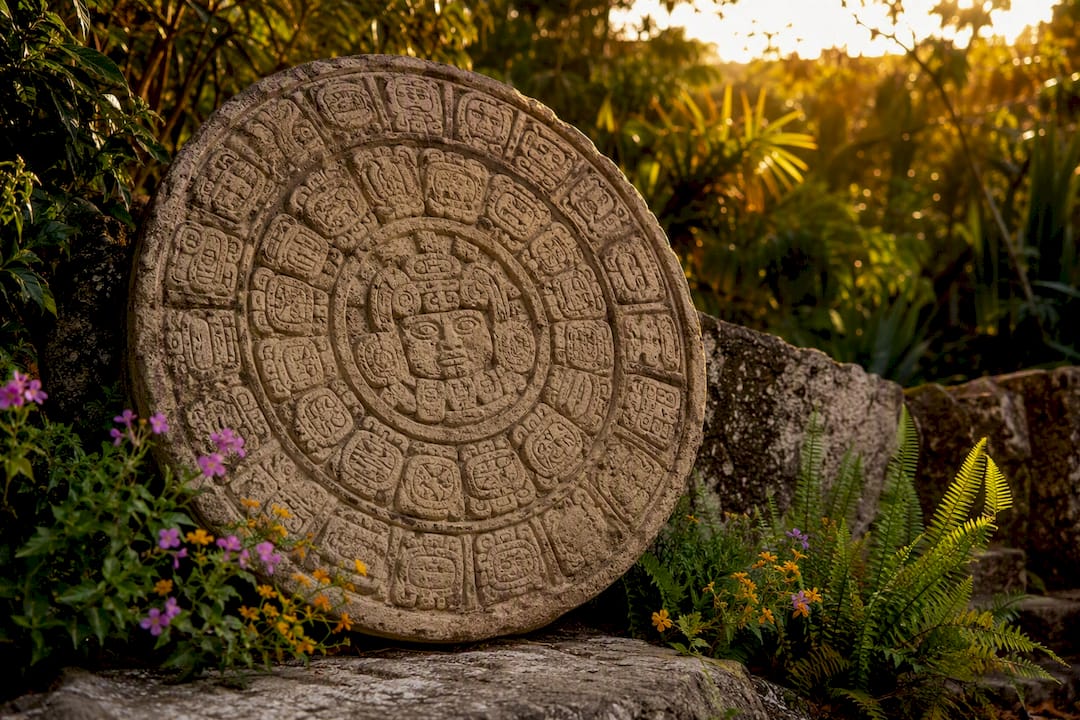
Mayan numerology reads your birth date against the Tzolkin, the 260-day sacred count, to give you a day sign (one of 20 nawales) paired with a Galactic Tone (a number from 1 to 13). Together they form your personal kin, the seed of a Mayan astrology reading. The fastest way to see yours is to run your Gregorian birth date through a Tzolkin converter or a dedicated sign calculator, which will hand you both pieces in seconds. Mymayansign offers that lookup free, then builds out the fuller, paid interpretation for readers who want to go deeper.
TL;DR:
- Your Mayan birth sign combines a day sign and Galactic Tone, created from your birth date using a reliable Tzolkin converter.
- The Tzolkin cycle of 260 days pairs 20 day signs with 13 tones, producing unique combinations that reset after each cycle.
- The free calculator provides your core kin, but deeper insights come from layered readings including trecena, surrounding days, and symbolic frameworks.
- A full interpretation links your sign, tone, and context together, transforming raw numbers into practical guidance for self-awareness and daily practices.
- Additional calendar systems like Haab and the Long Count add historical and cosmological background, but the Tzolkin remains central in personal numerology.
Table of Contents
- Mayan Numerology 101: The Tzolkin, Day Signs, and Galactic Tones
- How to Find Your Mayan Birth Sign, Step by Step
- Reading Layers: How Practitioners Combine Sign, Tone, and Trecena
- Using Your Reading for Self-Discovery, Relationships, and Daily Practice
- Beyond the Tzolkin: Haab and the Long Count
- How a Practitioner Actually Builds Your Reading
- Tools of the Trade: Calendars, Converters, and Charts
- Turning Your Numbers Into Actual Growth
- Where to Get a Personalized Mayan Numerology Reading
- Why a Guided Reading Beats a Number Alone
- Ready to See Your Full Mayan Numerology Reading?
- Sources
Mayan Numerology 101: The Tzolkin, Day Signs, and Galactic Tones
The Tzolkin is a 260-day cycle built from two interlocking wheels: 20 day signs and 13 numbers, spinning together like gears until every combination has occurred exactly once. That structure, 20 day signs paired with 13 Galactic Tones, produces 260 unique day-sign combinations, and no two days repeat their pairing until the whole cycle resets. If you’ve heard the Tzolkin called a “sacred count,” this is why: it’s counting, not stargazing.
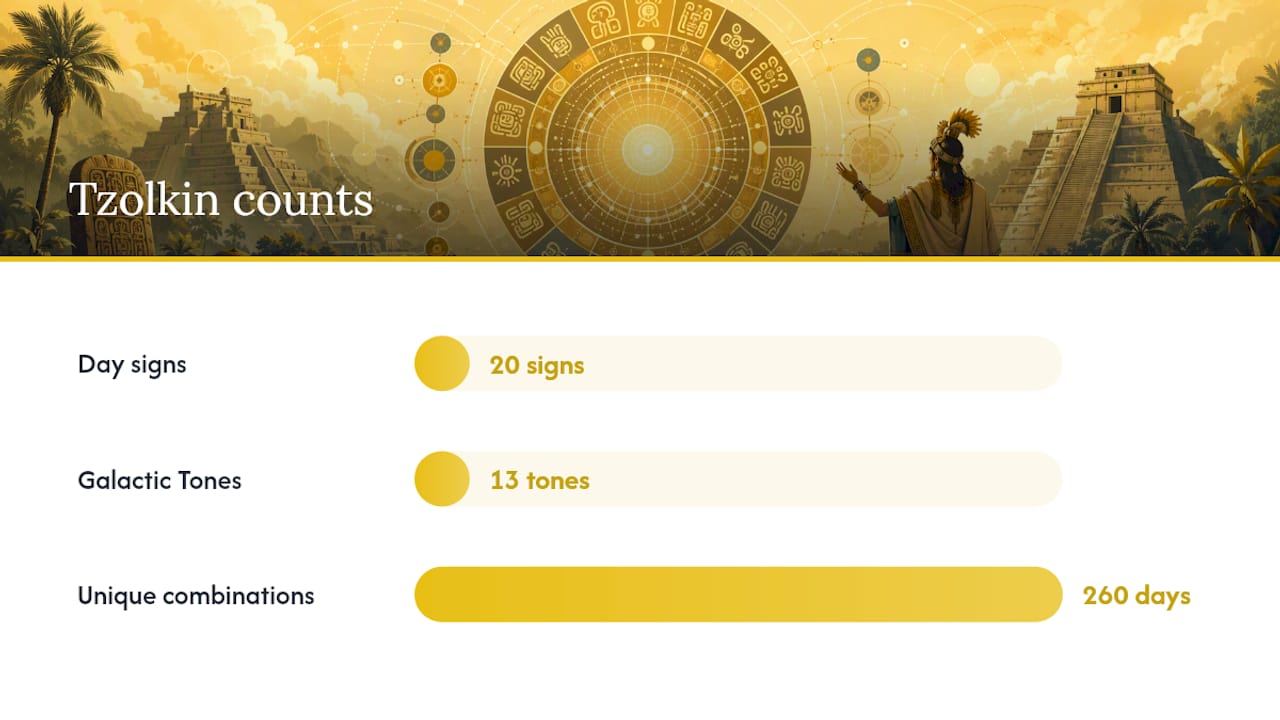
Your day sign is the essence of the reading, the archetype the ancient Maya assigned to the day you were born. Think of it as your inner compass, the raw material of your character before anything else gets layered on. There are 20 of them, from Jaguar to Wind to Sun, each carrying its own temperament and gift.
Your Galactic Tone is the tempo, the how rather than the what. A tone of 1 behaves differently than a tone of 9, even paired with the same day sign, because the number shapes the manner in which that essence moves through the world.
A few distinctions worth holding onto as you dig further:
- Day sign = essence, the core nature you were born carrying.
- Galactic Tone = expression, the rhythm or intensity that essence takes on.
- 260-day cycle = the full wheel, built from 20 signs times 13 tones.
- Not zodiac based: Mayan astrology relies on calendar cycles and numerology rather than planetary positions, which is the biggest departure from the Western system most readers already know.
Western astrology tracks where planets sat in the sky at your birth moment. Mayan numerology tracks where your birth day fell in an unbroken 260-day count that has been running, uninterrupted, for well over a thousand years. Same goal, self-understanding, entirely different math.
How to Find Your Mayan Birth Sign, Step by Step
You need less than you’d think. Gather your Gregorian birth date (month, day, year) and nothing else. Birth time rarely matters here, because the Tzolkin assigns one sign to an entire day, regardless of whether you arrived at dawn or midnight.
Here’s the process:
- Open a reliable converter. The Smithsonian’s Maya Calendar Converter is a solid academic option, or use Mymayansign’s free sign calculator for a faster, reading-oriented result.
- Enter your birth date exactly as it appears on your birth certificate. Precision matters, since the Tzolkin cycles independently of the Gregorian calendar.
- Note the two outputs: a number (1 through 13) and a day sign name. Together they read as something like “8 Jaguar” or “4 Sun.”
- Write down the trecena, the 13-day block your tone falls within, if the tool provides it. This context matters more once you move into interpretation.
- Cross-check with a second source if the two numbers don’t look right to you. Because there’s no annual date that maps permanently to one Mayan sign, your exact birth year has to be converted, not just the month and day.
Pro Tip: If your day sign and tone feel like a beginning rather than a full answer, that’s normal. Treat the free result as the doorway, not the destination, and consider a guided reading when you want the fuller map.
Reading Layers: How Practitioners Combine Sign, Tone, and Trecena
A basic kin reading starts simple: day sign first, since it carries your essence, then tone second, since it shapes how that essence shows up day to day. Practitioners rarely stop there, though. Once you know your kin, the tone often gets read against the trecena, the 13-day wave your birth falls within, because trecenas each carry their own life theme, like a mood that colors every day inside them.
Layers commonly used in a full reading include:
- Day sign, the essence or “solar seal.”
- Galactic Tone, the manner of expression, moving from seed to culmination.
- Trecena, the 13-day wave providing broader life-theme context.
- Surrounding days, sometimes called the four neighbors, which add nuance around your central kin.
- Tree of Life, a deeper symbolic layer some practitioners use to map personal growth patterns across the reading.
On tone specifically, practitioner interpretations often frame the numbers 1 through 13 as stages of creation: tone 1 as seed or initiation, tone 9 as completion, tone 13 as culmination or transcendence. Worth knowing, too, that many of the poetic labels you’ll see attached to tones (Magnetic, Lunar, Electric, and so on) are modern interpretive overlays, not ancient terminology. That doesn’t make them less useful. It just means you’re reading a living, evolving tradition rather than a fixed inscription.
The synthesis process is straightforward once you know the order: start with the day sign alone, sit with what it means on its own, then add the tone, then the trecena, then any deeper layer a full report offers. Build the picture in stages rather than trying to absorb everything at once.
Using Your Reading for Self-Discovery, Relationships, and Daily Practice
Your kin becomes far more useful once you actually do something with it. A morning check-in, even thirty seconds long, where you ask how your day sign’s energy wants to show up today, turns an abstract concept into a habit.
Some ways readers put a Mayan numerology reading to work:
- Daily meditation keyed to your day sign’s themes, five minutes before the day gets loud.
- Journaling prompts built around your tone, such as asking where in your week you moved with more force than the moment called for.
- Relationship reflection, comparing your kin against a partner’s or a friend’s to notice where energies complement or clash, more as a conversation starter than a verdict.
- Trecena awareness, checking which 13-day wave you’re currently inside and adjusting expectations accordingly.
One more thing worth saying plainly: this is a living tradition, still practiced by Maya communities today, not a historical relic repurposed for entertainment. Modern practitioners layer contemporary interpretations onto older practices, and the respectful way to engage is to treat your reading as a reflective tool, not a literal forecast, while acknowledging where the framework actually comes from.
Pro Tip: Pair your day sign with one small, repeatable action, not a life overhaul. A tone that leans intense benefits more from a five-minute breathing practice than a dramatic new routine you’ll abandon by Thursday.
Beyond the Tzolkin: Haab and the Long Count
The Tzolkin isn’t the only calendar in Maya cosmology, just the one numerology readings lean on most. The Haab is a 365-day solar calendar, 18 months of 20 days each, plus a short five-day period the Maya considered unlucky or transitional. Where the Tzolkin tracks spiritual and personal rhythm, the Haab tracked the agricultural and civic year, harvests, ceremonies, seasonal shifts.
When a Tzolkin date and a Haab date are combined, you get what scholars call the Calendar Round, a longer cycle that takes 52 years to fully repeat. Some practitioners reference a person’s Calendar Round position for added context, though it plays a smaller role in personal readings than the Tzolkin kin does.
The Long Count is the third major system, and the one most people have actually heard of, since it’s the calendar behind the “2012 phenomenon” headlines. It tracks time in an unbroken linear count from a fixed mythological starting point, using units like the baktun (roughly 394 years) rather than cycling repeatedly like the Tzolkin or Haab. You’ll occasionally see a Long Count date referenced in a deeper astrological report, mostly for historical or cosmological flavor rather than day-to-day personal guidance. If you want the mechanics of baktun notation, Mymayansign’s explainer walks through it clearly.
For personal numerology, the Tzolkin remains the workhorse. Haab and the Long Count add texture and context once you’re already comfortable with your core kin.
How a Practitioner Actually Builds Your Reading
A real reading follows a fairly consistent sequence, whether it comes from a human practitioner or a well-built platform. It starts with the conversion: your exact Gregorian birth date gets run through Tzolkin math to produce your day sign and tone. Everything downstream depends on getting this step right, which is why an accurate converter matters more than people expect.
From there, the practitioner identifies your trecena and often checks the four surrounding days for supporting or contrasting energy. This is where a reading starts to feel less like a lookup table and more like an actual interpretation, since the trecena’s theme can shift how a day sign’s core meaning gets applied to your specific life.
Next comes synthesis: weaving the day sign’s essence, the tone’s expression, and the trecena’s theme into a coherent narrative rather than three disconnected facts. A skilled interpretation reads almost like a short character study, one built from math rather than intuition alone.
Finally, many full reports add a symbolic layer, references to the Tree of Life or other traditional frameworks that connect your personal kin to broader themes of growth, challenge, and purpose. This last stage is usually what separates a quick free calculator result from a full personalized report: the free version gives you the two core numbers, while the paid version does the weaving.
Tools of the Trade: Calendars, Converters, and Charts
Every Mayan numerology reading rests on the same basic toolkit, even when the presentation varies wildly between practitioners.
The Tzolkin wheel itself, often shown as two interlocking gears, one with 20 day-sign glyphs and one with numbers 1 through 13, is the visual most readers encounter first. It’s a helpful mental model even if you never touch a physical version: picture two dials spinning together, clicking into a new combination every single day for 260 days before repeating.
Digital converters have replaced the manual counting tables older generations relied on. A reputable converter does the date math instantly, and platforms built specifically for readings, rather than pure academic reference, typically add the interpretive layer on top: what your day sign means, how your tone tends to express it, what your trecena theme looks like.
Trecena charts map all 20 thirteen-day waves across the full 260-day cycle, useful for readers who want to track their own patterns over time rather than get a single static reading. Some deeper reports also reference a personal Tree of Life chart, a symbolic structure connecting your kin to broader life themes.
Compatibility charts, comparing two people’s kin side by side, round out the common toolkit, popular among readers exploring relationship dynamics through this lens rather than through Western sun-sign compatibility.
Turning Your Numbers Into Actual Growth
Getting your day sign and tone is the easy part. Doing something meaningful with them is where most readers stall out, usually because they treat the result as a label rather than a starting question.
A better approach: hold your day sign loosely for a week before deciding what it means. Notice where its described traits show up in how you actually behaved, not just where they sound flattering. Tone works the same way. If your tone leans toward high intensity, watch for moments this week where you pushed harder than the situation needed, then ask what a calmer version of that same energy might have looked like.
The trecena adds a useful check on timing. If you’re inside a trecena themed around release or letting go, a decision that feels urgent might actually benefit from waiting until the wave shifts. This isn’t fortune telling so much as a structured pause, a reason to sit with a choice a little longer before acting on it.
Journaling remains the most practical integration tool available. A simple weekly prompt, “where did my day sign’s essence help me, and where did it get in my way,” turns an abstract reading into something you can track and actually learn from over months rather than treating it as a one-time novelty.
Where to Get a Personalized Mayan Numerology Reading
A free calculator answers the first question: what’s my day sign and tone? For readers who want the deeper synthesis, trecena context, and symbolic layering a real reading requires, Mymayansign’s paid reports build on that free foundation rather than replacing it.
The site’s birthday calendar tool is a good starting point for readers who want to explore before committing to a paid report, walking through how the Tzolkin maps to your specific birth date with more explanation than a bare calculator gives. From there, readers who want ongoing engagement rather than a single static reading often move toward the daily Tzolkin lookup, which shows the current day sign and tone in real time, useful for anyone building a daily reflective habit around the calendar.
For readers exploring this with a partner, a compatibility analysis compares two kin side by side rather than requiring you to interpret both readings separately and guess at how they interact. Whichever entry point you choose, the underlying math is the same, established converter logic applied to your specific birth date, with the depth of interpretation scaling up from there.
Why a Guided Reading Beats a Number Alone
A day sign and a tone are facts. What you do with them is interpretation, and that’s where most readers get stuck if they’re working from a bare calculator result and nothing else. I’ve come to think the biggest misconception about this practice is that the numbers themselves are the insight. They’re not. They’re the starting material.
The real value shows up in synthesis, when someone (or some well-built platform) weaves your day sign, tone, and trecena into a narrative that actually reflects how those pieces interact in a real life, not a generic paragraph pulled from a database of 260 static entries. Mymayansign builds its paid reports around exactly that synthesis, layering trecena context and Tree of Life references on top of the free calculator’s raw numbers.
If you’ve only run the free lookup so far, treat it as step one. The gap between “I got 8 Jaguar” and genuinely understanding what that means for how you make decisions is the entire point of going further.
— Fatih
Ready to See Your Full Mayan Numerology Reading?
You’ve got the free path already: run your birth date through Mymayansign’s sign calculator and get your day sign and Galactic Tone in seconds, no signup required.
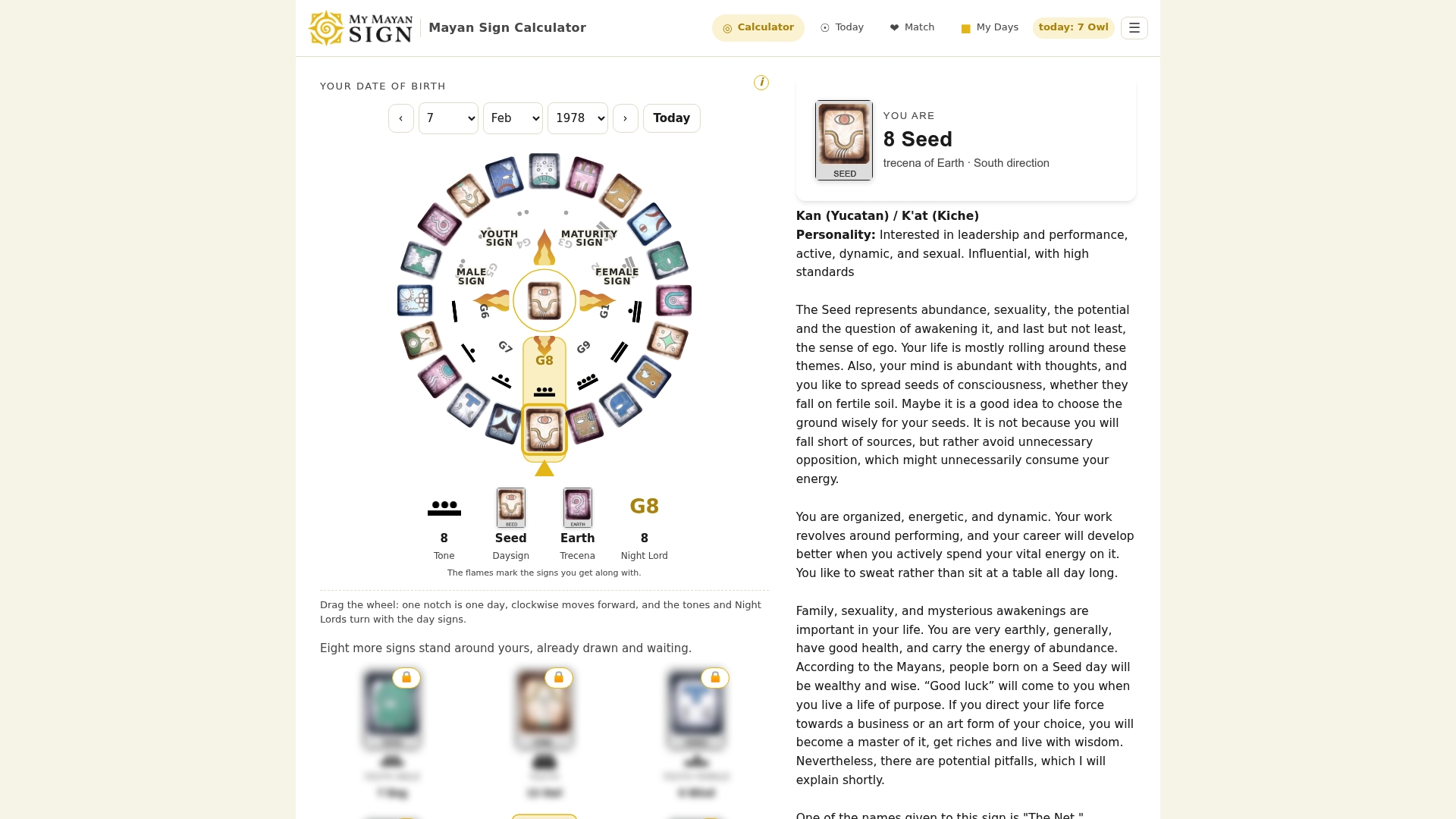
But that’s the seed, not the full harvest. Mymayansign’s paid personalized reports add the layers a quick lookup can’t: trecena context, Tree of Life symbolism, and interpretation written around your specific kin rather than a generic template. Readers exploring relationships can add a compatibility analysis comparing two signs side by side, and anyone who wants the practice to stick around daily can subscribe to Daily Mayan Wisdom for ongoing guidance keyed to the current Tzolkin day.
Start with the free calculator today, see what your day sign and tone actually say, and decide from there whether the fuller personalized report is your next step.
Sources
- Maya Calendar Converter | National Museum of the American Indian
- Mayan Astrology: Your Day Sign and Galactic Tone in the Tzolkin Calendar | Celesian
- Mayan astrology – Astrodienst Astrowiki
- Mayan Tzolkin: Solar Seals, Galactic Tones & Your Day Sign | Whisper.Day
Recommended
- Tzolkin Explained: The 260-Day Calendar of the Maya
- Kin Number Meaning: Your Complete Tzolkin Guide
- Your Mayan Birthday Calendar: Find Your Maya Day Sign
- Mayan Astrology Dates: How to Calculate and Interpret Yours