
Yellow Human, known in Yucatec as Eb, is the Mayan day sign of wisdom, influence, and conscious free will. It sits as the 12th of the 20 sacred solar seals in the Tzolk’in, part of the Yellow family associated with ripening and harvest. This guide walks through its symbolism, gifts, shadow side, how your Galactic Tone reshapes it, and how to find out if it’s your sign.
TL;DR:
- Yellow Human’s influence depends heavily on your Galactic Tone, with Tone 1 emphasizing choice and Tone 13 highlighting completion and transcendence.
- Its shadow patterns include manipulation, indecision, and people-pleasing, which can lead to exhaustion if influence is not consciously managed.
- Accurate identification of your sign and tone requires precise birth data and a reliable Tzolk’in converter to generate meaningful insights.
- The sign’s core message centers on being a vessel for wisdom and lineage, not hoarding knowledge or avoiding responsibility.
- Full understanding of your Yellow Human sign involves exploring how your tone and Tree of Life influence your expression and decision-making.
Table of Contents
- What Does Yellow Human (Eb) Symbolize?
- The Gifts and Shadow Side of Yellow Human
- How Your Galactic Tone Changes Yellow Human’s Expression
- Finding Your Yellow Human Day Sign From Your Birth Date
- Applying Yellow Human Meaning to Your Own Growth
- Where Yellow Human’s Meaning Comes From
- How Yellow Human Fits Into the Larger Maya Calendar System
- Comparing Yellow Human to the Other Human Day Signs
- Common Myths About Yellow Human, Corrected
- Notable Yellow Human Traits Across Different Life Paths
- A Working Note on Yellow Human Readings
- Get Your Full Yellow Human Reading
- Sources
What Does Yellow Human (Eb) Symbolize?
Picture an empty chalice, held up and waiting to be filled. That’s the central image practitioners return to when describing Eb: a vessel built to carry something larger than itself, whether that’s ancestral knowledge, community trust, or a single hard-won insight passed from an elder. The glyph also reads as a road or a stalk of corn pushing upward, both metaphors for a life lived in service of what comes next.
Mayan astrology references group Eb within the Yellow family, associated with the South direction and the theme of ripening. Where the Red family tends to signal initiation and the White family often points to purification, Yellow carries the energy of harvest, generosity, and the fruit of long effort. That placement matters in a personal reading. It tells you Eb isn’t a seed sign or a starting-gun sign. It’s a sign that asks what you’ve grown, and whether you’re ready to share it.
A few associations show up consistently across Mayan-astrology sources:
- Family: Yellow (ripening, harvest, generosity)
- Direction: South
- Core image: Human vessel, chalice, road, or corn stalk
- Position: 12th of 20 in the Tzolk’in sequence
- Underlying theme: Lineage, service, and the transmission of wisdom
The chalice metaphor is worth sitting with for a moment. A vessel doesn’t manufacture what it holds. It receives, protects, and eventually pours out. That’s the interpretive key to almost everything else about Yellow Human. You’re not meant to hoard what you know. You’re meant to become a conduit for it, and how well you manage that flow determines whether Eb’s gifts land as wisdom or curdle into control.
The Gifts and Shadow Side of Yellow Human
Eb’s reputation in practitioner literature centers on four qualities that tend to surface again and again in people who carry this sign.
- Wisdom that accumulates through lived experience, not abstract study. Yellow Humans often become the person a family or team quietly defers to when a decision gets complicated.
- Ethical influence. You move people, sometimes without raising your voice, because your presence carries weight. The question is always whether that influence serves others or just serves you.
- A pull toward service. Whether it’s mentoring, counseling, or simply being the reliable one, Eb tends to orient itself around what the community needs.
- Clear-eyed decision-making, at least when the sign is operating at its healthiest. Free will, for Yellow Human, isn’t a slogan. It’s a daily practice of choosing deliberately instead of drifting.
The shadow side is the flip of every one of those strengths. Yellow seals are described as generous and ripening, but Eb’s practitioner guides also flag manipulation and the burden of inherited expectation as recurring shadow patterns. Influence that isn’t examined can slide into subtle manipulation, the kind where you’re technically not lying but you’re definitely steering. Indecision shows up too, often disguised as open-mindedness, when really it’s a fear of the responsibility that comes with choosing. And people-pleasing is Eb’s most common trap: the vessel that’s so used to holding others’ needs that it forgets to check what it actually wants.
In relationships, this can look like a Yellow Human who mediates every conflict except their own. In leadership, it can look like someone who influences a room brilliantly but avoids ever stating a hard position outright. In community roles, it often shows up as the person who says yes to every request until resentment builds quietly underneath.
Pro Tip: Before you agree to carry someone else’s expectation, ask yourself whether you’re filling the vessel by choice or by habit. That one pause is often the entire difference between Eb’s wisdom and Eb’s exhaustion.
How Your Galactic Tone Changes Yellow Human’s Expression
Every day sign in the Tzolk’in pairs with a Galactic Tone, numbered 1 through 13, and that pairing is what actually produces your kin, or specific day. The tone acts like a verb attached to the sign’s noun. Yellow Human tells you what energy you’re working with. The tone tells you how that energy moves.
A handful of examples show how much range this creates within a single sign:
- Tone 1 (Magnetic) Yellow Human expresses Eb in its rawest form, pure choice, unattached to outcome. This person often struggles with commitment because every option still feels open.
- Tone 4 (Self-Existing) Yellow Human gives the sign structure and form. Wisdom here tends to show up as method, systems, and repeatable frameworks rather than intuition alone.
- Tone 7 (Resonant) Yellow Human channels influence through empathy. This pairing often produces natural counselors and mediators who lead by attunement rather than authority.
- Tone 13 (Cosmic) Yellow Human amplifies Eb toward completion and transcendence, often producing people who seem to arrive at wisdom late in a project but tie everything together when it matters most.
None of these are better or worse than the others. They’re the same chalice, filled differently depending on which tone is doing the pouring.
Finding Your Yellow Human Day Sign From Your Birth Date
Confirming whether Eb belongs to you takes three steps.
- Gather your exact birth date, month, day, and year. The Tzolk’in runs on a 260 day cycle that doesn’t map cleanly onto the Gregorian calendar, so precision matters here more than in Western astrology.
- Run that date through a reliable Tzolk’in converter. The Mayan Sign Calculator at MyMayanSign does this instantly and returns both your day sign and your Galactic Tone in one lookup.
- Confirm the result and note your tone pairing. Hand conversion is genuinely easy to get wrong, since it involves counting through a 20 sign, 13 tone matrix that resets differently than a standard week or month. A dedicated calculator removes that margin for error entirely.
Once you know your kin, you have the two pieces, sign and tone, that actually generate a meaningful reading. Sign alone tells you the archetype. Tone tells you how it moves through your life.
Applying Yellow Human Meaning to Your Own Growth
Knowing you’re a Yellow Human is only useful if it changes how you show up. A few journaling prompts tend to surface the sign’s real texture:
- Where in my life am I filling a role because I chose it, versus because it was handed to me?
- Whose wisdom did I inherit, and have I actually examined whether I agree with it?
- When did I last influence someone’s decision, and was that influence transparent?
- What would it look like to say no without over-explaining myself?
- Which relationship in my life relies on me being the reliable, steady one, and does that role still fit?
- If I stopped mediating, what conflict would surface?
A simple decision framework helps translate those prompts into action: start with clarity (what do I actually want here, stripped of what others expect), move to values alignment (does this choice match who I’m trying to be), check community impact (who else does this affect, and have I been honest with them), then set boundaries (what am I not willing to carry, even if asked).
Sign-only readings answer the “what.” A fuller picture, pairing Eb with your Galactic Tone and your Tree of Life, answers the “how” and “where.” That layered approach, sign as vessel, tone as movement, Tree of Life as direction, is why a complete Tzolk’in birthday reading tends to land with more precision than a sign description alone.
Where Yellow Human’s Meaning Comes From
The Tzolk’in itself predates the Yucatec and K’iche’ Maya civilizations that most people associate with the calendar, with roots that scholars trace to earlier Mesoamerican timekeeping traditions. Each of its 20 day signs, Eb included, functioned less like a horoscope and more like a civic and spiritual scheduling tool, used to name children, time ceremonies, and mark agricultural cycles tied to the region’s harvest patterns.
Eb’s specific imagery, the human figure, the road, the stalk of corn, reflects a culture where maize wasn’t just food. It was the literal metaphor for a life cycle: planted, tended, ripened, and eventually shared with the community that grew it. Naming a day sign after that image wasn’t decorative. It embedded an entire worldview about responsibility and lineage into a single glyph.
Colonial disruption pushed much of this knowledge underground for centuries, preserved mostly through oral tradition and a handful of surviving codices. What’s practiced today, including the Dreamspell variant that popularized Galactic Tones for a global audience in the late 20th century, blends older Tzolk’in structure with newer interpretive layers. That blending is worth naming honestly. It means modern Yellow Human readings carry both genuine ancient roots and modern reinterpretation, and a good reading acknowledges both rather than pretending the tradition never changed.
How Yellow Human Fits Into the Larger Maya Calendar System
The Tzolk’in doesn’t operate alone. It runs alongside the Haab, a 365 day solar calendar, and together they form the Calendar Round, a combined cycle that takes 52 years to fully repeat. Eb’s position as the 12th sign means it recurs every 20 days within the Tzolk’in, but its exact pairing with a Haab date only repeats once every 52 years, which is part of why traditional Maya timekeeping treated certain combinations as especially significant.
It’s also worth placing the Tzolk’in in a broader indigenous context rather than treating it as an isolated curiosity. Multiple Mesoamerican cultures, including the Aztec and Zapotec, kept their own 260 day ritual calendars built on similar 20 by 13 logic, which suggests the structure reflects something deeper about how Mesoamerican cosmology organized time around human gestation and agricultural rhythm rather than solar mechanics alone. Yellow Human, in that light, isn’t a standalone personality sign the way a zodiac sign functions. It’s one node in an interlocking system where sign, tone, and solar date all have to align before a full picture emerges. That’s the real argument for pulling a complete Mayan sign reading rather than stopping at the day sign alone.
Comparing Yellow Human to the Other Human Day Signs
The Tzolk’in actually contains four human centered signs, one from each color family, and comparing them clarifies what makes Eb distinct. Red Human (or its color equivalent in some sign sets) tends to carry initiation energy, the person who starts things. White signs in the human category often lean toward refinement and purification, asking “is this pure enough to continue.” Blue human associated signs typically carry transformation, the capacity to shift form or perspective entirely.
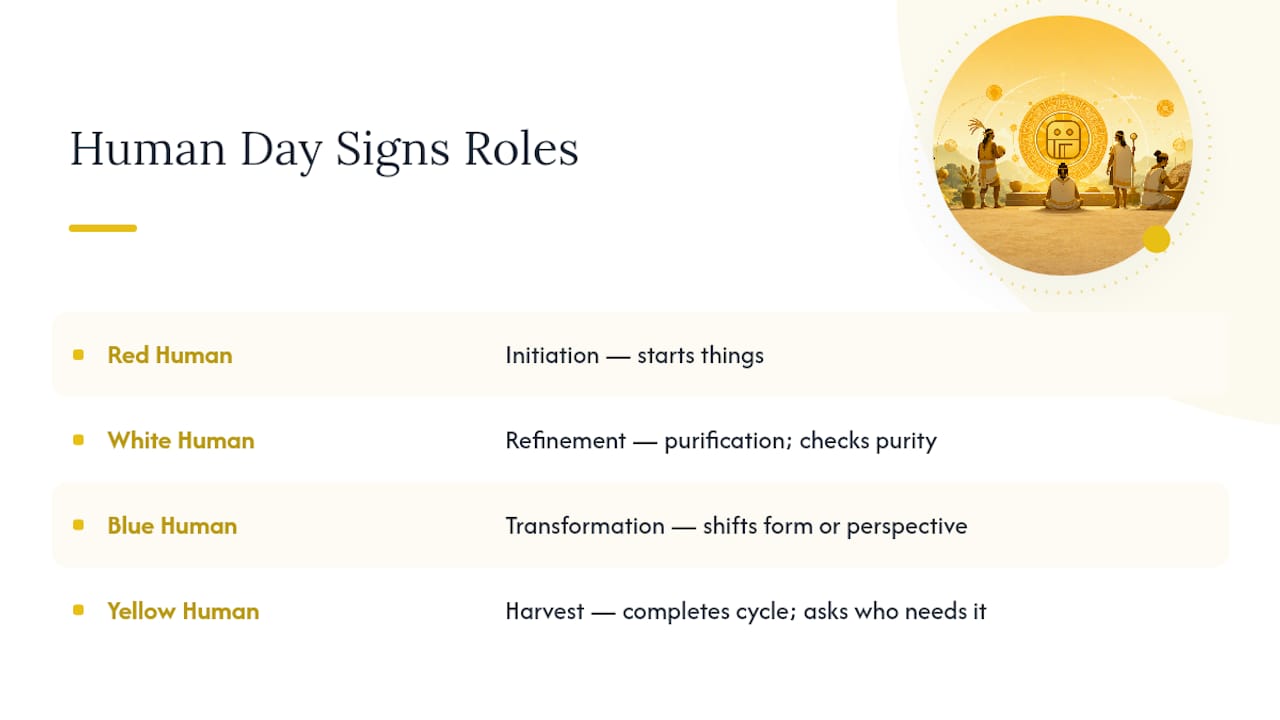
Yellow Human, by contrast, is the harvest position. It doesn’t start the cycle or transform it. It completes it, and then asks what should be done with what’s been gathered. Where a Red sign might ask “what should I build,” Eb asks “what have I already built, and who needs it now.”
This distinction matters most in compatibility readings. Pairing a Yellow Human with an early cycle Red sign can create a productive tension, one partner generating raw momentum, the other shaping it into something usable. Pairing two Yellow family signs together often produces a relationship strong on generosity but occasionally short on forward motion, since both people are oriented toward giving rather than initiating. None of these pairings are fixed rules. They’re tendencies, and a proper compatibility chart weighs tone alongside sign before drawing conclusions.
Common Myths About Yellow Human, Corrected
The biggest misconception is that Yellow Human is a passive or purely gentle sign because it’s associated with generosity and service. That’s a shallow read. Eb’s influence can be quietly forceful, and the sign’s shadow side, manipulation born from unexamined influence, only exists because the underlying power is real. Confusing gentleness with weakness misses the point entirely.
A second myth: that every Yellow Human is destined to be a caretaker or counselor by profession. The sign describes an orientation toward service and wisdom transmission, not a required career path. A Yellow Human can run a business, lead an engineering team, or work entirely alone, and still express Eb’s core theme through how they mentor, share credit, or make ethical calls under pressure.
A third myth treats Yellow Human as identical across every person who carries it, ignoring the Galactic Tone entirely. As covered earlier, a Tone 1 Yellow Human and a Tone 13 Yellow Human can look almost unrecognizable next to each other in daily temperament, even though they share the same underlying archetype.
Finally, some casual sources conflate Eb with general “yellow” color symbolism, optimism, brightness, cheerfulness, and treat the day sign as a mood descriptor. That’s a different subject entirely. Eb is a specific glyph with a specific position in the Tzolk’in, not a color psychology concept, and collapsing the two flattens what’s actually a fairly precise piece of Mesoamerican cosmology.
Notable Yellow Human Traits Across Different Life Paths
Because birth records rarely list Tzolk’in kin, there’s no verified public roster of celebrities matching Eb the way Western astrology sometimes claims for zodiac signs. What’s more useful, and more honest, is looking at the trait pattern the sign consistently produces and where it tends to concentrate.
People practitioners describe as strong Yellow Human expressions often gravitate toward roles where accumulated judgment matters more than raw speed: senior mediators, community elders, therapists who’ve logged decades of practice, or the quiet senior engineer everyone routes hard problems to before a launch. The through-line isn’t fame or title. It’s that others instinctively bring decisions to this person, and the person’s core challenge is deciding which of those decisions are actually theirs to carry.

The healthiest expression tends to show restraint alongside influence, someone who could sway a room but chooses when that’s appropriate. The strained expression shows up as chronic overcommitment, the person who’s become indispensable to everyone else’s decisions and has quietly lost track of their own. Recognizing which pattern you’re living in, more than any list of names, is the actual value of studying this sign closely.
A Working Note on Yellow Human Readings
The theme I see surface again and again in Yellow Human readings is the gap between the sign’s gift and its exhaustion. Eb doesn’t struggle with a lack of wisdom or influence. It struggles with knowing when to stop offering both. That distinction rarely shows up in short sign descriptions, which tend to list “wise” and “influential” as static traits rather than capacities that need active management.
What I’d push back on is the tendency to read Yellow Human as automatically nurturing or safe. Influence is influence, regardless of the color family it’s filed under, and pretending otherwise sets people up to miss their own shadow patterns. A Yellow Human who’s honest about their capacity for quiet control tends to become a far better version of the sign than one who assumes generosity excuses everything.
If you want to go past the archetype and see how your specific Galactic Tone and Tree of Life shape your version of Eb, that’s exactly the layered picture a full personalized chart is built to provide.
— Fatih
Get Your Full Yellow Human Reading
Knowing you’re a Yellow Human is the starting point. Knowing which tone you carry, and how your Tree of Life directs that energy, is what turns a general archetype into something you can actually use in daily decisions. The Mayan Sign Calculator gives you that kin lookup free, in seconds, with no guesswork about which conversion method to trust.
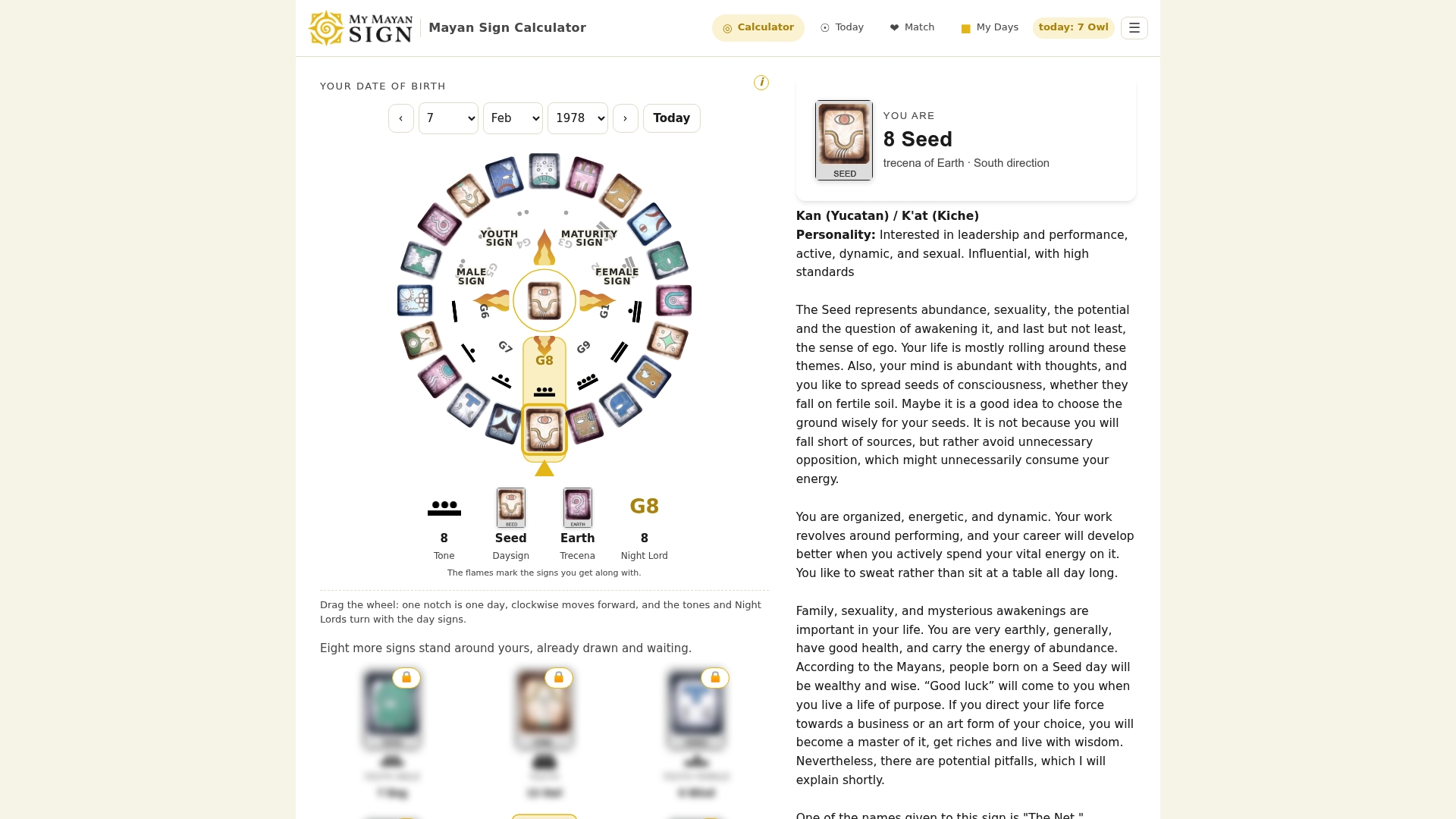
For readers who want the deeper layer, tone, Tree of Life, and how they interact with your day sign, Mayan Astrology Explained walks through the full system in plain language, while Daily Mayan Wisdom delivers ongoing interpretation keyed to your specific kin rather than a one-time snapshot. Start with the free calculator, then decide which depth fits where you are right now.
Sources
- Yellow Human (Eb): Meaning & All 13 Kins in the Mayan Tzolk’in | ZodiacRoots
- Descriptions of the 20 Tribes of Galactic Time ~ by SkyTime
- 20 Mayan Solar Seals: Complete Reference Guide | Whisper
Recommended
- Daily Mayan Wisdom – MyMayanSign
- Mayan Calendar Today: Today’s Tzolkin Day Sign, Tone & Meaning
- Mayan Astrology Blog | Day Signs, Tzolkin & Calendar