In Mayan astrology, a Venus cycle marks moments when Star qualities and matching Galactic Tones grow stronger in your reading. It shows up as symbolic resonance, not astronomical data. The fastest way to feel it: check your Tzolkin Seal and Tone today against your birth Seal and Tone, then watch for the overlap.
TL;DR:
- The Venus cycle in Mayan astrology is personal and based on the player’s Tzolkin Seal and Tone, not astronomical Venus data.
- Key resonance occurs when Lamat (Star) appears on the calendar or when current Tzolkin Tones match birth Tones, amplifying Venus influence.
- Tracking resonance windows over a full Tzolkin cycle helps reveal patterns and the actual impact of Venus days on individual traits and activities.
- Practical practices on Venus days should focus on creative, relational, or manifestation actions, emphasizing tangible outcomes over superficial appearances.
- Automated tools like Mymayansign streamline resonance tracking, making it easier to identify significant Venus windows and deepen personal astrology insights.
Table of Contents
- What Does the Venus Cycle Mean in Mayan Astrology?
- How Do You Detect a Venus Resonance Window for Your Birth Profile?
- Rituals and Micro-Practices for Working With Venus Energy
- How MyMayanSign Helps You Track Venus-Aware Readings
- Where Does Venus Fit Into Mayan Mythology and History?
- How Does Venus Fit Into the Tzolkin and Haab Together?
- How Do Other Mesoamerican Cultures Interpret Venus Differently?
- What Do People Get Wrong About the Venus Cycle in Mayan Astrology?
- A Practitioner’s Note on Living With Venus Resonance
- Get Your Personalized Venus-Aware Mayan Reading
- Sources
What Does the Venus Cycle Mean in Mayan Astrology?
Forget synodic tables and observation cycles. When practitioners talk about a venus cycle mayan style reading, they mean something personal: the rhythm of Venus symbolism as it moves through your Tzolkin profile, not the planet’s path through the sky. Your working map for this is the 260-day Tzolkin, built from 20 Solar Seals and 13 Galactic Tones layered together. Each day carries one Seal and one Tone, and that pairing forms the basis every Mayan Astrology reading rests on.
Lamat, often called Star, is the Seal most directly tied to Venus in Mayan tradition. It’s described as the seed of light, associated with beauty, creativity, and harmony, and practitioners treat any day carrying Lamat as a Venus-relevant day. But you don’t need Lamat as your birth Seal to feel its pull. Star energy radiates outward through the calendar, touching other Seals when the timing lines up, the way a single bright note can color an entire chord.
That’s where Tone resonance comes in. When today’s Galactic Tone matches your own birth Tone, practitioners describe an amplification effect on your natal qualities, and this is doubly true on a Lamat day, when Tone resonance and Star symbolism stack together.
Three signals are worth watching for:
- Your birth Seal and Tone, the fixed coordinates of your chart
- Any day where Lamat (Star) appears on the calendar, regardless of your own Seal
- Days where the current Tone matches your birth Tone, creating resonance
Hold those three in mind, and the rest of this becomes a tracking exercise rather than a mystery.
How Do You Detect a Venus Resonance Window for Your Birth Profile?
Finding your own Venus windows takes four repeatable steps. None of them require guesswork once you know your birth Seal and Tone.
- Find your Seal and Tone. Pull your exact birth pairing using a Tzolkin birthday lookup or a personal Mayan calendar calculator.
- Check today’s Seal and Tone. Cross-reference the current date against your today’s Tzolkin day sign to see what energy is active right now.
- Identify the resonance window. Look for two triggers: a Lamat day (Star energy present for everyone) or a Tone match (your birth Tone echoing in today’s date).
- Log it and interpret. Write down the date, the Seal and Tone combination, what you intended, and what actually happened.
Here’s how that plays out for two different people. Someone born under Lamat feels Venus energy as a near-constant undertone, but their sharpest days are when their birth Tone also repeats, stacking Star symbolism with Tone resonance for a rare double signal. Someone born under a different Seal, say Ik (Wind), experiences Venus influence only when Lamat shows up on the calendar itself, borrowing that day’s beauty and harmony themes for twenty-four hours before the energy shifts elsewhere.
Pro Tip: Track your resonance days for one full Tzolkin round, all 260 days, before drawing conclusions. Patterns that look random after two weeks often become obvious after two months.
For notation, keep it short: record the Seal+Tone pairing (your “KIN” shorthand), a one-line intention, and a simple outcome code, zero for no result, one for a minor result, two for something significant. That compact log becomes your own private dataset for spotting which Venus windows actually move the needle for you.
Rituals and Micro-Practices for Working With Venus Energy
Once you’ve spotted a resonance window, the question becomes what to actually do with it. Star energy responds best to practices that produce something tangible rather than practices aimed at surface appearance. A poem, a sketch, a piece of music, a repaired relationship conversation. The Lamat archetype is about creative fertility and harmony made visible, not vanity.
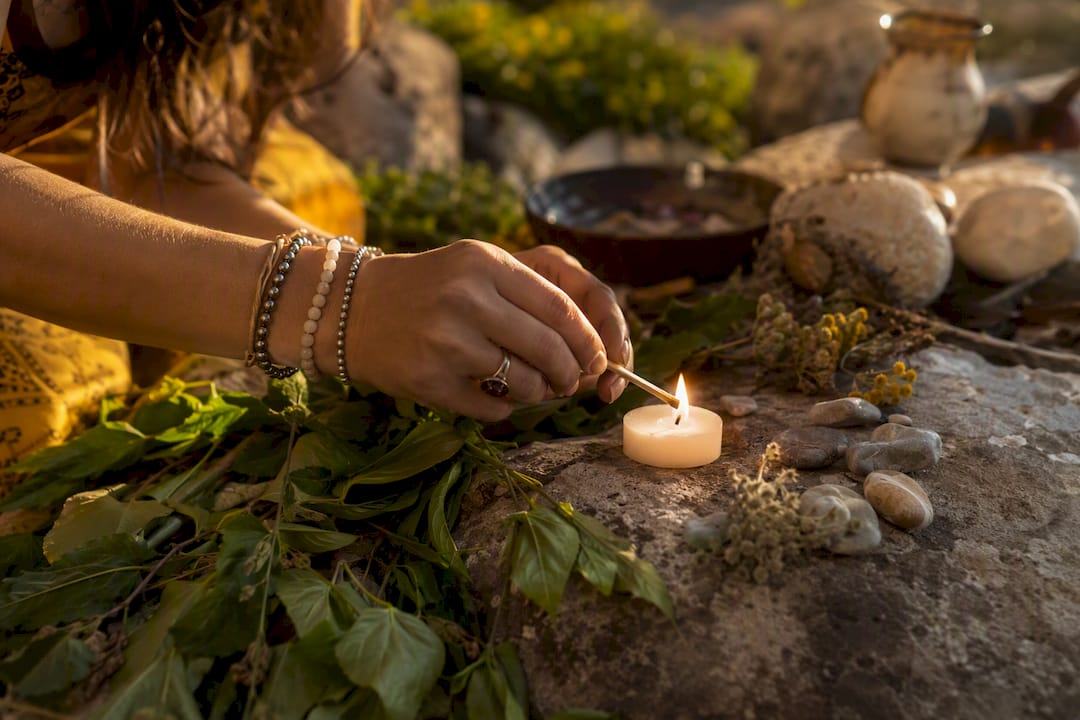
For creative activation on a Venus day, set aside twenty minutes to start (not finish) a creative project you’ve been avoiding. For relationship calibration, use the day to have one honest conversation you’ve been postponing, since Star energy favors harmony built through honesty rather than avoidance. For beauty and manifestation work, write down one intention tied to something you want to grow, then take one physical action toward it before the day ends.
If you only have five minutes, a micro-practice works: light a candle, name your intention aloud, and note it in your log. If you have a full day, dedicate it to a single creative or relational project from start to finish.
A few practical notes on frequency: contemporary trackers who log daily Seal, Tone, intention, and outcome tend to find their own patterns become legible within three to six months of consistent notation, since the Tzolkin’s 260-day cycle needs time to repeat enough combinations to compare. This is self-tracking, not a clinical study, so treat the pattern as a personal signal rather than a universal rule.
One more thing worth holding onto: Mayan astrology sources are explicit that favorable days offer potential, not guarantees. Intention and follow-through shape the outcome. A Venus day without action is just a pleasant day on the calendar.
How MyMayanSign Helps You Track Venus-Aware Readings
Manually cross-referencing your birth Seal, today’s Tone, and resonance windows works, but it’s tedious to do by hand every day. Mymayansign builds that tracking method directly into a set of tools designed for exactly this kind of personal astrology work.
Here’s what’s available and how each piece maps to the method above:
- The Mayan sign calculator gives you your birth Seal and Tone in seconds, the first step in any resonance check.
- The Galactic Tone day feature shows today’s active Tone, so you can compare it against your birth Tone without doing the math yourself.
- A personalized calendar tracks upcoming Lamat days and Tone matches automatically, replacing the manual log described in the how-to steps above.
- Daily Mayan Wisdom delivers a daily prompt tied to your specific chart, useful for the journal habit that makes resonance tracking meaningful over time.
- The Sacred Teachings of Mayan Astrology eBook goes deeper into Seal and Tone meaning for readers who want the full cultural and symbolic context behind their chart.
Getting a personalized calendar takes three steps: enter your birth date, review your Seal and Tone profile, then opt into calendar tracking so Lamat days and Tone matches surface automatically instead of requiring a manual cross-check every morning.
Where Does Venus Fit Into Mayan Mythology and History?
Venus held serious weight in Mayan cosmology long before modern astrology adapted its symbolism into personal readings. Scholarly work on Mayan glyphs and codices documents multiple names for Venus across different sources, including Chac Ek and Noh Ek, each carrying its own shade of meaning within the broader mythological framework. That naming pattern alone tells you something: a culture doesn’t give a celestial body several distinct names unless it occupies serious cultural real estate.
Venus appears in Mayan codices and glyphic records tied to cycles of transformation, rebirth, and duality, themes that echo into how modern practitioners frame Lamat and Star energy today. The connection isn’t a direct one-to-one translation from ancient ritual to modern reading. It’s more that the symbolic DNA, beauty paired with intensity, harmony paired with transformation, survived the centuries and resurfaced in how Lamat gets interpreted now.
If you want to go deeper into how specific glyphs carry these layered meanings, the Mayan glyph meanings guide walks through how names like Ek connect to broader symbolic systems. Understanding that history doesn’t change how you track a resonance window today, but it does add weight to why Star days feel meaningful rather than arbitrary. You’re tapping into a symbol with genuine cultural depth, not a modern invention dressed up in old language.
How Does Venus Fit Into the Tzolkin and Haab Together?
Mayan timekeeping runs on two interlocking cycles: the 260-day Tzolkin and the 365-day Haab, or solar calendar. Together they form the Calendar Round, a larger cycle that takes 52 years to fully repeat. Venus symbolism, as expressed through Lamat, lives primarily inside the Tzolkin side of this system, since the Tzolkin is the cycle personal astrology readings draw from.
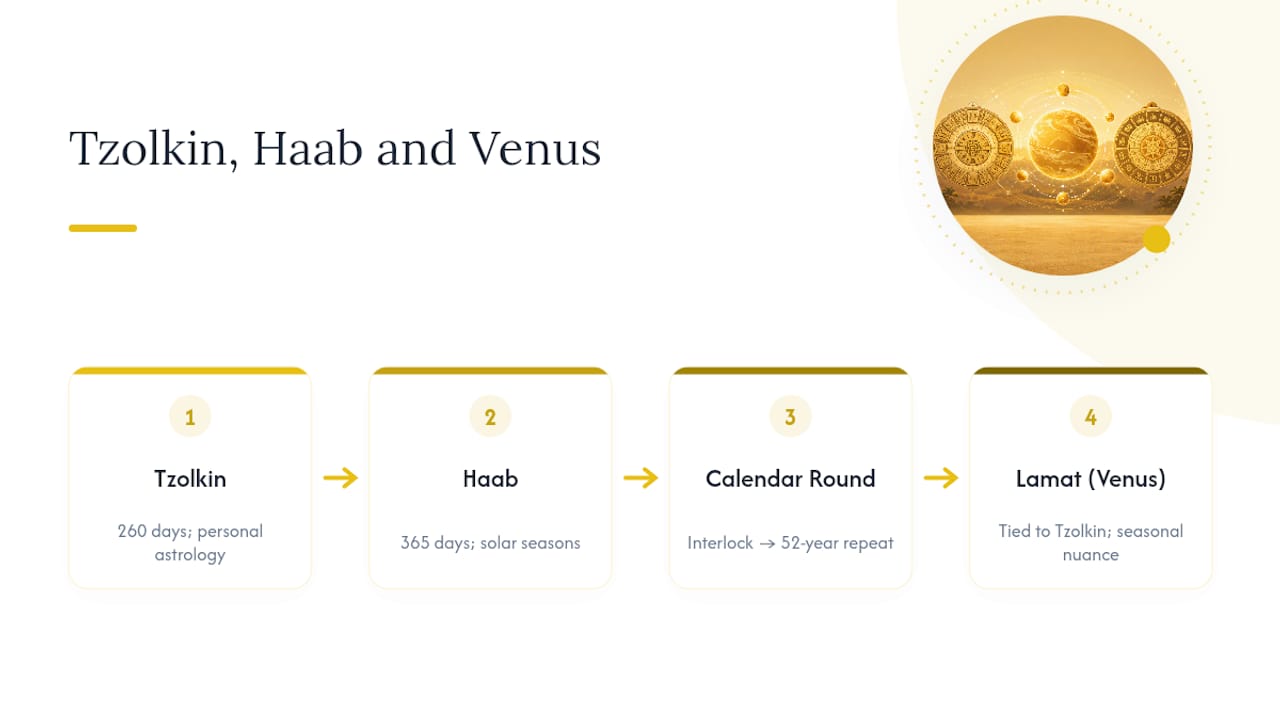
The Haab tracks agricultural and solar seasons, eighteen months of twenty days plus a short five-day period. It answers a different question than the Tzolkin does. Where the Tzolkin asks “what energy is active on this day,” the Haab asks “where are we in the solar year.” Venus-linked Star energy doesn’t shift with the Haab the way it shifts with Tzolkin Tone resonance, because the symbolic weight of Lamat is tied to its position among the 20 Seals, not to the solar calendar’s seasonal markers.
This matters for anyone doing personal tracking: your Venus resonance windows come from Tzolkin math exclusively. You don’t need to layer Haab positioning into the calculation to find a Star day or a Tone match. That said, some practitioners note that Haab positioning can add seasonal flavor to how a Tzolkin reading feels, a Lamat day in a harvest-associated Haab month might lean more toward abundance themes, while the same Lamat day in a different Haab period might lean more toward creative renewal. It’s a layer of nuance, not a requirement.
How Do Other Mesoamerican Cultures Interpret Venus Differently?
The Maya weren’t the only Mesoamerican culture to treat Venus as symbolically significant. The Aztec tradition associated Venus closely with Quetzalcoatl, the feathered serpent deity, framing the planet’s presence as tied to cycles of death and rebirth in a more overtly mythological, less personality-based way than Mayan Lamat symbolism.
Where Mayan practice, particularly in its modern personal-astrology form, treats Venus through Lamat as a personality and timing signal, something that colors an individual’s traits and daily windows, Aztec cosmology leaned harder into Venus as a cosmic and political force, tied to warfare timing and ritual calendars at a civilizational scale rather than an individual one. Both traditions clearly held Venus in high regard. They just pointed that regard in different directions: one toward the collective and the sacred calendar of state ritual, the other, in its contemporary form, toward the individual’s own chart and daily practice.
This distinction matters if you’re reading broadly about Mesoamerican astronomy and start wondering why a “Venus cycle” in a Mayan context feels so different from what you might read about Aztec Venus rituals. They’re related cultural threads, not identical systems, and Mymayansign’s approach draws specifically from the Mayan Tzolkin tradition rather than blending traditions together. Keeping them distinct actually makes each system easier to understand on its own terms, since forcing a merge tends to flatten the specific texture that makes Lamat symbolism meaningful in the first place.
What Do People Get Wrong About the Venus Cycle in Mayan Astrology?
The biggest misconception is treating “Venus cycle” as a synonym for the planet’s actual orbital pattern. Popular articles online frequently conflate the two, presenting synodic period tables alongside astrology content as though they’re the same subject. They’re not. The personal-astrology sense of Venus, the one this guide covers, is about Lamat symbolism and Tone resonance in your Tzolkin chart. It has nothing to do with when Venus rises as a morning or evening star.
A second common error is assuming Venus influence only applies if your birth Seal is Lamat itself. It doesn’t. Star energy radiates through the calendar on any day Lamat appears, regardless of whose birth chart you’re checking, which is exactly why the resonance-tracking method in this guide works for every Seal, not just Star-born readers.
A third misconception treats Tone resonance and Star days as deterministic, guaranteed outcomes rather than potential windows. Mayan astrology sources are consistent on this point: favorable timing creates opportunity, not certainty. A Lamat day with a Tone match is a strong signal to lean into creative or relational work. It’s not a promise that the work will succeed without effort behind it.
A Practitioner’s Note on Living With Venus Resonance
The pattern that surprised me most in researching resonance tracking wasn’t the theory. It was how differently the same Tone match feels depending on what Seal frames it. A Tone resonance day landing on Lamat reads as expansive, almost generous. The same Tone match landing on a more introspective Seal can read as quietly intense instead. The Tone doesn’t change. The Seal it’s paired with does the shaping.
That’s the part conventional shortlists of “Venus days” tend to flatten. They treat every Lamat appearance as identical, when in practice the Tone riding alongside it changes the texture completely. If you’re only checking whether today is a Star day and skipping the Tone check, you’re reading half the chart.
Check your resonance weekly, not daily. Daily checking creates noise; weekly checking lets real patterns surface in your log without you forcing meaning onto random days.
— Fatih
Get Your Personalized Venus-Aware Mayan Reading
Mymayansign turns the manual tracking method in this guide into something that runs itself. Instead of cross-referencing your birth Tone against today’s calendar by hand, you get your Seal and Tone instantly, then let a personalized calendar flag Lamat days and Tone matches as they come up.
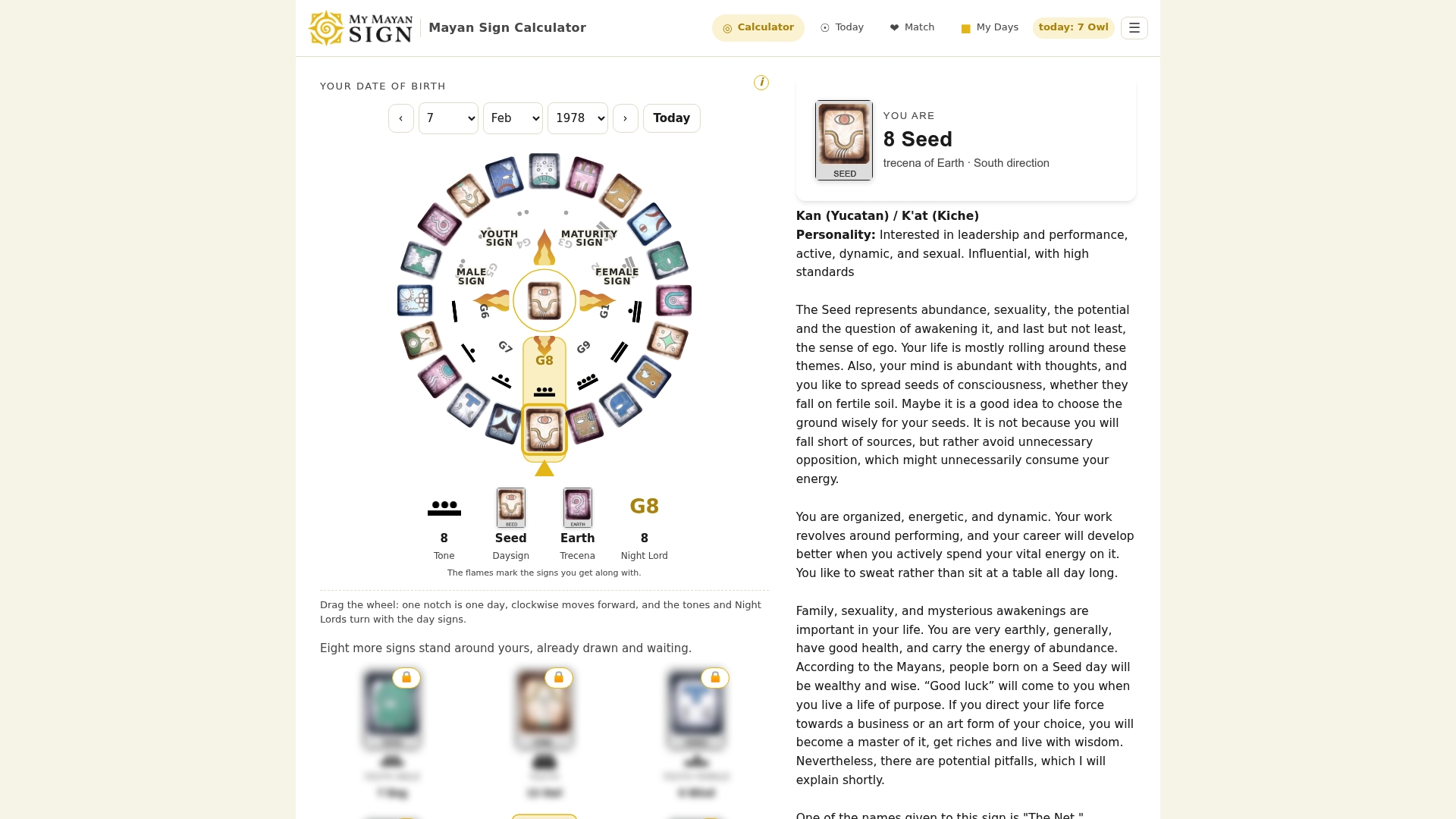
The core tools map directly to what you’ve just read: a birth sign lookup, ongoing Galactic Tone tracking, a custom calendar built around your specific profile, and daily prompts through Daily Mayan Wisdom for readers who want a journal habit built in. For deeper study, the Sacred Teachings eBook expands on Seal and Tone symbolism well beyond what a quick lookup can cover.
Start with the Mayan sign calculator to find your Seal and Tone, then check whether today carries a Venus resonance for your chart. It takes less time than reading this sentence took.
Sources
- Mayan Astrology – Astrodienst Astrowiki
- Mayan Astrology Signs and Meanings: Discover Your Mayan Zodiac Sign | Meaningful Moon
- Mayan Tzolkin: Solar Seals, Galactic Tones & Your Day Sign
- Mayan Venus-related glyph and codex scholarship (excerpt)
Recommended
- What Is My Mayan Sign? Find It From Your Birth Date – MyMayanSign
- Mayan Astrology Explained: Signs, Meanings & Tzolk’in
- Mayan Zodiac Sign Calculator | Free Day Sign & Tone
- Your Mayan Birthday Calendar: Find Your Maya Day Sign