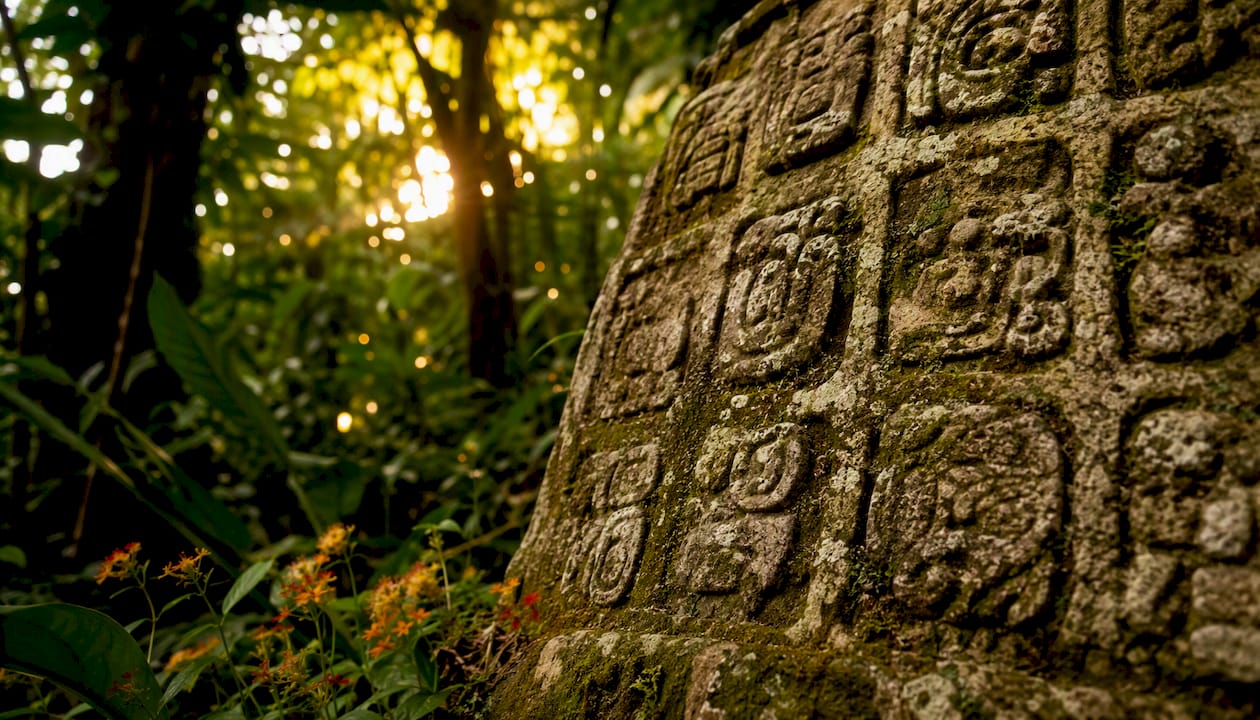
The Tzolkin is a 260-day sacred day-count built from 20 named days cycling against 13 numbers, and it exists to mark the spiritual character of a day rather than to track the sun’s position in the sky. Every civilization that watches the sky eventually builds a calendar, but the Maya built two, and the Tzolkin is the one that has nothing to do with seasons, harvests, or solstices. It is older than counting years. It is a rhythm, and once you understand how the rhythm works, you start to see the Maya calendar system as one of the more elegant pieces of intellectual architecture the ancient world produced.
Here is what you need before we go any further:
- How 260 is formed: twenty named days rotate against thirteen numbers, and the pairing never repeats until all 260 combinations have cycled through.
- What it was used for: ritual scheduling, divination, naming ceremonies, and a documented link to the human gestation window, still practiced today by trained daykeepers in the Guatemalan highlands.
- Where it fits in the larger system: the Tzolkin interlocks with the 365-day Haab solar calendar to create the 52-year Calendar Round, the unit the Maya used before the Long Count arrived for longer-range dating.
What follows unpacks each piece: the mechanics of the two cycles, a working glossary of the day-names and tones, how to actually read a date, where the 260-day count came from, and how traditional daykeepers use it differently than the modern spiritual movements that borrowed its name.
Key Takeaways
The Tzolkin works as a 260-day sacred cycle because 13 numbers and 20 named days share no common factor besides 1, forcing every pairing to be unique across the full count.
| Point | Details |
|---|---|
| Definition | The Tzolkin combines 20 day-names with 13 numbers to form 260 unique days, per Britannica and Merriam-Webster. |
| The math behind 260 | 13 × 20 = 260 because the two cycles share no common factor, so pairings repeat only after the full count. |
| Reading a Kin | Advance the number and day-name cycles by one each day; the pairing you land on is that day’s Kin. |
| Bigger calendar system | The Tzolkin interlocks with the 365-day Haab to form the 52-year Calendar Round used before the Long Count. |
| Traditional vs modern | Living Cholq’ij daykeeper practice in Guatemala differs meaningfully from modern adaptations like Dreamspell. |
| Get your own reading | Mymayansign’s free calculator and paid reports map your birth date to its Kin and expand on its meaning. |
Table of Contents
- How the Tzolkin Calendar Meaning Comes From Two Interlocking Cycles
- The 20 Day-Names: A Quick-Reference Glossary
- The 13 Tones: How Numbers Shape a Day’s Character
- Reading a Kin: Why the Cycle Locks at Exactly 260 Days
- How to Convert a Tzolkin Day to a Gregorian Date
- Where the Tzolkin Fits: Haab, Calendar Round, and the Long Count
- Origins and Archaeological Evidence Behind the 260-Day Cycle
- Traditional Uses: Daykeepers, Divination, and Living Practice
- Common Misconceptions and Modern Adaptations Like Dreamspell
- How a Personalized Mayan Astrology Reading Maps Your Birth Date
- Three Worked Examples: Sample Kins and What They Reveal
- Why the Tzolkin Still Matters Beyond Its Mathematics
- Get Your Own Kin: Free Calculator and Personalized Readings
- Sources
How the Tzolkin Calendar Meaning Comes From Two Interlocking Cycles
Picture two gears of different sizes turning together, one with 20 teeth and one with 13. That is the entire mechanical secret of the tzolkin calendar meaning: a smaller wheel of numbers and a larger wheel of named days, rotating in tandem, never landing on the same pairing twice until 260 days have passed.
The first cycle is the sequence of 20 day-names, sometimes called day-signs. Each one carries a specific identity, similar in function to a zodiac sign but rooted in Maya cosmology rather than constellations. The second cycle is a simple count from 1 to 13, referred to as the tones or numbers. Both cycles advance by one step every single day, independently, which is why a name like Imix might pair with the number 8 today and the number 9 the next time it appears thirteen days later.
Britannica’s entry on the Tzolkin describes this exact structure: a cycle of twenty named days combined with a cycle of thirteen numbers, producing 260 unique days. Merriam-Webster’s definition of tzolkin confirms the same math from a purely lexical angle, calling it “a period of 260 days constituting the complete cycle produced by permutations of 20 day names with numbers 1 to 13.”
Here are the 20 day-names in their fixed order, the sequence they always follow:
| Position | Day-Name |
|---|---|
| 1 | Imix |
| 2 | Ik’ |
| 3 | Ak’b’al |
| 4 | K’an |
| 5 | Chikchan |
| 6 | Kimi |
| 7 | Manik’ |
| 8 | Lamat |
| 9 | Muluk |
| 10 | Ok |
| 11 | Chuwen |
| 12 | Eb’ |
| 13 | B’en |
| — | Ix |
| — | Men |
| — | K’ib’ |
| — | Kab’an |
| 18 | Etz’nab’ |
| — | Kawak |
| 20 | Ajaw |
The 13 tones do something different. Rather than naming an energy, they modify its intensity or stage of development. Think of them less as separate identities and more as a rhythm of expansion and contraction:
- Tones 1 through 4 mark beginnings, tension, stability, and definition, the early scaffolding of an idea.
- Tones 5 through 9 mark the middle stretch, where power, flow, breakthrough, and reflection alternate.
- Tones 10 through 13 mark manifestation, cooperation, spiritual refinement, and completion, the closing arc of the thirteen-day unit.
Each run of 13 days forms what daykeepers call a trecena, a mini-season inside the larger 260-day count. Imagine a 13-row by 20-column grid: read down a column and you get the same day-name paired with every tone in sequence over multiple cycles; read across a row and you see 20 different day-names all carrying the same tone. That grid, more than any metaphor of wheels, is why the combination only repeats after exactly 260 steps.
The 20 Day-Names: A Quick-Reference Glossary
Learning to read a Tzolkin chart starts with knowing what each name actually represents, since the names are not arbitrary labels. Most carry an association with an animal, a natural force, or a human experience, and Maya daykeepers have passed down one-line meanings for each through generations of oral and written tradition.
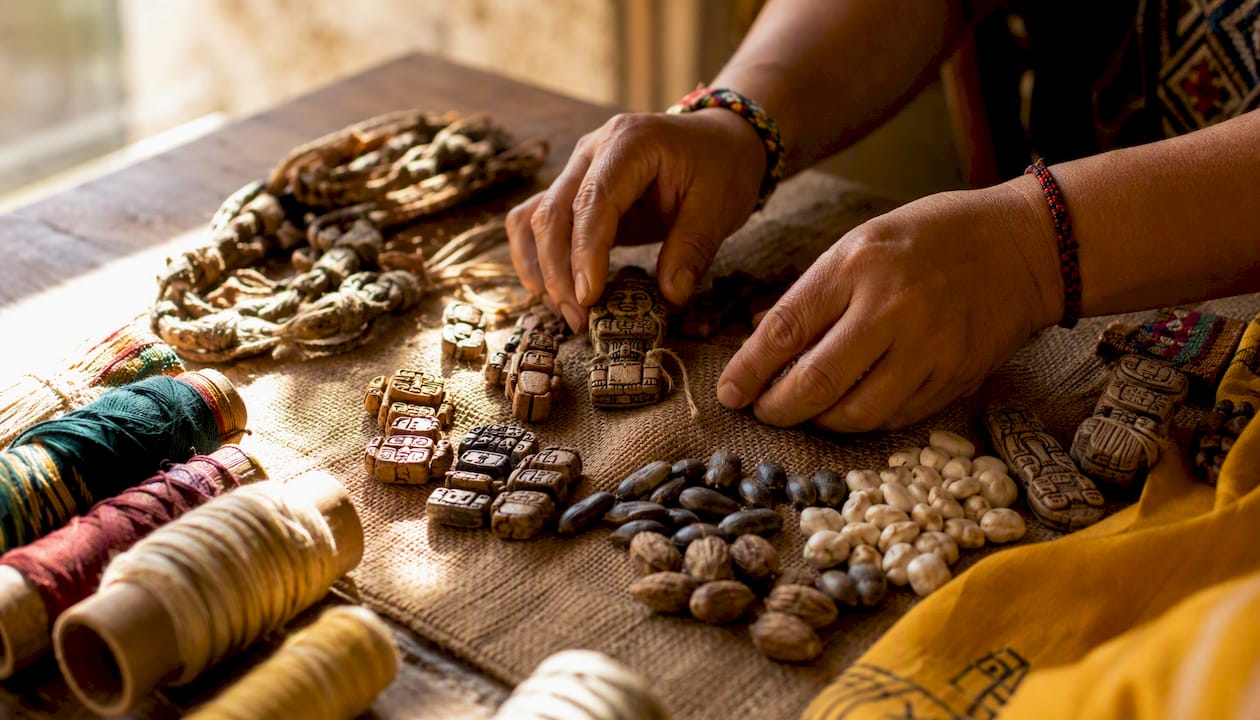
| Day-Name | Common Variants | Core Association |
|---|---|---|
| Imix | Imox, Imix | The primordial crocodile; nurturing, origin, maternal energy |
| Ik’ | Ik, Iq’ | Wind and breath; communication, spirit, thought |
| Ak’b’al | Akbal, Votan | Night and darkness; introspection, dreaming, the underworld |
| K’an | Kan, K’at | The seed; ripening, abundance, growth |
| Chikchan | Chicchan | The celestial serpent; life force, vitality, kundalini-like energy |
| Kimi | Cimi, Kame | Death; transformation, release, ancestral connection |
| Manik’ | Manik | The deer hand; healing, grace, resourcefulness |
| Lamat | Lamat | Venus and the rabbit; abundance, art, fertility |
| Muluk | Muluc | Water and jade; emotion, offering, purification |
| Ok | Oc | The dog; loyalty, guidance, companionship |
| Chuwen | Chuen | The monkey; creativity, playfulness, artisan skill |
| Eb’ | Eb | The road; humility, destiny, human journey |
| B’en | Ben | The reed; leadership, authority, home |
| Ix | Hix | The jaguar; magic, earth energy, feminine power |
| Men | Men | The eagle; vision, ambition, higher perspective |
| K’ib’ | Cib | Wisdom and the owl; ancestral knowledge, introspection |
| Kab’an | Caban | The earth; movement, synchronicity, global awareness |
| Etz’nab’ | Etznab | The flint knife; clarity, truth, mirror-like reflection |
| Kawak | Cauac | The storm; catalytic change, purification, renewal |
| Ajaw | Ahau | The sun lord; enlightenment, completion, radiance |
A note on pronunciation and spelling: modern Maya linguists use a standardized orthography with apostrophes marking glottal stops (the little catch in the throat before certain consonants), which is why you will see both “K’an” and the older Spanish-influenced “Kan” in different sources. The calendar itself goes by several names depending on language and region: Tzolk’in in K’iche’ orthography, Cholq’ij among many highland Guatemalan daykeepers, and occasionally Aj Ilabal Q’ij in specific community contexts. None of these is more “correct” than another; they reflect dialect and transcription choices rather than different calendars. For deeper linguistic grounding, museum and academic resources remain the most reliable next stop, since popular spiritual sites often simplify or Anglicize names in ways that lose the original phonetic precision.
The 13 Tones: How Numbers Shape a Day’s Character
If the day-names are the nouns of the Tzolkin, the tones are the verbs, and understanding how to use Tzolkin readings well means learning both halves. Each number from 1 to 13 carries a descriptive quality that daykeepers and modern interpreters alike use to color the day-name it lands on:
- 1, Hun: Initiating. The spark, the first move, unity of purpose.
- 2, Ka’: Polarizing. Duality, choice, the tension between two options.
- 3, Ox: Activating. Movement, the first visible action, momentum building.
- 4, Kan: Defining. Stability, structure, the foundation setting in.
- 5, Ho’: Empowering. Radiating influence, leadership stepping forward.
- 6, Wak: Balancing. Rhythm, flow, organizing what came before.
- 7, Huk: Attuning. Reflection, mystical insight, inward channeling.
- 8, Waxak: Harmonizing. Integrity, integration, aligning parts into a whole.
- 9, B’olon: Pulsing. Realization arriving in waves, patience under pressure.
- 10, Lajun: Manifesting. Solid results, productivity, tangible completion.
- 11, Buluk: Releasing. Dissolving what no longer serves, letting go.
- 12, Lajka’: Cooperating. Understanding gained through connection with others.
- 13, Oxlajun: Transcending. Cosmic culmination, the closing surge before the cycle turns over.
A few compact examples make the pairing concrete. 1 Imix carries the number of initiation landing on the day of primal nurturing, so daykeepers often read it as the energy of a fresh start rooted in maternal or ancestral support. 7 Aj (a variant of B’en associated with the home and reed) combines reflective attunement with domestic authority, a day associated with quiet reassessment of one’s foundations. 13 Ben closes a full trecena on the reed day, pairing transcendent completion with leadership, often read as the culmination of a cycle of growth that is ready to be handed forward.
In carved inscriptions, this pairing shows up as a bar-and-dot numeral (bars count five, dots count one) placed directly beside the day-name’s glyph, the pictographic symbol representing that name. You can see authentic examples of this notation on stelae and in the Dresden Codex, one of the few surviving pre-Columbian Maya manuscripts, where astronomers and priests recorded these combinations for ritual planning.
Reading a Kin: Why the Cycle Locks at Exactly 260 Days
A single Tzolkin day is called a Kin, and reading one is simpler than it looks once you see the pattern in motion. Here is the step-by-step logic.
- Start with a known Kin. Say today is 4 Ajaw. That means the number cycle is at position 4 and the day-name cycle is at position 20 (Ajaw’s spot in the fixed sequence).
- Advance both cycles by one each day. Tomorrow, the number moves to 5, and the day-name wraps back to position 1, Imix. So tomorrow is 5 Imix.
- Keep advancing. The day after is 6 Ik’, then 7 Ak’b’al, and so on, each cycle ticking forward independently at its own pace.
- Watch for the return. Because 13 and 20 share no common factor other than 1, the two wheels only realign on the exact same pairing after their least common multiple, which is 13 × 20 = 260. That is the entire mathematical reason the sacred count runs 260 days and not some rounder number.
A simplified way to picture this is a 13-row by 20-column matrix, similar to the grid mentioned earlier. Label the rows 1 through 13 and the columns with the twenty day-names in order. Starting at any cell, moving diagonally down and across one step per day, you will visit every single cell in the grid exactly once before returning to your starting point. That diagonal walk through all 260 cells is, quite literally, the Tzolkin.
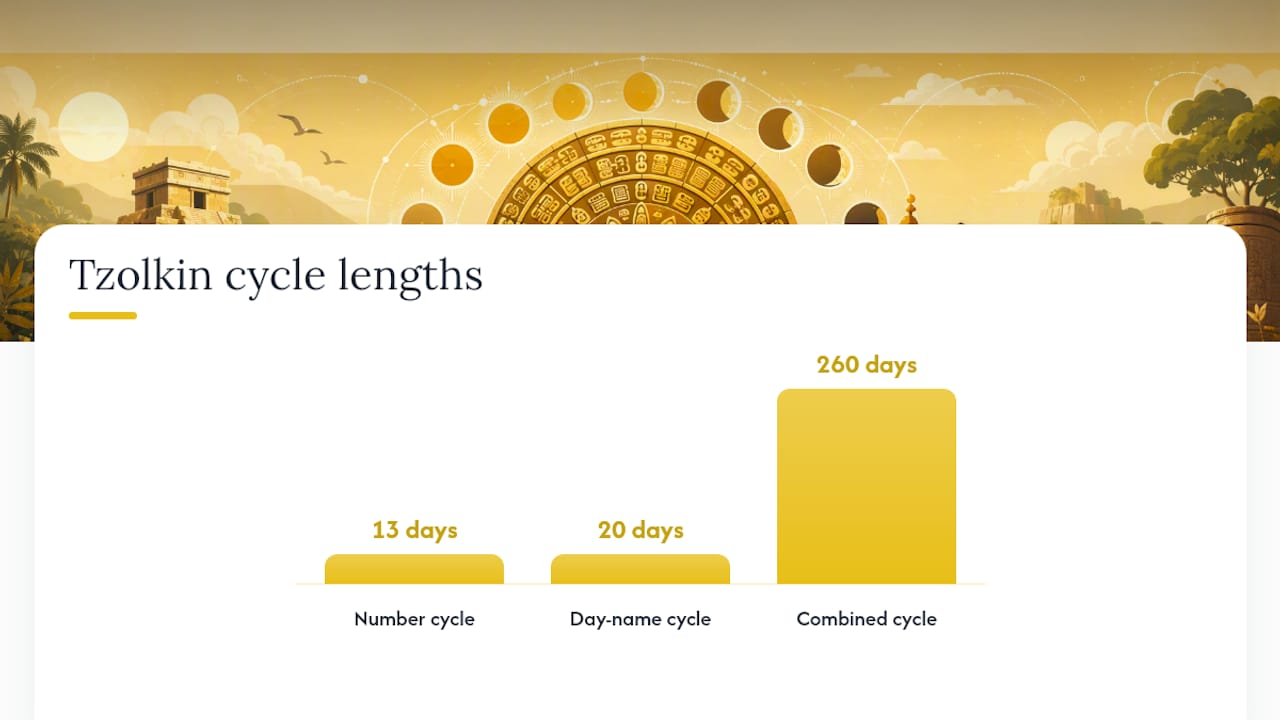
| Cycle | Length | Role in the pairing |
|---|---|---|
| Number cycle | 13 | Adds intensity or stage to the day |
| Day-name cycle | 20 | Provides the fixed identity or archetype |
| Combined cycle | 260 (13 × 20) | Produces the full, non-repeating sacred count |
This is not a coincidence discovered by trial and error; it is the same principle behind why a 12-hour clock and a 7-day week only line up on the same hour and weekday every so many days. The Maya applied that logic deliberately, and Wikipedia’s overview of the Tzolk’in notes that scholars including Anthony Aveni have argued the 260-day length was chosen partly because it interlocks conveniently with lunar, Venus, and agricultural cycles, giving Maya astronomer-priests a flexible common denominator for tracking multiple celestial rhythms at once.
How to Convert a Tzolkin Day to a Gregorian Date
Converting a modern date into its Tzolkin equivalent involves counting forward or backward from a known reference point, called a correlation constant, that links the ancient Long Count to the Gregorian calendar. Most academic sources use the Goodman-Martinez-Thompson (GMT) correlation, which anchors the calendars together and allows every date since to be calculated with consistent math.
Here is the practical logic without diving into the full Long Count formula:
- Pick a birth date or date of interest.
- Count the total number of days elapsed since a known correlation date.
- Divide that day-count by 13 to find the number position, and separately track position within the 20-name sequence.
- The remainder from each division tells you exactly which number and which day-name apply to your chosen date.
Doing this by hand is tedious and error-prone, which is why the Smithsonian’s National Museum of the American Indian built a Maya calendar converter grounded in the GMT correlation, and it remains one of the more trustworthy free tools for verifying a date. If you would rather skip the manual math entirely, Mymayansign’s free Mayan zodiac sign calculator runs the same underlying logic and returns your day-name and tone instantly.
A caveat worth taking seriously: correlation constants are not universally agreed upon. Some regional counts, especially those maintained by different highland Guatemalan communities, can differ by small amounts from the GMT standard due to centuries of independent transmission. Separately, the Dreamspell system popularized in the 1980s uses its own offset calendar entirely disconnected from the traditional count, so a date calculated in Dreamspell will not match a date calculated through GMT or through a living Cholq’ij daykeeper. Always check which system a calculator uses before comparing results across sources.
Pro Tip: When you get a Kin from any online tool, cross-check it against a second, independently built calculator. If both agree, you can trust the result; if they disagree by a day-name or two, one of them is likely running on the Dreamspell offset rather than the traditional correlation.
Where the Tzolkin Fits: Haab, Calendar Round, and the Long Count
The Tzolkin never worked alone. Maya timekeepers ran it side by side with the Haab, a 365-day solar calendar built from 18 months of 20 days plus a short 5-day period considered unlucky or transitional. Where the Tzolkin tracks spiritual quality, the Haab tracked the practical solar year, useful for agriculture, seasonal ritual, and civic scheduling.
Running both calendars simultaneously created a combined date, something like “4 Ajaw 8 Kumk’u,” naming both the Tzolkin position and the Haab position on the same day. Because 260 and 365 share a common factor of 5, the two systems only realign on the exact same combined date every 18,980 days, which works out to 52 Haab years. This 52-year span is the Calendar Round, and it was significant enough in Maya culture that reaching it marked a genuine generational milestone, not unlike a modern golden anniversary.
Each system served a distinct practical purpose:
- Tzolkin: ritual scheduling, divination, naming days, and daykeeper training.
- Haab: solar and agricultural tracking, civic calendar dates, seasonal ceremonies.
- Calendar Round: dating events within a 52-year span, useful for records that did not need to specify which 52-year cycle they belonged to.
- Long Count: a separate, linear day-count system used for monumental inscriptions and historical chronology stretching back thousands of years, solving the ambiguity the Calendar Round could not.
| System | Length | Primary Function |
|---|---|---|
| Tzolkin | 260 days | Ritual and divinatory day-count |
| Haab | 365 days | Solar and agricultural tracking |
| Calendar Round | 18,980 days (52 years) | Combined dating cycle |
The Long Count deserves a brief mention here because it solved a problem neither the Tzolkin nor the Calendar Round could: unambiguous long-range dating. Since the Calendar Round repeats every 52 years, a lone date like “4 Ajaw 8 Kumk’u” could refer to any of dozens of possible years across a monument’s history. The Long Count fixed that by counting days continuously from a fixed mythological starting point, the same system famously (and mistakenly) associated with 2012 doomsday predictions.
Origins and Archaeological Evidence Behind the 260-Day Cycle
No single origin theory for the Tzolkin’s length has won universal acceptance among researchers, and that uncertainty is itself worth understanding rather than glossing over. Four main explanations circulate in the scholarship:
- Numerical or mathematical basis: 13 and 20 were both culturally significant numbers across Mesoamerica (13 layers of the heavens, 20 as a base for counting on fingers and toes), and their product simply became the natural sacred cycle.
- Agricultural or maize-cycle theory: some researchers connect 260 days to the maize growing cycle in parts of Mesoamerica, from planting to harvest.
- Human gestation theory: the average span between a missed period and birth runs close to 260 days, and this correlation shows up repeatedly in ethnographic accounts of naming and midwifery practices.
- Zenith sun passage theory: in certain latitudes near Copán and other southern Maya sites, roughly 260 days separate the sun’s zenith passages, an astronomical coincidence some scholars believe anchored the count originally.
Archaeological evidence for early use is scattered but genuine. The Tzolk’in overview on Wikipedia points to a mural at San Bartolo in Guatemala bearing a “7 Deer” day sign dated to roughly the 3rd century BCE, considered among the earliest unambiguous written examples of the count in use. Earlier possible traces exist in Olmec and Zapotec contexts, but those remain disputed among specialists, since a numeral or glyph fragment alone doesn’t always prove a full 260-day system was already operating.
Scholars including Anthony Aveni have argued that whatever its origin, the 260-day length proved practically valuable because it interlocks cleanly with lunar months, the Venus cycle, and various agricultural intervals, making it a flexible common measure for astronomer-priests tracking several celestial rhythms at once.
That practical flexibility may be the real answer behind the “why 260” question: not one single cause, but a length that happened to work well across several overlapping systems the Maya cared about simultaneously.
Traditional Uses: Daykeepers, Divination, and Living Practice
Long before it became a subject for popular books, the Tzolkin functioned as a working ritual technology, and in parts of highland Guatemala, it still does. The people trained to read it are called Aj K’ij, often translated as daykeepers, and their role blends calendar-keeping with divination, counseling, and ceremonial leadership.
Training to become an Aj K’ij traditionally spans roughly nine months, one full pass through the 260-day count from a particular starting point, after which the novice undergoes a ceremony described as a kind of rebirth into the role. That nine-month training period is not incidental. It deliberately echoes the same gestational length the calendar itself is associated with, reinforcing a symbolic link between calendar mastery and the process of bringing new life into the world.
The gestational connection runs deeper than symbolism. Midwives and community elders in several Maya regions have historically used the 260-day count to estimate due dates and to select auspicious days for naming ceremonies, tying a newborn’s identity to the specific Kin of their birth. This is one of the clearest, most concrete practical applications of the calendar outside of pure ritual scheduling.
The 260-day cycle’s rough alignment with human gestation has shaped naming and midwifery practices in Maya communities, giving the calendar a role that extends well beyond abstract divination into the practical timing of birth and identity.
It matters to draw a clean line here: traditional Aj K’ij practice, maintained continuously within specific highland Guatemalan communities, is not the same thing as the popular spiritual movements that later borrowed Tzolkin terminology. The living Cholq’ij tradition involves community accountability, oral transmission from established daykeepers, and specific ceremonial protocols that outside practitioners, including publishers like Mymayansign, do not claim to replicate. Educational content about the calendar’s structure and meanings is a different category of engagement than initiation into community daykeeper practice, and readers who want deeper ethnographic grounding should look to museum resources and community-published accounts rather than treat any single website as the final word on living tradition.
Common Misconceptions and Modern Adaptations Like Dreamspell
A few myths about the Tzolkin persist widely enough that they deserve direct correction.
- Myth: the Tzolkin is a solar calendar. Fact: it tracks a sacred, non-astronomical cycle of days; the Haab is the solar calendar. The Living Maya Time project is explicit that the Tzolkin does not function as an astronomical or seasonal tracking tool.
- Myth: Dreamspell is the traditional Maya count. Fact: Dreamspell is a 20th-century system created by José Argüelles, disconnected from the correlation used by living daykeepers and from academic GMT calculations. It uses its own starting point and a 13-moon framing that has no basis in pre-Columbian practice.
- Myth: a Tzolkin reading predicts a fixed, unchangeable destiny. Fact: traditional daykeepers generally treat a Kin as describing tendencies and spiritual character, a lens for understanding a day or a birth, not a deterministic script.
- Myth: all modern Tzolkin content reflects the same tradition. Fact: sources vary enormously in fidelity to community-maintained practice. Some popularizations simplify or reinterpret meanings freely, which is fine for educational or reflective use but shouldn’t be mistaken for the ethnographic record.
Argüelles’ Dreamspell deserves specific mention because it remains the most widespread source of confusion. It introduced the now-popular “13 moon” calendar and reassigned day-name and tone pairings using a different starting correlation than the traditional count. Museum and academic resources consistently treat Dreamspell as a distinct modern spiritual movement rather than a continuation of Maya tradition, and readers who want the community-maintained version should look toward ethnographic and museum sources like the Smithsonian’s Living Maya Time project rather than 13-moon calendar products.
How a Personalized Mayan Astrology Reading Maps Your Birth Date
Turning a birth date into a full Tzolkin-based reading follows a consistent sequence, whether you are doing it manually with a reference table or using a digital tool built for the purpose.
- Input the birth date. The starting point is always a standard Gregorian date, month, day, and year.
- Calculate the Kin. The date gets converted using a correlation constant into its Tzolkin position, producing a specific number and day-name pairing, such as 9 Kawak.
- Identify the trecena. The Kin falls within one of twenty 13-day trecenas, which adds a broader thematic layer beyond the single day.
- Layer in supporting structures. Some interpretive traditions add further context, like wavespell groupings (used in Dreamspell-adjacent frameworks) or Tree of Life placements (a structure Mymayansign uses in its own reports to connect a Kin to broader symbolic themes).
- Generate the interpretation. The final reading combines the day-name’s core meaning, the tone’s modifying quality, and any additional interpretive framework the platform applies.
It matters to be transparent about where tradition ends and interpretation begins. The day-name and tone meanings themselves come from documented Maya cosmology and ethnographic sources. What a platform adds on top, whether that’s personality-style write-ups, compatibility angles, or a Tree of Life narrative, is a publisher’s interpretive framework layered onto that traditional foundation, not a claim to replicate daykeeper ceremony. Mymayansign’s Mayan astrology overview explains this layering directly, and a paid report typically expands the bare Kin into a fuller narrative covering personality tendencies, compatibility notes, and life-path themes drawn from that same structural base.
If you are curious what your own Kin looks like before committing to a full report, Mymayansign’s calculator gives you the day-name and tone free of charge, a useful starting point before deciding whether a deeper reading is worth exploring.
Three Worked Examples: Sample Kins and What They Reveal
Seeing the math applied to real dates makes the whole system click faster than any abstract explanation.
- A birth date landing on 1 Imix. The number 1 (initiating) pairs with Imix (nurturing origin). A person with this Kin, in traditional interpretive terms, is often described as carrying strong foundational or maternal energy, someone whose life themes circle back repeatedly to beginnings and care for others.
- A birth date landing on 7 Aj (B’en). The number 7 (attuning, reflective) pairs with the reed day-name associated with home and authority. This suggests an introspective relationship to leadership, someone who governs or guides through quiet reflection rather than force.
- A birth date landing on 13 Ben. The transcendent, completion-oriented number 13 paired again with B’en emphasizes closure and culmination within a leadership theme, often read as someone who finishes what earlier Ben-influenced cycles started.
Notice how the same day-name, B’en, produces two meaningfully different readings depending purely on the tone attached to it. That is the entire interpretive engine of the Tzolkin in miniature: fixed identity, variable intensity. Mymayansign’s daily Tzolkin lookup is a solid way to see this pairing shift in real time, since the day-name and tone change together every single day of the year.
Before trusting any interpretation drawn from these examples, or your own birth date, run the date through at least one independent source, whether that’s the Smithsonian’s converter or Mymayansign’s own calculator, to confirm the Kin matches across tools.
Why the Tzolkin Still Matters Beyond Its Mathematics
The Tzolkin survives not because it predicted anything with scientific precision, but because it gave people a repeatable, shareable language for talking about the character of time itself. That is a genuinely rare accomplishment for any calendar system, ancient or modern. Most of what we inherited from antiquity around timekeeping is purely mechanical: track the sun, track the moon, mark the season. The Tzolkin tried to do something more ambitious, assigning texture and meaning to individual days in a structured, learnable way.
What gets lost in a lot of casual online content is the distinction between engaging with the Tzolkin as an educational or reflective tool and claiming lineage to the living daykeeper tradition still practiced in Guatemala. You can appreciate the structure, learn the day-names, and use a Kin as a lens for self-reflection without pretending that makes you an Aj K’ij. Respecting that boundary is not a limitation on curiosity; it is what keeps the tradition intact for the communities who still carry it forward.
Pro Tip: Before adopting any Tzolkin-based practice into your own routine, spend time with museum ethnographic resources or community-published accounts of Cholq’ij practice. It deepens your understanding and keeps the living tradition properly credited rather than flattened into a generic wellness trend.
Educational tools that explain the structure clearly, without overstating their authority to speak for the tradition, serve a real purpose here. They give curious people a doorway into genuinely old knowledge, provided they are honest about which parts are ancestral and which parts are interpretive layering added for a modern audience.
Get Your Own Kin: Free Calculator and Personalized Readings
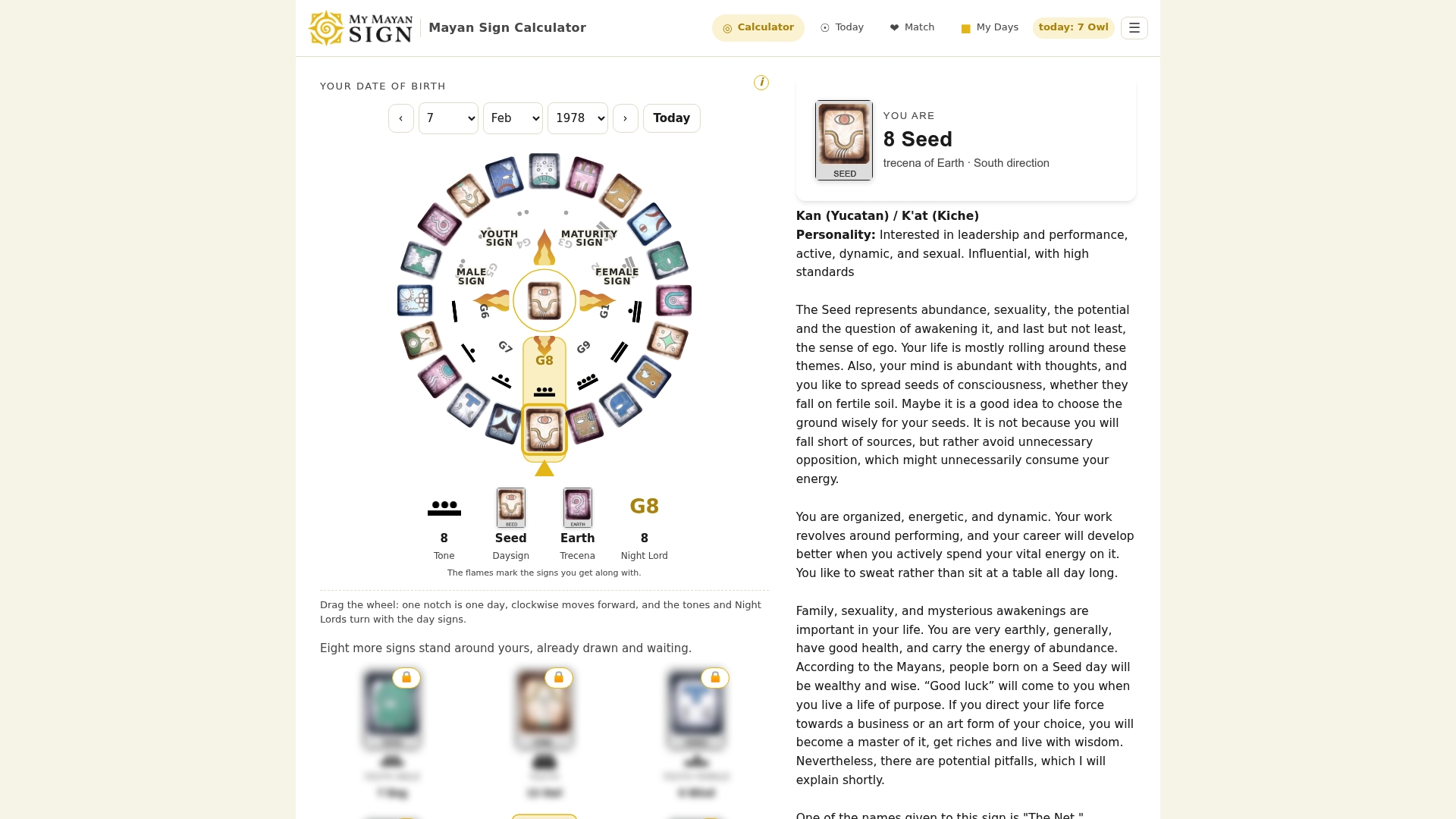
Reading about the Tzolkin in the abstract is one thing. Seeing your own day-name and tone, and understanding what they mean specifically for you, is a different experience entirely. Mymayansign gives you that entry point without requiring you to learn correlation math or track down a museum converter yourself.
A few ways to go deeper once you know your Kin:
- Run your birth date through the free Mayan zodiac sign calculator to instantly get your day-name and tone.
- Explore your Galactic Tone in detail if you want a fuller breakdown of how your specific number shapes your day-to-day energy.
- Subscribe to Daily Mayan Wisdom if you’d rather receive the day’s Kin and its meaning automatically rather than looking it up yourself.
If your birth date reveals a Kin that intrigues you, a full personalized report expands beyond the bare day-name and tone into compatibility notes, life-path themes, and your placement within the broader Tree of Life structure Mymayansign uses to connect ancient meaning to your specific chart. Start with the free calculator, see what your Kin actually says, and decide from there whether the deeper reading is worth your time.
Sources
- The Calendar System | Living Maya Time
- Tzolkin | Britannica
- TZOLKIN Definition & Meaning – Merriam-Webster
- Tzolkʼin — Wikipedia
For ethnographic depth beyond these academic and museum resources, seek out community-published accounts from active Aj K’ij daykeepers, whose living practice remains the most authoritative voice on how the Tzolkin is actually used today.
Recommended
- Tzolkin Birthday – MyMayanSign
- Mayan Astrology Blog | Day Signs, Tzolkin & Calendar
- Your Mayan Birthday Calendar: Find Your Maya Day Sign
- Mayan Calendar Today: Today’s Tzolkin Day Sign, Tone & Meaning