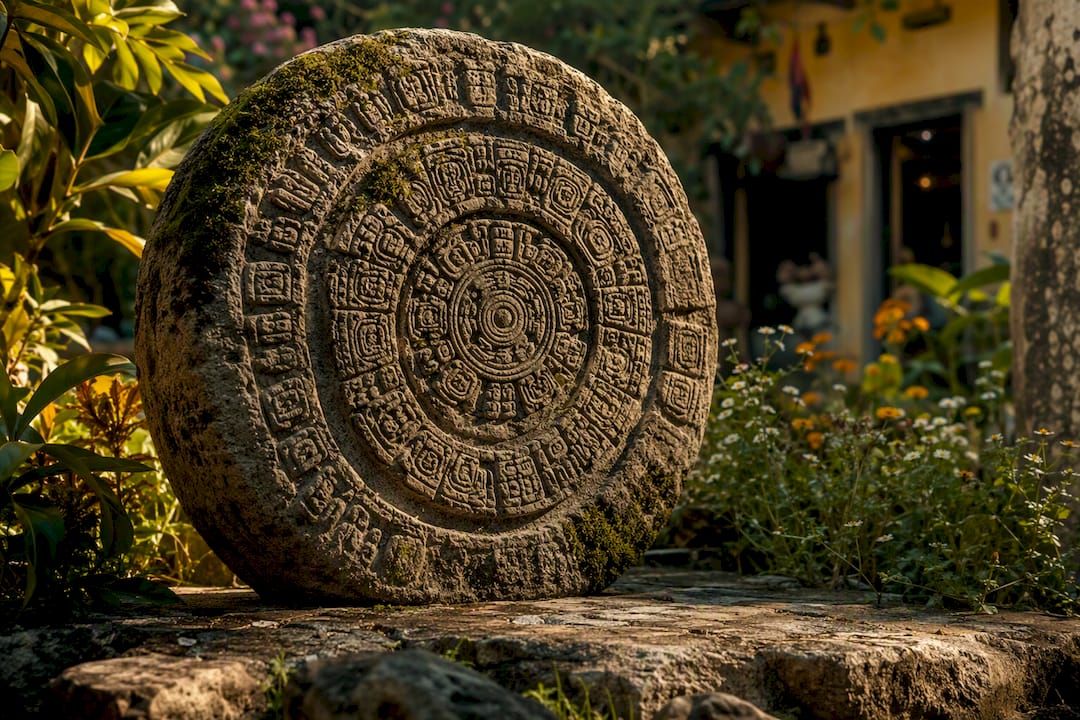
The Long Count is an absolute day-counting system that records the number of days elapsed since a fixed mythical creation date, generally correlated to August 11, 3114 BCE under the Goodman–Martinez–Thompson correlation. Unlike a repeating calendar that cycles back to day one, the Long Count simply keeps climbing. It never resets on its own.
Here’s what you need to know before we go deeper:
- Structure: a modified vigesimal (base-20) system with one built-in exception
- Units: Kin (1 day), Winal (20 days), Tun (360 days), Katun (7,200 days), Baktun (144,000 days)
- The famous cycle: 13 Baktuns equal 1,872,000 days, or roughly 5,125 years, a span that closed on December 21, 2012
- The correlation: GMT, short for Goodman, Martinez, and Thompson, the three scholars whose work anchors Long Count math to our Gregorian calendar
You’ll find worked math, inscription examples from Palenque and Coba, and a full myth-debunking of the 2012 story later in this piece. First, let’s understand where this counting system came from and why the Maya needed it at all.
Key Takeaways
The Long Count converts to a Gregorian date by totaling its component days and adding the GMT correlation constant of 584,283, a method verifiable against paired Calendar Round dates.
| Point | Details |
|---|---|
| Absolute, not cyclical | The Long Count counts forward from creation and never resets, unlike the Tzolk’in or Haab. |
| Modified vigesimal math | Every unit multiplies by 20 except the Tun, which uses 18 Winals to approximate a solar year. |
| GMT correlation anchors dates | Adding 584,283 to a Long Count’s total days yields a Julian Day Number for Gregorian conversion. |
| 2012 was a rollover, not an ending | The 13-Baktun cycle closed on December 21, 2012, but inscriptions confirm counting continued. |
| Modern tools build on ancient math | Mymayansign’s calculators use the same Tzolk’in cycle logic to generate personal Mayan sign readings. |
Table of Contents
- What Is the Long Count, and Where Did It Come From?
- How Does the Long Count Work? Units and Place-Value
- How Are Long Count Dates Written on Monuments?
- How Do You Convert a Long Count Date to a Gregorian Date?
- How Does the Long Count Connect to the Tzolk’in and Haab?
- What Do Real Maya Inscriptions Look Like?
- What Are the Higher-Order Units Beyond the Baktun?
- Did the Long Count Predict the End of the World in 2012?
- Why Does the Long Count Still Matter Today?
- How Does the Long Count Relate to Mayan Astrology Today?
- Explore Your Own Place in the Maya Calendar
- Frequently Asked Questions
- Sources
What Is the Long Count, and Where Did It Come From?
Long before anyone carved a Long Count date into limestone, Mesoamerican societies were already tracking time with two interlocking cycles: the 260-day Tzolk’in and the 365-day Haab. Both are beautiful, rhythmic systems. Both are also cyclical, meaning a date like “4 Ajaw 8 Kumk’u” recurs every 52 years. That repetition creates a problem if you’re a scribe trying to record exactly when something happened in a way that won’t be confused with an event from two generations earlier.
The Long Count solved that problem by counting forward, day by day, from a single starting point. Think of it less like a wall calendar and more like an odometer. It doesn’t reset when the year changes. It just keeps rolling, giving every day in Maya history a unique, unrepeated address.
This mattered enormously to Classic Period rulers. A king who wanted to legitimize his reign didn’t just say “I was born in such-and-such year.” He tied his birth, his accession, his military victories, all of it, directly back to the mythical creation event itself, sometimes across thousands of years of accumulated days. That’s not calendar-keeping for its own sake. That’s political theater carved in stone, meant to say: my authority reaches back to the beginning of time itself.
The Smithsonian’s Living Maya Time project frames the Long Count’s core function plainly: it exists to place a specific day in an unbroken, linear sequence stretching from a fixed starting point, rather than to mark a repeating season or ritual cycle.
The accepted starting point sits at August 11, 3114 BCE in the proleptic Gregorian calendar, a date scholars reached through the GMT correlation, named for researchers Joseph Goodman, Juan Martinez Hernández, and J. Eric S. Thompson. Their combined work, built over decades of cross-referencing colonial-era documents, astronomical records, and inscriptions, remains the dominant correlation used by archaeologists and epigraphers today, though it isn’t the only one ever proposed.
A rough timeline helps place all this in context:
- Preclassic period: early Long Count style dates appear on monuments in the Isthmus region, predating the Classic Maya heartland
- Classic Period (roughly 250 to 900 CE): the Long Count reaches its peak use, appearing on stelae across dozens of city-states
- Postclassic decline: full five-place Long Count notation becomes rare, replaced in some regions by an abbreviated “Short Count” tracking only Katuns
- Colonial and modern scholarship: researchers reconstruct the system from surviving codices, inscriptions, and ethnohistoric sources
That shift toward the Short Count is worth pausing on, since it often confuses newcomers comparing Long Count vs Short Count systems. The Short Count doesn’t replace the Long Count’s math. It just drops precision, tracking only which Katun a date falls in rather than pinning down the exact day. It’s the difference between saying “sometime in the 1990s” versus giving a full date, month, and year.
How Does the Long Count Work? Units and Place-Value
The Long Count reads almost like an odometer with five wheels, each one representing a different unit of time, and each wheel triggering the next when it rolls over. Here’s the breakdown, in order from smallest to largest:
- Kin = 1 day
- Winal = 20 Kins = 20 days
- Tun = 18 Winals = 360 days
- Katun = 20 Tuns = 7,200 days
- Baktun = 20 Katuns = 144,000 days
Notice something odd in step three. Every other jump multiplies by 20, but the Tun only needs 18 Winals to complete. That’s not a scribal error. It’s a deliberate design choice. Twenty Winals would give you 400 days, drifting far from the actual solar year. Eighteen Winals gives you 360 days, a number far closer to the 365.24-day year and one that made agricultural and ritual planning much more practical. Scholars researching the calendar’s mechanics at the Smithsonian describe this as an intentional correction, a fusion of pure base-20 math with real astronomical observation.
That single exception is why the Long Count is called a modified vigesimal system rather than a pure base-20 one. Every position multiplies by 20 except the jump from Winal to Tun, which multiplies by 18. Once you know that one quirk, the rest of the arithmetic is refreshingly consistent.
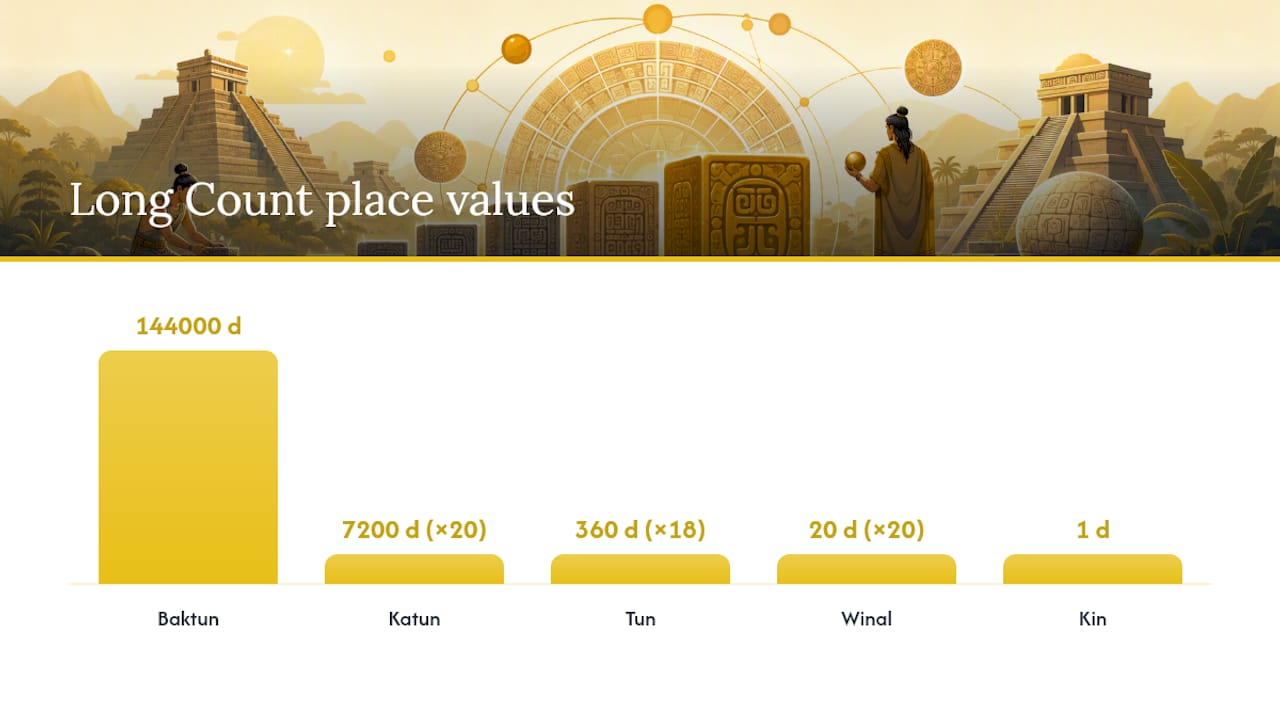
Here’s the reference table you’ll want to bookmark:
A Long Count date is always written as five numbers separated by periods, in the order Baktun.Katun.Tun.Winal.Kin. So a date like 9.13.10.0.0 breaks down like this:
- Multiply each unit by its day value: 9 Baktuns × 144,000, plus 13 Katuns × 7,200, plus 10 Tuns × 360, plus 0 Winals × 20, plus 0 Kins × 1
- That gives you 1,296,000 + 93,600 + 3,600 + 0 + 0
- Add those together for a running total of 1,393,200 days since the creation date
That total day count is the real backbone of the whole system. Everything else, the notation, the inscriptions, the Gregorian conversion, builds from that single number.
How Are Long Count Dates Written on Monuments?
Maya scribes didn’t write numbers the way we do. Instead of digits like 0 through 9, they used a compact visual system: a dot represented one, a bar represented five, and a stylized shell shape represented zero. Stack these symbols and you can represent any number from zero through nineteen in a single glyph block, which is exactly what each of the five Long Count positions needed.
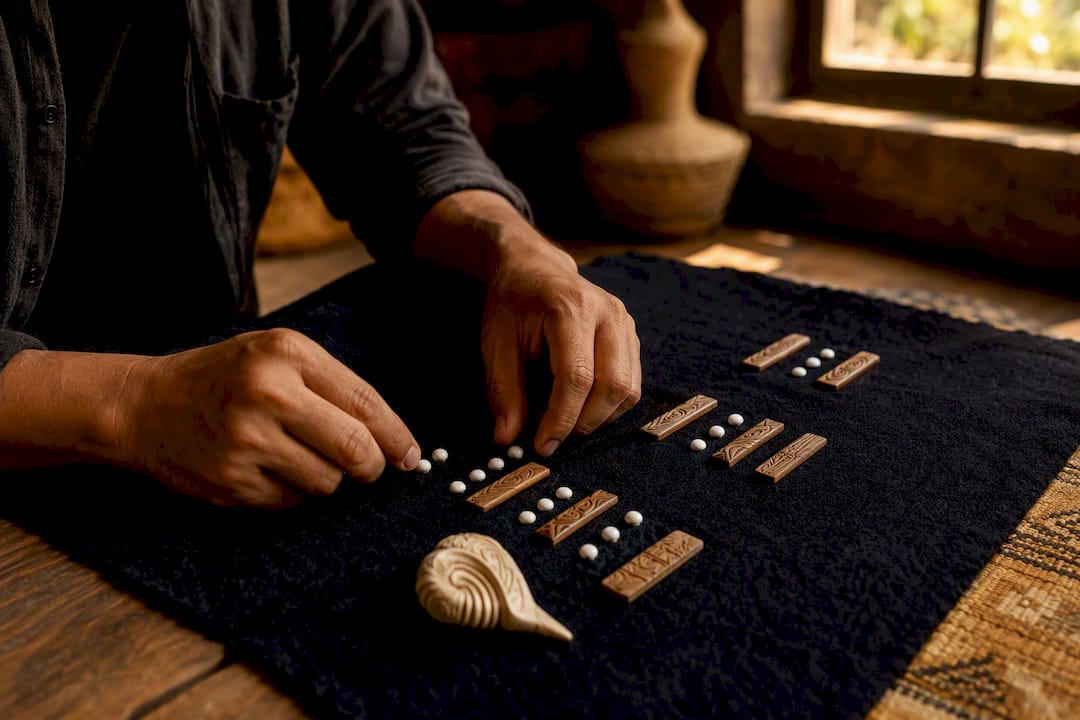
That shell zero deserves its own moment of appreciation. Positional zero as a placeholder is one of history’s great mathematical inventions, and the Maya were using it centuries before it appeared in European mathematics, a point well documented in the historical record. Without a true zero, you can’t cleanly represent “zero Winals” in a date like 9.13.10.0.0. The shell made that possible.
On an actual stela or stone monument, a Long Count date rarely stands alone. It typically opens with the Introductory Series Initial Glyph, often abbreviated ISIG, a large, ornate glyph block that signals “a Long Count date follows” and often names the patron deity associated with that particular month position. After the ISIG comes the five-digit Long Count itself, read top to bottom or left to right depending on the monument’s layout, followed by the Calendar Round date and, on more detailed inscriptions, a supplementary series carrying lunar data, such as which lunation of the current cycle the date falls within.
If you’re trying to read a glyphic date yourself, here’s a practical sequence to follow:
- Look for the large ISIG block first, usually distinct in size from the rest of the text
- Read the five numeral blocks that follow, largest unit (Baktun) to smallest (Kin)
- Identify the trailing Calendar Round glyphs, a day sign paired with a month glyph
- Check for a supplementary series if the inscription is lengthy, often containing lunar age data
Pro Tip: Don’t assume every large glyph block near a date is part of the Long Count itself. Some are name glyphs for the ruler or deity being referenced. If a block doesn’t fit the expected numeral pattern of dots, bars, or the shell zero, it’s probably not part of the count.
How Do You Convert a Long Count Date to a Gregorian Date?
Converting a Long Count date starts with the same total-days calculation you just learned, then adds a fixed constant to bridge Maya day-counting to the Julian Day Number system astronomers and historians use to compare calendars across cultures. The GMT correlation sets that constant at 584,283 days, a figure derived from decades of cross-checking Long Count inscriptions against colonial-era Maya and Spanish records.
Here’s the process broken into clear steps:
- Calculate the total day count for your Long Count date, exactly as shown in the previous section
- Add the GMT correlation constant (584,283) to that total, giving you a Julian Day Number
- Convert the Julian Day Number to a Gregorian calendar date using a standard Julian Day conversion method or table
- Cross-check with the Calendar Round, if the inscription provides one, since a Tzolk’in and Haab pairing should match your converted date and catch arithmetic errors
Let’s walk through a full worked example using 9.13.10.0.0, the date we broke down earlier.
We already calculated the total days: 1,393,200. Add the GMT constant of 584,283, and you get a Julian Day Number of 1,977,483. Running that Julian Day Number through a standard conversion table lands on a date in the year 702 CE, in the Gregorian calendar, placing this date firmly in the heart of the Classic Period, a time when cities like Palenque and Tikal were near their political peak.
A note on precision here matters. Scholars distinguish between the Julian calendar and the proleptic Gregorian calendar when discussing dates this far back, since the Gregorian calendar wasn’t adopted in Europe until 1582. Most modern Maya scholarship uses the proleptic Gregorian system, projecting our current calendar backward, which is why you’ll sometimes see the creation date written as August 11, 3114 BCE rather than in Julian calendar terms.
It’s also worth knowing that GMT isn’t the only correlation ever proposed. A small number of researchers have argued for alternate constants, including versions that shift the result by two days. These debates rarely change the broader historical picture, but they explain why you might occasionally see a Long Count conversion land a day or two off from another source. When the stakes are academic precision rather than casual reading, checking which correlation a source uses is worth the extra step.
How Does the Long Count Connect to the Tzolk’in and Haab?
A Long Count date almost never appears alone on a monument. It’s nearly always paired with a Calendar Round date, the combined output of the 260-day Tzolk’in and the 365-day Haab running together. Multiply those two cycle lengths out, accounting for their shared factors, and you get a repeat interval of 18,980 days, or about 52 years. That’s the length of a full Calendar Round, the point at which both cycles return to the same combined position simultaneously.
Here’s why that pairing matters practically, not just ceremonially. A Calendar Round date by itself is ambiguous. A day like “4 Ajaw 8 Kumk’u” recurs every 52 years, so on its own it can’t tell you which occurrence of that date a scribe meant. The Long Count removes that ambiguity entirely, while the Calendar Round adds ritual and seasonal context the Long Count alone doesn’t carry.
This is also how modern scholars catch conversion errors. If you calculate a Long Count date’s Gregorian equivalent, you can independently verify it by checking whether the corresponding Tzolk’in and Haab positions match what’s actually carved on the monument. A mismatch flags a math error somewhere in the chain.
The verification process generally follows this pattern:
- Convert the Long Count date to a total day count, as shown earlier
- Determine the Tzolk’in position by finding the remainder when dividing by 260
- Determine the Haab position by finding the remainder when dividing by 365
- Compare both results against the Calendar Round glyphs on the object
- Long Count alone: gives an unambiguous, absolute day count
- Calendar Round alone: repeats every 52 years, useful for ritual timing but ambiguous historically
- Both together: combination used to confirm a reading is correct
What Do Real Maya Inscriptions Look Like?
Theory is one thing. Standing in front of an actual carved monument is another entirely, and a handful of sites make the Long Count’s real-world use vivid.
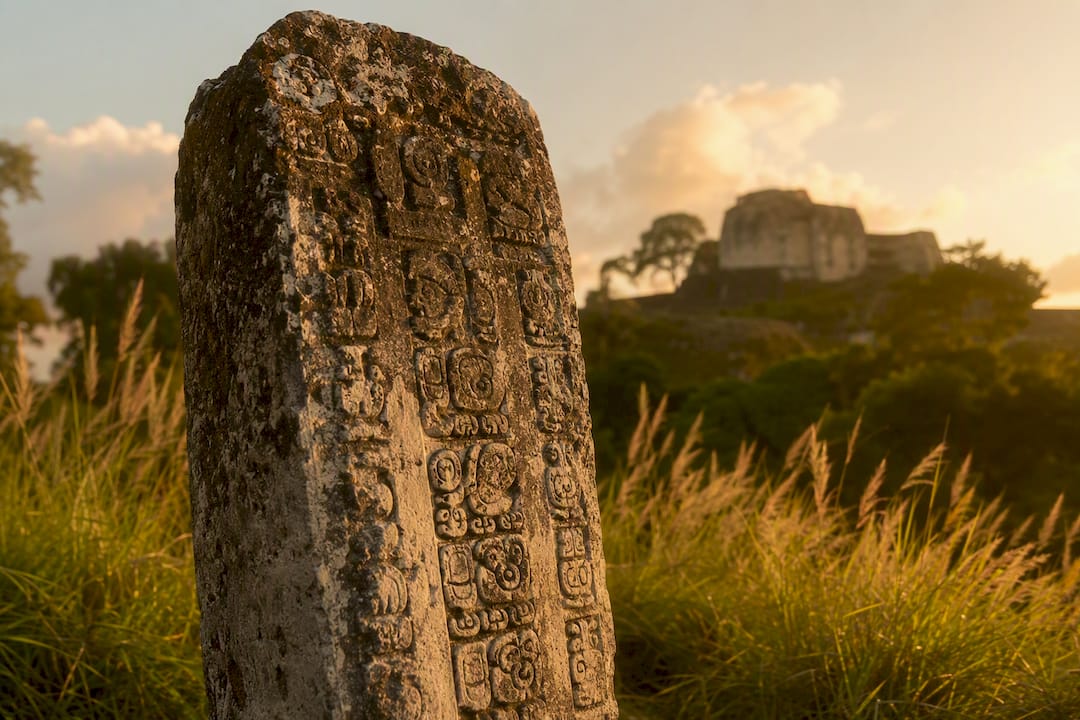
At Palenque, the Temple of the Inscriptions houses one of the most celebrated Long Count monuments in the Maya world, a text closely tied to the ruler K’inich Janaab’ Pakal. The temple’s hieroglyphic panels use the full ISIG-plus-five-digit format, anchoring Pakal’s reign, death, and burial to specific, calculable days rather than vague seasonal references.
Quiriguá, in present-day Guatemala, is famous for Stela E, one of the tallest carved stone monuments in the Maya region, packed with Long Count and Calendar Round data commemorating the accession of a local ruler. Coba, meanwhile, produced some of the most mathematically extreme inscriptions known, stone texts that push numeral strings far beyond a single Baktun, numbers so large they’ve fueled ongoing scholarly discussion about how literally to read them.
Commentary on these extended numeral strings from Plus notes that inscriptions at sites like Coba and Yaxchilan contain repeated sequences of the number 13, strings so long that specialists actively debate whether they represent literal counts or symbolic, almost ceremonial, expressions of vastness.
A few things to watch for if you ever study these inscriptions directly:
- The ISIG almost always appears first, larger and more elaborate than surrounding glyphs
- Ruler names and titles often sit adjacent to the date, not embedded within it
- Supplementary lunar series appear more often on longer, more detailed monument texts
- Weathering and breakage on stone monuments sometimes force scholars to reconstruct missing digits from context
What Are the Higher-Order Units Beyond the Baktun?
Baktun isn’t actually where Maya numeral vocabulary stops. Scribes had names and values for periods far larger, units that rarely appear in everyday inscriptions but show up in a handful of monuments attempting to express truly vast spans of time.
Some inscriptions, particularly at Coba, feature strings preceded by long runs of the number 13, a pattern that has generated the idea of a “Grand Long Count,” a reckoning that stretches conceptually far beyond the familiar 13-Baktun cycle most people know. Whether these strings were meant as literal chronological statements or as symbolic gestures toward cosmic vastness remains an open question among specialists, and that ambiguity is part of the ongoing scholarly conversation rather than a settled fact.
- Higher-order units always multiply the previous unit by 20, with no exceptions like the Tun’s 18. These units appear almost exclusively on monuments attempting to express extraordinarily long timeframes, and their rarity is part of why they’re debated.
Did the Long Count Predict the End of the World in 2012?
No, and the inscriptions themselves say so. December 21, 2012 marked the completion of a 13-Baktun cycle, the moment the Long Count reached 13.0.0.0.0, a span of 1,872,000 days, roughly 5,125 years, since the mythical creation date. That’s a real, calculable milestone. It is not, however, evidence of an ending.
Several inscriptions reference dates that fall well beyond 13.0.0.0.0, some using Piktun notation to describe events thousands of years in the future from a Classic Period scribe’s perspective. If the Maya had believed time simply stopped at the close of the 13th Baktun, they wouldn’t have bothered carving references to what comes after it.
Scholars generally frame Maya timekeeping as cyclical and continuous rather than apocalyptic, a reading reinforced by specialist commentary from archaeologists studying the calendar system directly. The 13-Baktun completion likely carried ceremonial weight, comparable to how a millennium rollover feels significant to us, without carrying any built-in prophecy of destruction.
- 13.0.0.0.0 completed on December 21, 2012, under the GMT correlation
- Inscriptions referencing higher-order units imply the count was expected to continue
- The “end of the world” reading is a modern media narrative, not an ancient Maya one
Pro Tip: A quick way to spot a sensationalized 2012 account versus a scholarly one: sensationalized sources treat 13.0.0.0.0 as a finish line, while scholarly sources treat it as a rollover, closer in spirit to an odometer hitting 100,000 than to a countdown reaching zero.
Why Does the Long Count Still Matter Today?
Beyond the mechanics, the Long Count carried real political and intellectual weight in the ancient world, and it still shapes how historians reconstruct Mesoamerican chronology today.
Politically, tying a ruler’s accession or military victory to an exact, calculable day since creation was a powerful legitimizing move, one that placed a living king’s authority within an unbroken cosmic timeline rather than isolated, recent history. Historically, that same precision is a gift to modern archaeology. Because the Long Count is absolute rather than cyclical, researchers can pin events at different city-states to the same fixed timeline and build accurate chronologies across centuries, something the repeating Tzolk’in and Haab alone couldn’t do.
Mathematically, the system reflects genuinely sophisticated thinking, a positional place-value structure with a working zero, built centuries before similar concepts took hold elsewhere.
As the Smithsonian’s Living Maya Time project frames it, the calendar’s design reflects a fusion of political function and careful astronomical correction, not simple record-keeping for its own sake.
- Political function: anchoring rulers to deep, cosmic time
- Historical function: enabling absolute cross-site chronology
- Mathematical function: demonstrating an early, working positional zero
How Does the Long Count Relate to Mayan Astrology Today?
The Long Count’s absolute dates don’t just matter to archaeologists. They’re also the backbone that lets modern Mayan astrology tools calculate a personal Tzolk’in day sign or Galactic Tone from any Gregorian birth date. If you know exactly how many days have elapsed since the mythical creation date, you can work forward or backward to find where any given day falls within the 260-day Tzolk’in cycle, which is precisely the calculation behind a personal Mayan sign reading.
It’s worth being clear about the distinction here. Archaeologists use Long Count mechanics to date ancient monuments and reconstruct history. Contemporary spiritual and astrological applications use those same underlying cycles, the Tzolk’in especially, for personal reflection and cultural connection rather than historical dating. Both are legitimate, but they answer different questions.
Say you wanted to know your own Tzolk’in day sign. The math starts the same way an epigrapher would approach an inscription: convert your birth date to a day count, then find its position within the 260-day cycle. Tools like Mymayansign’s calculator automate that process, drawing on the same calendar mechanics this article just walked through.
- Long Count math provides the absolute day-count foundation these tools rely on
- The Tzolk’in cycle, layered on top, produces your personal day sign and Galactic Tone
- Historical scholarship and modern spiritual practice both draw from the same calendar roots, applied to different purposes
Pro Tip: If you want to see this connection firsthand, try tracing your own birth date through the Tzolk’in birthday calculation and notice how the same 260-day rhythm that governed royal inscriptions now maps onto a personal reading.
A Personal Note on Why This Topic Sticks With Me
Working through Long Count mechanics changes how you see those glyph-covered stelae in museum photographs. What looked like decoration turns out to be precise, verifiable math, carved by people solving a problem, how to record time without ambiguity, centuries before anyone else attempted it at that scale. I find that more compelling than any mystical reading of 2012 ever was. If this piece sparked your curiosity, Mymayansign’s blog has more on how these ancient cycles connect to modern practice.
Explore Your Own Place in the Maya Calendar
Reading a stela’s Long Count date takes patience and a working knowledge of base-20 math. Finding your own connection to these same calendar cycles doesn’t have to take nearly as long. Mymayansign built its tools specifically so you don’t need to calculate Julian Day Numbers or cross-check Calendar Round glyphs to discover where your birth date falls within the Tzolk’in and Haab traditions this article just explained.
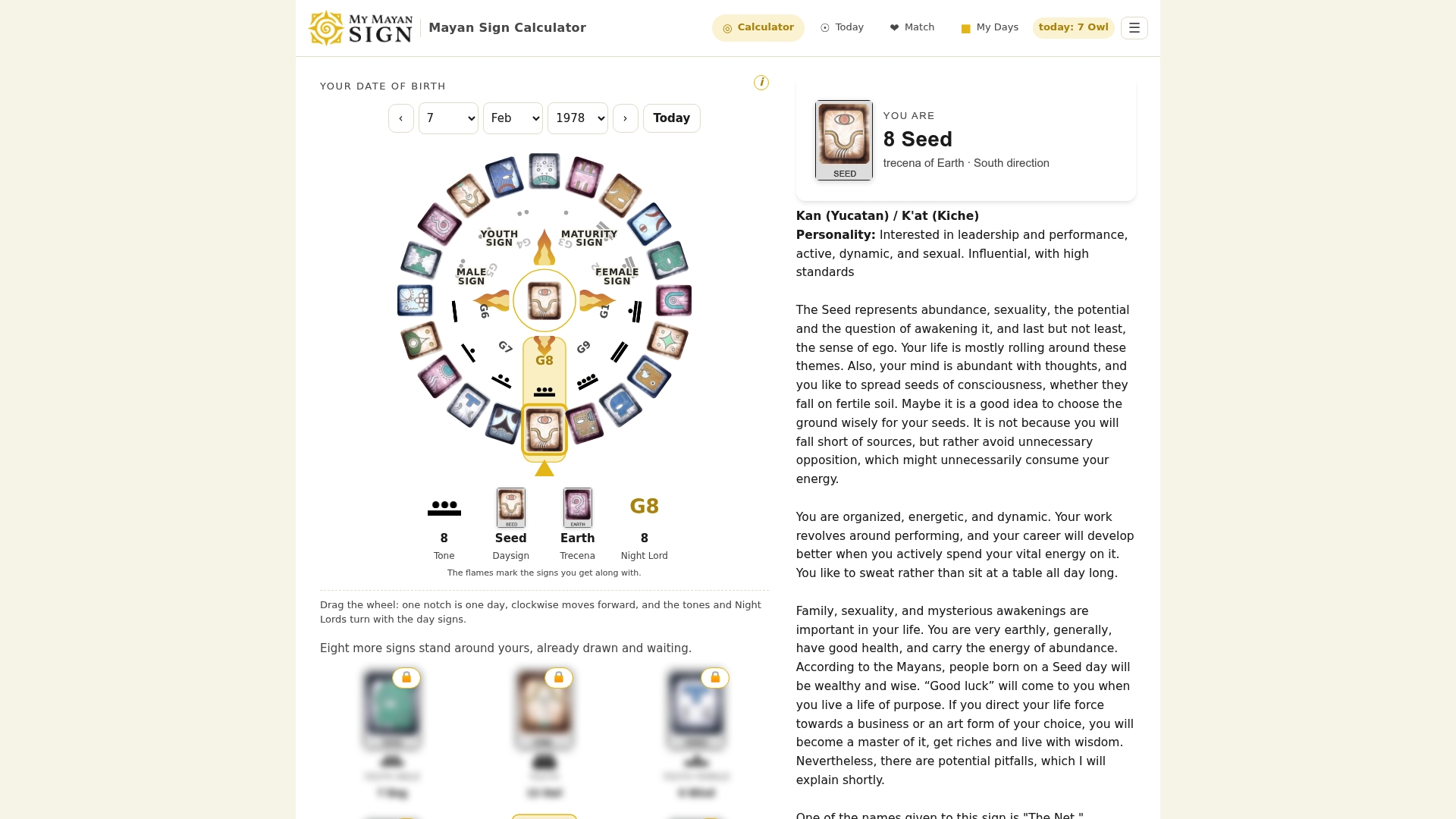
The site’s free calculator gives you a fast starting point: enter your birth date and see your Mayan zodiac sign instantly. From there, Mymayansign offers deeper, personalized paid reports covering your Galactic Tone, your Tree of Life, and compatibility readings, all built on the same calendar mechanics that Classic Period scribes once carved into limestone. These modern tools are spiritual and interpretive resources, distinct from the archaeological scholarship covered above, and they’re meant for self-discovery rather than historical research. If you’re curious what your own day sign reveals, find your Mayan sign now and see how these ancient cycles map onto your own life.
Frequently Asked Questions
What is the Long Count in simple terms?
The Long Count is a day-counting system that tracks the number of days since a fixed mythical creation date, generally placed at August 11, 3114 BCE, rather than cycling repeatedly like a standard calendar year.
How does the Long Count differ from the Tzolk’in?
The Tzolk’in is a repeating 260-day ritual cycle, while the Long Count is absolute and never repeats, giving every day since creation a unique numerical address across Baktuns, Katuns, Tuns, Winals, and Kins.
What does GMT correlation mean?
GMT stands for Goodman, Martinez, and Thompson, the researchers whose combined work established the correlation constant of 584,283 days used to convert Long Count dates into the Gregorian calendar.
Why is the Tun 360 days instead of 400?
The Tun uses 18 Winals rather than 20 specifically to approximate the 365-day solar year more closely, a deliberate adjustment to an otherwise pure base-20 system.
Did the Maya believe the world would end in 2012?
No. December 21, 2012 marked the completion of a 13-Baktun cycle, and inscriptions referencing dates beyond that point show the Maya expected time to continue, not stop.
What is the difference between Long Count and Short Count?
The Long Count records a full five-digit date pinpointing an exact day, while the Short Count, used more in the Postclassic period, tracks only the current Katun, offering less precision.
Can I convert a Long Count date myself?
Yes. Multiply each unit by its day value, sum the totals, add the GMT correlation constant of 584,283, and convert the resulting Julian Day Number to a Gregorian date, ideally cross-checked against any paired Calendar Round.
Sources
For readers who want to go deeper into the primary scholarship behind this piece:
- The Calendar System | Living Maya Time (Smithsonian NMAI)
- Plus
- Mesoamerican Long Count calendar (Wikipedia)
Readers pursuing alternate correlation theories or deeper epigraphic debate will find these sources cite the primary academic disagreements directly, rather than repeating secondhand summaries.
Recommended
- Mayan Astrology Blog | Day Signs, Tzolkin & Calendar
- Day Out of Time Meaning: What It Is and How to Observe
- Your Mayan Birthday Calendar: Find Your Maya Day Sign
- My Important Days – MyMayanSign