Mayan astrology maps the energy of the day you were born using the 260-day Tzolkin calendar, a sacred count built from 20 day signs and 13 tones. Your birth date, not your birth time, is all you need. The fastest way in is a Mayan zodiac sign calculator, which converts your date into your day sign and tone in seconds.
TL;DR:
- Your Mayan day sign and tone are calculated solely based on your birth date, requiring roughly thirty seconds and no precise birth time.
- The 260-day Tzolkin cycle generates 260 unique combinations of signs and tones, with no repeats within that period, reflecting natural and cosmic patterns.
- Your specific sign and tone provide a personal energetic prompt, but they are not predictive of fixed traits or future events.
- The Tzolkin operates alongside the Haab and Long Count calendars, but only the Tzolkin is necessary for personal readings, and discrepancies may occur near midnight or due to historical offsets.
- Use reliable calculators and approach the system with humility, engaging through small daily practices that honor its indigenous origins rather than seeking fortune-telling or astrology-like certainty.
Table of Contents
- What the Tzolkin Calendar Is (and Why 260 Days Matters)
- How to Find Your Mayan Day Sign and Tone
- A Quick Guide to the 20 Mayan Day Signs
- Galactic Tones, Trecenas, and How They Shape Your Reading
- Practical Ways to Work With Your Mayan Sign
- Why This Beginner’s Guide Is Worth Trusting
- The History Behind the Mayan Astrological System
- How the Tzolkin Connects to the Haab and the Long Count
- Common Misconceptions About Mayan Astrology
- How Mayan Astrology Differs From Western Astrology
- Recommended Resources for Going Deeper
- The Real Value of Starting Simple
- Try Your Free Mayan Sign Calculator Today
- Sources
What the Tzolkin Calendar Is (and Why 260 Days Matters)
Picture two gears turning together: one with 20 teeth, one with 13. That’s the Tzolkin. Each day carries a unique pairing of a day sign and a tone, and because 20 and 13 don’t share a common factor, the cycle doesn’t repeat itself for 260 days. Every single day in that span has its own fingerprint.
That math produces something worth sitting with:
- 20 day signs — the “character” of the day, drawn from nature and cosmic forces (jaguar, wind, seed, and so on)
- 13 tones — the “intensity” or function of that character, numbered one through thirteen
- 260 unique combinations — no repeats within the full cycle, according to the way the Tzolk’in has traditionally been structured
The days also split into trecenas — thirteen-day segments, each one a small story arc. A trecena opens with tone one and a specific day sign, then builds in intensity until it resolves on tone thirteen. Think of a trecena as a chapter; your day sign and tone are simply where you land within that chapter.
Here’s where scholarship adds real texture. Museum and ethnographic research describes the Tzolkin as a ceremonial and divinatory calendar, sometimes called a calendar of midwives because its 260-day span echoes the length of human gestation. That framing matters. This was never designed as a fortune-telling gimmick. It grew out of careful observation, ritual practice, and the rhythms of community life, so treating it with curiosity and respect is more appropriate than treating it like a party trick.
How to Find Your Mayan Day Sign and Tone
You don’t need an astronomer’s toolkit for this. You need your birth date and about thirty seconds.
- Write down your birth date exactly as it appears on your ID (month, day, year).
- Enter it into a Tzolkin converter, such as the Mayan Zodiac Sign Calculator, which translates the Gregorian date into its Tzolkin equivalent.
- Read your result: you’ll get a day sign (say, White Wind) paired with a tone (say, Tone 7).
- Note the trecena, if it’s shown, since it adds one extra layer of context to your reading.
Unlike Western natal astrology, you won’t need your exact birth hour or location. The system runs on the date alone. One small caveat: if you were born close to midnight, double-check which calendar day your birth technically fell on in your local time zone, since that can shift a borderline result.
Manual correlation between the Gregorian and Tzolkin calendars involves historical offsets that are easy to miscount by hand, which is why modern guides consistently point beginners toward a calculator instead. For a deeper walkthrough, Mymayansign’s guide to Mayan astrology dates breaks down the conversion step by step.
Pro Tip: If your result feels off or your tone seems ambiguous, cross-check it against a second calculator or the Mayan birthday calendar. A one-day discrepancy usually traces back to a time zone or leap-year quirk, not a flaw in the system.
A Quick Guide to the 20 Mayan Day Signs
Each day sign carries an archetype drawn from the natural and cosmic world, and beginner-friendly overviews typically present them as short trait summaries rather than dense character studies. Here’s the full sequence, grouped loosely by feel so you can scan for your own.
Initiating energies (signs that open cycles and spark new starts):
- Imix (Crocodile): primal beginnings, nurturing instinct, and raw creative force
- Ik (Wind): communication, breath, and the spark of new ideas
- Akbal (Night): intuition, dreams, and the quiet work done in darkness
- Kan (Seed): growth potential and the discipline to nurture what’s planted
Creative and expressive energies:
- Chicchan (Serpent): life force, instinct, and physical vitality
- Cimi (Death): transformation, letting go, and honoring endings
- Manik (Deer): gentleness paired with quiet leadership
- Lamat (Star): abundance, harmony, and artistic flair
Supportive and structural energies:
- Muluc (Moon/Water): emotional depth and the flow of feeling
- Oc (Dog): loyalty, companionship, and unconditional love
- Chuen (Monkey): playfulness, craft, and inventive problem solving
- Eb (Grass/Road): persistence and the steady pursuit of a personal path
Protective and grounding energies:
- Ben (Reed): authority, exploration, and self reliance
- Ix (Jaguar): magic, earth wisdom, and quiet strength
- Men (Eagle): vision, ambition, and a wide perspective
- Cib (Owl/Vulture): wisdom passed through experience and ancestral memory
Transformative and closing energies:
- Caban (Earth): movement, evolution, and connection to the collective
- Etznab (Flint): clarity, truth telling, and sharp decision making
- Cauac (Storm): cleansing change and emotional intensity
- Ahau (Sun): enlightenment, completion, and radiant purpose
Find your sign, sit with its one-liner, and ask yourself: does this feel familiar, or does it stretch you toward a trait you’re still growing into? Both answers are useful.
Galactic Tones, Trecenas, and How They Shape Your Reading
If the day sign is the what, the tone is the how. Each of the 13 tones functions like a verb attached to your sign’s noun.
- Tone 1 (Hun): initiates, plants intention
- Tone 2 (Ca): creates polarity, invites choice
- Tone 3 (Ox): activates, sets rhythm in motion
- Tone 4 (Can): stabilizes, defines form
- Tone 5 (Ho): empowers, radiates outward
- Tone 6 (Uac): organizes, builds flow
- Tone 7 (Uuc): aligns inner and outer awareness
- Tone 8 (Uaxac): harmonizes, brings balance
- Tone 9 (Bolon): pulses forward, deepens patience
- Tone 10 (Lahun): manifests, brings tangible results
- Tone 11 (Buluc): dissolves what no longer fits
- Tone 12 (Lahca): universalizes, connects to community
- Tone 13 (Oxlahun): transcends, completes the cycle
A trecena is the 13-day container these tones move through, and it adds one extra layer of context, not a whole new reading. Say your day sign is Ix (Jaguar) at Tone 7. That combination suggests quiet strength paired with a moment of inner alignment, an invitation to trust instinct rather than push outward. Nothing predictive, nothing fixed. Just a starting point for reflection.
Practical Ways to Work With Your Mayan Sign
You don’t need a ceremony kit to start engaging with your day sign. Small, consistent practices tend to teach the system faster than memorizing every trait list at once.
- Journal with your sign in mind. Each morning, write one sentence connecting your day sign’s core trait to something you’re facing. If you carry Chuen (Monkey), ask where a little more playfulness could help today.
- Build a two-minute micro-ritual. Light a candle, say your sign’s name aloud, or simply pause before checking your phone. Small repeated gestures build familiarity faster than reading.
- Time small decisions loosely around trecena shifts. If you know a new trecena is beginning, treat it as a natural nudge to start something rather than a rigid deadline.
One honest note: this calendar comes from a living tradition, still practiced by Maya day keepers today. Engage with humility. Read from practitioners and cultural sources rather than treating the system as a personality quiz, and resist the urge to claim expertise you haven’t earned through real study.
Pro Tip: Keep a running note of which day signs and tones show up on days you’d call meaningful. Patterns tend to surface faster than you’d expect.
Why This Beginner’s Guide Is Worth Trusting
This guide was put together by Fatih, with grounding in ethnographic and academic sources on the Tzolkin rather than guesswork. Mymayansign builds every reading on the same 260-day framework museums and researchers describe, not invented symbolism…
If you want to go further than a one-line sign lookup, try the free Mayan sign calculator first, then consider a personalized paid report for deeper detail…
The History Behind the Mayan Astrological System
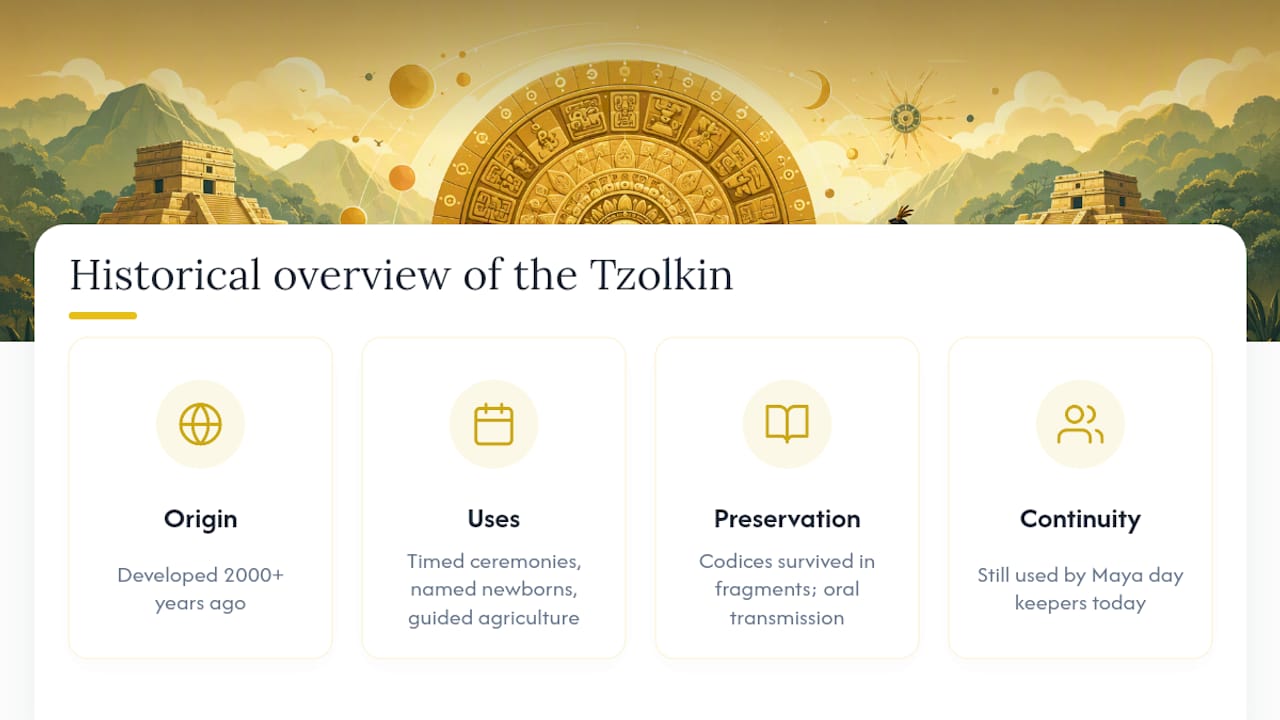
The Tzolkin isn’t a recent spiritual trend. It developed among Mesoamerican cultures well over two thousand years ago, used by the Maya alongside neighboring civilizations like the Zapotec and Aztec, each with their own version of the same 260-day logic. Priests, healers, and day keepers used it to time ceremonies, name newborns, and guide agricultural and community decisions.
What makes the system culturally significant isn’t just its age. It’s that the Tzolkin survived colonization, suppression, and centuries of disruption, and it’s still actively used today by Maya day keepers in Guatemala and parts of southern Mexico. When you look up your day sign, you’re touching a tradition with genuine continuity, not a reconstructed novelty.
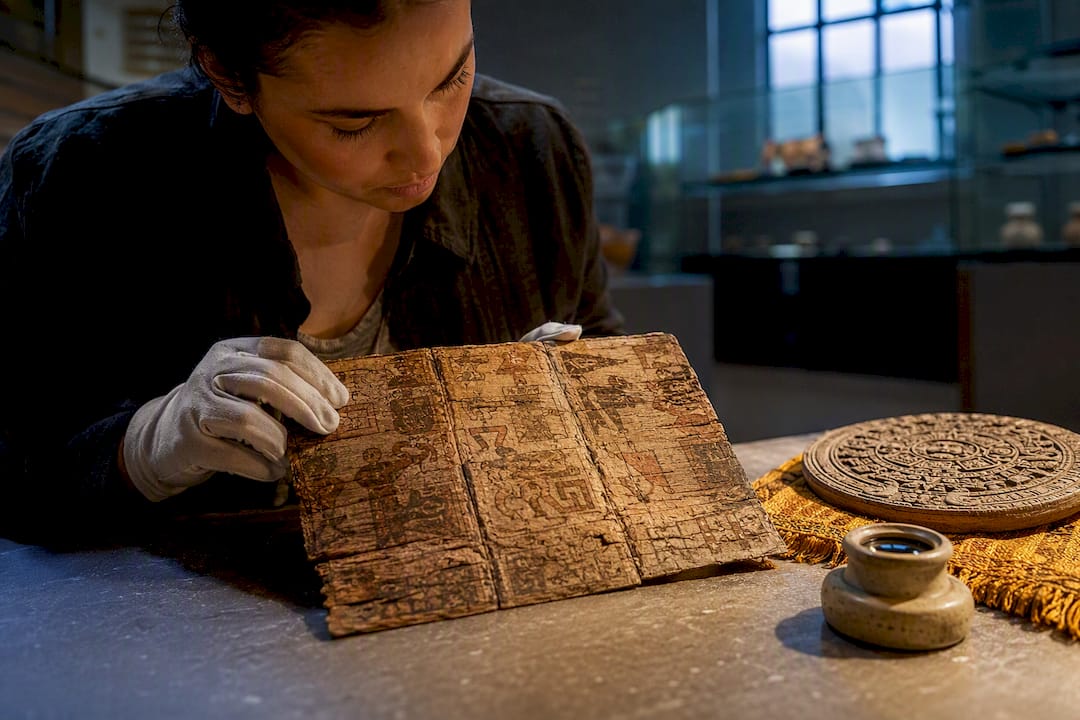
Codices, the folded-bark books the Maya used to record astronomical and ritual knowledge, preserved fragments of this calendar system, though most were destroyed during colonization. What survived, paired with oral tradition passed down through generations of day keepers, is what modern researchers and practitioners draw from today. That’s worth remembering every time you glance at a day-sign chart: it’s a living thread, not a museum piece.
Understanding that history changes how you approach your own reading. This isn’t a system built for individual entertainment. It’s a communal, ceremonial framework that happens to also offer something personal: a mirror for reflection, if you’re willing to look at it with respect rather than casual curiosity.
How the Tzolkin Connects to the Haab and the Long Count
The Tzolkin doesn’t operate alone. The Maya used it alongside two other calendar systems, and understanding how they interlock clears up a lot of beginner confusion.
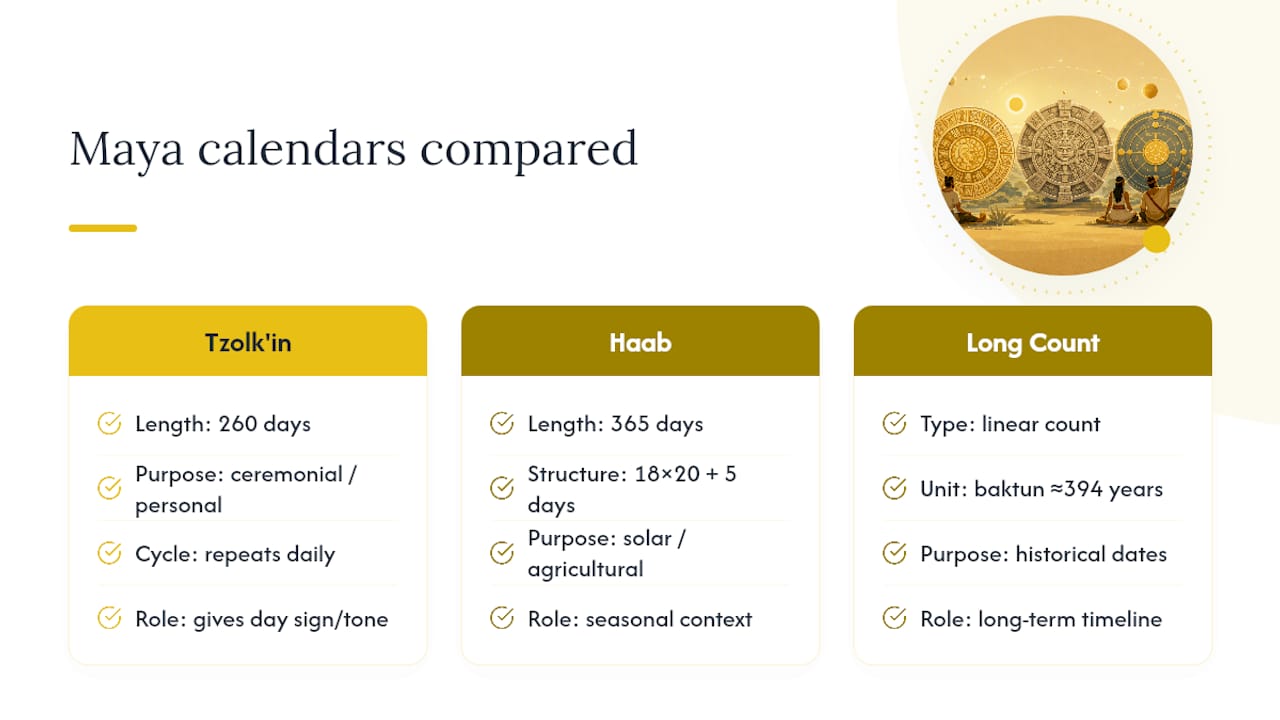
The Haab is a 365-day solar calendar, structured as 18 months of 20 days plus five extra “unlucky” days at the end. Where the Tzolkin tracks ceremonial and personal energy, the Haab tracked the agricultural and solar year, harvests, seasons, and planting cycles.
Here’s the elegant part: the Tzolkin and Haab run simultaneously, like two interlocking gears. Because 260 and 365 share a common factor, the two calendars only realign on the exact same date combination once every 52 years, a span called the Calendar Round. Ancient Maya communities treated that 52-year convergence as a significant turning point, roughly equivalent to a generational milestone.
Then there’s the Long Count, a linear system that tracks vast stretches of time using units like the baktun (roughly 394 years) rather than cycling repeatedly like the Tzolkin and Haab. The Long Count is what the Maya used to mark historical dates and long-term prophecy, distinct from the day-to-day rhythm the Tzolkin provides.
For a beginner, the takeaway is simple: your day sign and tone come from the Tzolkin alone. The Haab and Long Count add historical and seasonal context, but you don’t need them to get a meaningful personal reading. Mymayansign’s Tzolkin explained guide covers this layered structure in more depth if you want the fuller picture.
Common Misconceptions About Mayan Astrology
The biggest misunderstanding: treating the Tzolkin like a fortune-telling app that predicts your future. It doesn’t. Ethnographic sources frame Mayan divination as participatory and contextual, a tool used alongside ceremony and guidance from experienced practitioners, not a standalone oracle that spits out destiny. Your day sign is a starting point for reflection, a compass rather than a verdict.
A second misconception: assuming the system is identical to Western astrology with different names swapped in. It isn’t. There’s no concept of rising signs, planetary transits, or houses. The structure, math, and philosophy behind the Tzolkin are entirely distinct from zodiac-based systems.
Third, some beginners assume every online calculator gives the same result. Small differences in correlation constants (the historical formula used to align Gregorian and Mayan dates) can shift results by a day here and there. That’s exactly why choosing a reliable calculator with a transparent, well-documented method matters more than picking the first search result.
Finally, avoid the trap of thinking one “bad” day sign locks you into negative traits forever. Every sign carries both a light and shadow expression. The 20 signs aren’t ranked from best to worst. They’re 20 different lenses, each with something to offer depending on the day, the tone, and how you choose to work with it.
How Mayan Astrology Differs From Western Astrology
Western astrology centers on your birth moment relative to planetary positions: your sun sign, moon sign, rising sign, and a full natal chart mapped against constellations. Mayan astrology centers on your birth date’s position within a 260-day sacred count, no planets involved at all.
The cycle lengths tell the story on their own. Western zodiac signs repeat every 12 months. The Tzolkin’s 260-day cycle doesn’t align with the solar year at all, which means your day sign shifts to a completely different position each birthday until the Calendar Round resets after 52 years.
Interpretation style differs too. A Western natal chart typically maps a fixed personality profile built from multiple planetary placements. A Tzolkin reading offers a single day sign and tone combination meant to be read as an energetic prompt, something to consider and apply, not a comprehensive psychological blueprint.
Purpose diverges as well. Western astrology, particularly in its popular modern form, leans heavily toward personal prediction and compatibility matching. The Tzolkin’s roots lean toward ceremony, timing, and communal ritual, with personal insight as one layer among several. That doesn’t make one system more valid than the other. It does mean bringing Western astrology assumptions into a Tzolkin reading, expecting a “rising sign” equivalent or a fixed twelve-month cycle, will only leave you confused.
Recommended Resources for Going Deeper
Once you’ve found your day sign and tone, a few resources help you build real understanding instead of surface-level trivia.
For structured practice, How to Practice Mayan Astrology: The Tzolkin Calendar offers concrete techniques for working with the calendar in daily life while emphasizing respect for its indigenous origins. It’s a solid next step after you’ve absorbed the basics here.
For cultural and historical grounding, the Smithsonian’s Mayan calendar system overview remains one of the most credible academic entry points available online, written by people with actual museum and ethnographic expertise rather than lifestyle-blog guesswork.
For ongoing personal exploration, Mymayansign’s own educational hub, including the Mayan numerology guide and the full Mayan astrology explained overview, walks beginners from a single day-sign lookup toward a fuller understanding of tones, trecenas, and layered readings.
Treat books and academic sources as your foundation, and calculators as your daily working tool. Combining both gives you a far richer entry point than relying on either alone.
The Real Value of Starting Simple
The conventional advice on this topic oversells complexity. Most beginner content buries you in glyph history and correlation math before you’ve even found your own sign, which is backward. Start with the sign and tone. Let curiosity pull you toward the deeper mechanics later, not the other way around.
Where I’d push back hardest: treating Mayan astrology as a novelty personality test does the tradition a disservice, and it also shortchanges you. The Tzolkin rewards repeated, small engagement, a morning journal line, a noticed pattern, over a single dramatic reading you check once and forget.
What should you prioritize first? Accuracy over speed. A calculator built on a documented, consistent correlation method beats a random result you can’t trace back to a real methodology. After that, consistency beats intensity. Five minutes with your day sign each morning for a month teaches you more than one long reading ever will.
— Fatih
Try Your Free Mayan Sign Calculator Today
Reading through 20 day signs and 13 tones is one thing. Seeing your own combination is another. Mymayansign’s free calculator gives you your day sign and galactic tone in seconds, using nothing more than your birth date, no correlation math required on your end.
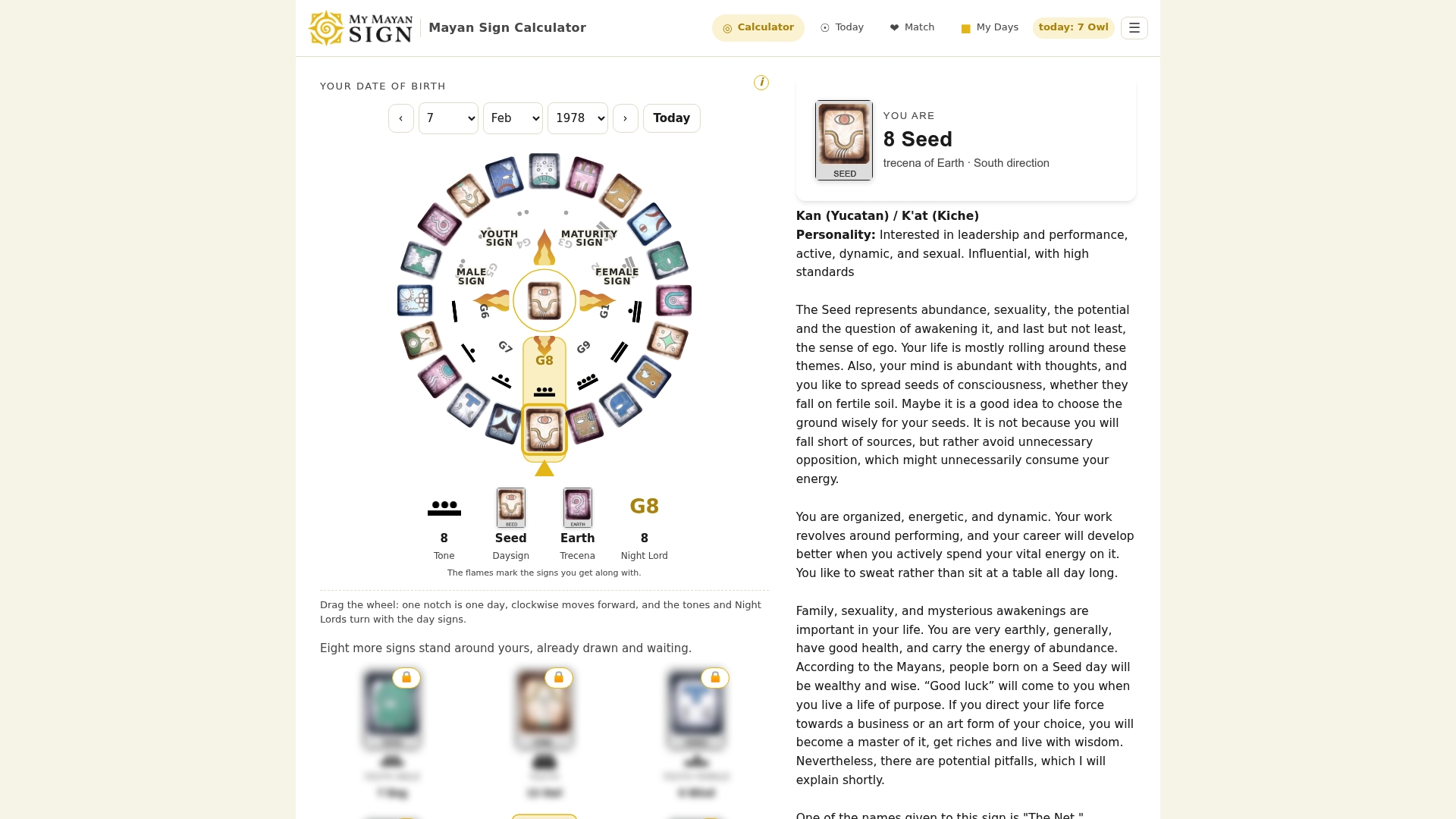
Once you’ve got your basic reading, the free result is just the entry point. A personalized report goes further: your full Tree of Life, a compatibility reading for a partner or friend, and a spiritual birthday calendar that tracks meaningful dates throughout your year. If you’re curious how all the pieces fit together first, the Mayan astrology explained page walks through the full system before you commit to anything paid.
Start free. Get your day sign and tone right now, then decide if a deeper personalized report is worth the next step for you.
Sources
- Mayan calendar system — National Museum of the American Indian (Smithsonian)
- Tzolkʼin — Wikipedia
- Understanding Mayan Astrological Calendars | Anahana
Recommended
- Mayan Astrology Dates: How to Calculate and Interpret Yours
- Your Mayan Birthday Calendar: Find Your Maya Day Sign
- What Is My Mayan Sign? Find It From Your Birth Date
- Mayan Sign Compatibility Calculator | Relationship Analysis