© 2019, My Mayan Sign
Share

Kin Number Meaning: Your Complete Tzolkin Guide

Your kin number is the galactic tone (1–13) assigned to your birth date within the 260-day Tzolkin calendar. It pairs with one of 20 day signs to form your full kin, the sacred coordinate that the ancient Maya used to mark every single day. Someone born on June 15, 1990, for example, lands on a specific Tzolkin day that gives a galactic tone of Cosmic paired with the day sign Ben (Reed). You can find yours in seconds using the free Mayan Sign Calculator at Mymayansign. In English, Cambridge defines “kin” as one’s relatives or kindred, so it is worth knowing right away that the Mayan calendar term means something entirely different: day.

Here is what you will find below:

  • The galactic tones and their one-line meanings
  • A step-by-step method to calculate your kin number manually
  • How tone and day sign combine into a full kin reading
  • Practical daily uses and cultural context

Key Takeaways

Your kin number is the galactic tone (1–13) in the 260-day Tzolkin that, combined with one of 20 day signs, forms the full kin coordinate used in Mayan calendar readings.

Point Details
Kin number = galactic tone The kin number is always a value from 1 to 13, representing one of the 13 archetypal tones.
Full kin = tone + day sign A complete kin reading requires both the tone and the day sign working together.
Calculator is the fastest method Mymayansign’s free calculator returns your day sign, tone, and full kin from your birth date instantly.
Tone colors the day sign The tone describes how the day sign’s energy expresses, not a separate meaning layered on top.
Mymayansign for deeper readings Personalized reports and daily calendar alerts expand the kin into life-purpose and compatibility guidance.

Table of Contents

What the Tzolkin calendar is and where kin fits

The Tzolkin is a 260-day sacred count that the Maya used alongside the 365-day solar Haab calendar for ritual, agricultural, and ceremonial timing. Its structure is elegantly simple: 20 named day signs cycle continuously against 13 numbered tones, and because 20 and 13 share no common factor, every possible combination appears exactly once before the full 260-day round resets.

The word kin in Yucatec Maya translates most directly as “day,” and it also carries associations with the sun and movement in several Mayan-language sources. Each day in the Tzolkin is itself called a kin, so your birth kin is simply the specific day-coordinate you arrived on. The 20 day signs (called nawales in some traditions) carry archetypal energies: Imix (Crocodile), Ik (Wind), Akbal (Night), and so on through Ahau (Sun). The 13 tones are the numerical pulse layered on top. Together they form a grid of 260 unique kins, each one a distinct doorway into a particular quality of time.

What the kin number (1–13) really means

When people ask about kin number meaning, they are usually asking about the galactic tone, the number half of the kin coordinate. Each tone from 1 to 13 carries an archetypal name and a core quality that colors how the day sign expresses itself. Think of the day sign as the character and the tone as the mood or power level that character is operating at.

The table below gives each tone its short name and a one-line interpretive meaning, drawn from the traditional Tzolkin framework used in modern spiritual self-discovery guides.

Tone Name Core meaning
1 Magnetic Unity, attraction, new beginnings, setting intention
2 Lunar Duality, challenge, relationship, finding balance
3 Electric Activation, service, creative energy in motion
4 Self-Existing Form, definition, measuring, building a foundation
Overtone Radiance, empowerment, gathering core strength
Rhythmic Balance, equality, organizing for flow
7 Resonant Attunement, inspiration, channeling higher guidance
Galactic Integrity, modeling, harmonizing with higher purpose
9 Solar Intention, pulse, realizing the greater vision
Planetary Manifestation, production, perfecting the form
11 Spectral Liberation, release, dissolving what no longer serves
12 Crystal Cooperation, dedication, universal sharing
13 Cosmic Transcendence, presence, endurance beyond cycles

Pro Tip: The tone does not override the day sign; it modulates it. A Tone 1 Wind kin (1 Ik) is a fresh, magnetically focused expression of Wind’s communicative energy, while a Tone 11 Wind kin (11 Ik) carries that same Wind quality but with a liberating, releasing charge. Always read them together.

How to find your kin number step by step

The fastest route is the Mayan Sign Calculator at Mymayansign, which returns your day sign, galactic tone, and full kin from your birth date in one click. For those who want to understand the math behind it, here is the manual method, which follows the same mod-260 logic demonstrated by the Number-to-Kin Translator.

  1. Count your Tzolkin day number. Calculate how many days have elapsed from a known Tzolkin anchor date to your birth date, then reduce that count modulo 260. The result (1–260) is your Tzolkin day number.
  2. Extract the galactic tone. Take your Tzolkin day number and apply: tone = ((day number − 1) mod 13) + 1. This always returns a value from 1 to 13.
  3. Extract the day sign. Apply: sign position = ((day number − 1) mod 20) + 1. Map that position to the ordered list of 20 day signs.
  4. Combine. Your kin is Tone + Day Sign (for example, 3 Chicchan, or 3 Serpent).

Worked example using May 12, 1985:

Counting from the standard anchor used in most Tzolkin calculators, May 12, 1985 falls on Tzolkin day 196.

  • Tone: ((196 − 1) mod 13) + 1 = (195 mod 13) + 1 = 0 + 1 = 1 (Magnetic)
  • Sign position: ((196 − 1) mod 20) + 1 = (195 mod 20) + 1 = 15 + 1 = 16 (Cib / Warrior)
  • Full kin: 1 Cib (1 Warrior / Magnetic Warrior)

The most common manual calculation errors are off-by-one mistakes when counting elapsed days and using the wrong calendar type. Always confirm whether your source uses the GMT correlation constant (584,283), the most widely accepted scholarly standard, and double-check that you are counting in UTC rather than your local time zone, since a birth near midnight can shift the Tzolkin day entirely.

How kin number and day sign combine into a full reading

The kin number alone is a starting point, not a complete picture. The full kin is always stated as Tone + Day Sign, and both halves carry equal interpretive weight. The tone tells you how the energy moves; the day sign tells you what energy is moving.

Take 4 Ahau (4 Sun) as an example. Ahau, the Sun sign, carries qualities of enlightenment, completion, and radiant leadership. Tone 4 (Self-Existing) adds the quality of form, definition, and building a stable foundation. A person born on 4 Ahau tends to express their solar, visionary nature through careful structure rather than spontaneous bursts. They are the ones who turn big ideas into organized, lasting systems.

Common interpretive angles readers use with their full kin:

  • Life purpose: The day sign points to the core gift or challenge; the tone describes the style of expression.
  • Daily oracle: When today’s Tzolkin kin matches your birth kin, many practitioners treat it as a personal power day.
  • Complementary strengths: Your tone number also appears in a specific position within the 13-day trecena cycle, suggesting where your energy peaks within any given short cycle.

Practical ways to use your kin number every day

Once you know your kin, the Tzolkin becomes a living calendar rather than an abstract system. Here are the most common ways people bring it into daily practice:

  • Daily oracle prompt. Check today’s Tzolkin day sign and tone each morning. The day’s kin sets a thematic tone for reflection or intention-setting, much the way a daily tarot card does.
  • Personality shorthand. In readings and conversations, your full kin serves as a compact spiritual profile. Sharing “I’m a 7 Ix (Resonant Jaguar)” communicates both your core archetype and your energetic style in four words.
  • Compatibility check. Comparing kin numbers with a partner or close friend can reveal complementary tones and signs. A Mayan sign compatibility analysis maps those relationships systematically.
  • Timing and decisions. Practitioners often align significant choices, launches, or ceremonies with kin days that resonate with their birth tone or sign.

Pro Tip: Layer your kin with the trecena cycle for short-term planning. Each 13-day trecena is governed by a specific day sign, and the tone of each day within it (1 through 13) creates a mini arc of energy. Knowing where your birth tone falls within the current trecena gives you a precise, practical planning window.

Origins, etymology, and respectful use of Mayan calendar knowledge

The word kin in Mayan languages most commonly translates as “day,” with secondary associations to the sun and cyclical movement. This is a fundamentally different meaning from the English word “kin,” which Merriam-Webster defines as a group of persons of common ancestry or one’s relatives, tracing back through Old English cynn to Proto-Germanic roots. The two words are unrelated; the overlap is purely coincidental.

The Tzolkin itself has roots stretching back at least to the pre-Classic Maya period, with evidence of its use found in the Dresden Codex and other surviving codices. It was not a calendar invented for personal astrology in the modern sense. It was a ritual and divinatory instrument used by trained daykeepers (aj q’ij in K’iche’ Maya) to guide planting, ceremony, naming, and community decision-making. That context matters when you use it today.

A few practical guidelines for respectful engagement:

  • Acknowledge that this system originates with living indigenous communities, not with New Age publishing.
  • Avoid presenting yourself as an authority on Mayan tradition based solely on online reading.
  • Seek out writing and teaching by indigenous Maya scholars and daykeepers when you want to go deeper.
  • Treat the calendar as a doorway into a rich tradition, not a personality quiz to be consumed and discarded.

Pro Tip: The most grounded way to use the Tzolkin is to hold your kin as a lens for self-reflection, not a fixed verdict about who you are. The Maya themselves understood these energies as living forces to work with, not labels to wear.

Reading kin numbers in actual practice, beyond one-line meanings

A one-line tone meaning is a seed, not the full plant. In actual readings, practitioners layer several elements to arrive at something genuinely useful.

Consider someone born on 9 Ik (9 Wind). The surface reading: Tone 9 (Solar) brings intentional pulse and visionary drive; Ik (Wind) governs breath, communication, and the movement of ideas. Together, the reading suggests a person whose purpose involves transmitting vision through words or teaching, someone whose communication carries an almost prophetic quality when they are aligned.

The deeper layer comes from the trecena context. 9 Ik falls within a specific 13-day trecena governed by a particular leading sign. If that leading sign is, say, Imix (Crocodile, the primal creative force), then the trecena adds a note of raw, generative creativity to the Wind’s communicative gift. The person is not just a communicator; they are a creative originator who communicates.

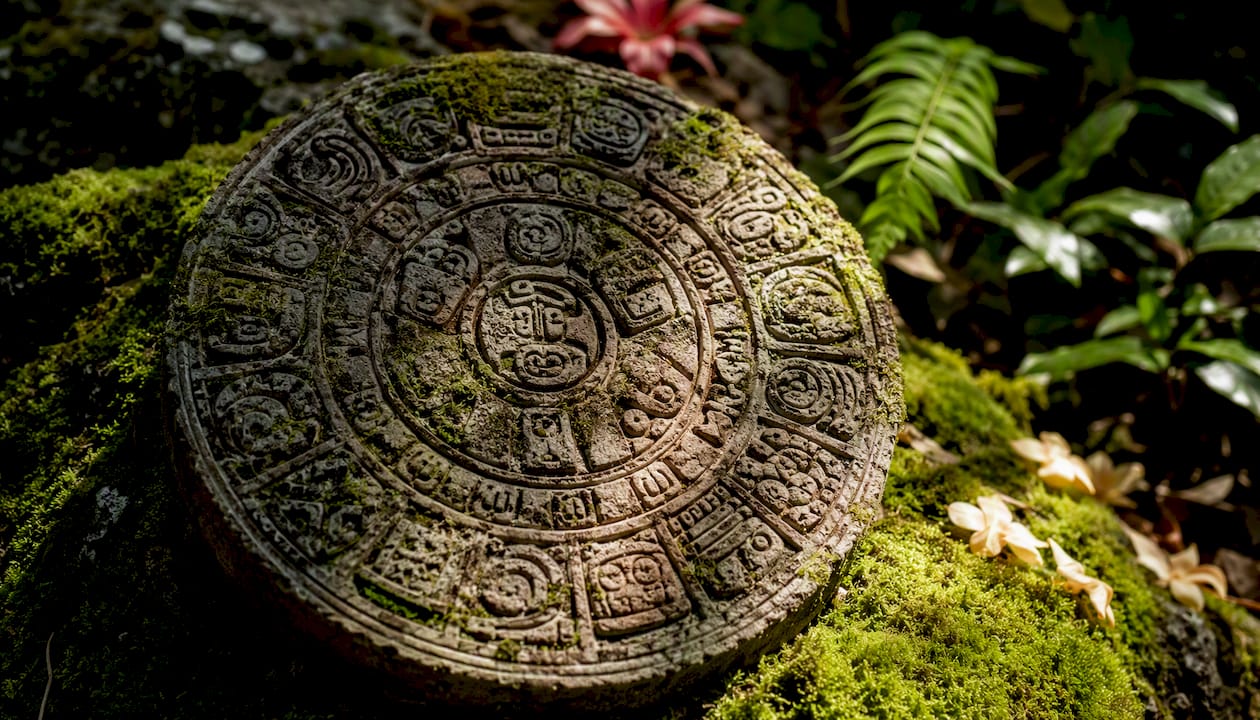
Hand tracing Mayan calendar glyph carving

A third layer is the Wavespell, the 13-kin arc within the 260-day round that begins on Tone 1 of the same day sign. Your position within your own Wavespell (which tone you hold) describes the role you play in a larger collective unfolding. Tone 9 within a Wavespell is the pulse point, the moment when the Wavespell’s intention crystallizes into forward movement.

None of this requires advanced scholarship. It requires sitting with the layers, one at a time, and asking what resonates.

How the Maya developed and used the kin number system

The Tzolkin’s 260-day structure appears across multiple Mesoamerican cultures, including the Aztec (who called it the tonalpohualli), suggesting a shared origin that predates the Classic Maya period. The most widely accepted scholarly explanation for the 260-day count is that it approximates the human gestation period and also corresponds to the interval between the sun’s zenith passages at certain Mesoamerican latitudes, particularly around 15° north latitude.

Maya daykeepers used the Tzolkin in combination with the 365-day Haab to produce the Calendar Round, a 52-year cycle in which no single day-name combination repeated. A child’s birth kin was determined by the daykeeper and carried ritual significance for the child’s entire life, influencing their name, vocation, and ceremonial responsibilities. The Dresden Codex, one of only four surviving pre-Columbian Maya books, contains detailed Tzolkin tables used for astronomical and divinatory calculations.

The system was never purely personal in the modern sense. It was communal, embedded in agricultural cycles, astronomical observation, and the maintenance of social order. Modern spiritual use of the Tzolkin draws on this tradition while adapting it for individual self-inquiry, a shift worth acknowledging honestly.

Common mistakes people make when calculating or interpreting their kin number

Several errors appear repeatedly among people new to the Tzolkin, and most of them are easy to avoid once you know what to watch for.

Confusing the kin number with the kin itself. The kin number (1–13) is the galactic tone only. The full kin is always Tone + Day Sign. Saying “my kin number is 7” is incomplete; “my kin is 7 Cauac (7 Storm)” is the full coordinate.

Using the wrong correlation constant. Multiple scholarly correlations exist for aligning the Maya Long Count with the Gregorian calendar. The GMT correlation (584,283) is the most widely accepted, but some calculators use variants. If two tools give you different results, the correlation constant is almost certainly the reason.

Ignoring time zones. A birth at 11:45 PM in Los Angeles is already the next calendar day in New York and well into the following day in London. Most Tzolkin calculators use UTC as their reference. If you were born near midnight, check both the UTC date and your local date to confirm which Tzolkin day applies.

Treating the tone as the dominant meaning. The tone and the day sign carry roughly equal weight. Readers who focus only on the tone number miss the richer, more specific guidance that the day sign provides.

Applying Western astrology frameworks. The Tzolkin is not a zodiac. There are no houses, no rising signs, no planetary rulers in the Western sense. Importing those frameworks onto the Tzolkin produces readings that are neither accurate to the Maya tradition nor internally consistent.

Common mistakes people make when calculating or interpreting their kin number — overview diagram

What the kin number means for your self-discovery path

The Tzolkin is not a verdict. It is a map, and like any map, its value depends entirely on how you use it. Your kin number, that galactic tone from 1 to 13, is the energetic frequency you arrived with. It does not determine your fate; it describes a quality of awareness you carry and can consciously develop.

What strikes me most, having worked with the Tzolkin for years, is how often people arrive at their kin reading expecting a personality label and leave with something more useful: a question. Tone 11 (Spectral) people, for instance, often resist the idea that their gift is release rather than creation. But when they sit with it honestly, they recognize that their most meaningful contributions have always come from clearing the way for others, not from building monuments to themselves.

The kin number is most powerful when you stop asking “what does this say about me?” and start asking “what is this inviting me to practice?” That shift, from passive label to active inquiry, is where the Tzolkin’s real depth lives.

Mymayansign gives you your full kin reading instantly

Your kin number is the starting point. What you do with it depends on how deeply you want to go.

Mymayansign

Mymayansign’s free Mayan Sign Calculator returns your day sign, galactic tone, and full kin from your birth date in seconds, no math required. Beyond the free lookup, a personalized report expands your tone and day sign into a detailed life-purpose and compatibility reading. For ongoing practice, the Daily Mayan Wisdom subscription delivers each day’s Tzolkin kin directly to you, so the calendar becomes a living daily companion rather than a one-time curiosity. Enter your birth date, find your kin, and let the map show you where you are.

Sources

Want your full Mayan chart? Your detailed Mayan astrology report gives a written reading of all nine signs on your Tree of Life. Or start free with the Mayan Sign Calculator.

Leave a Comment