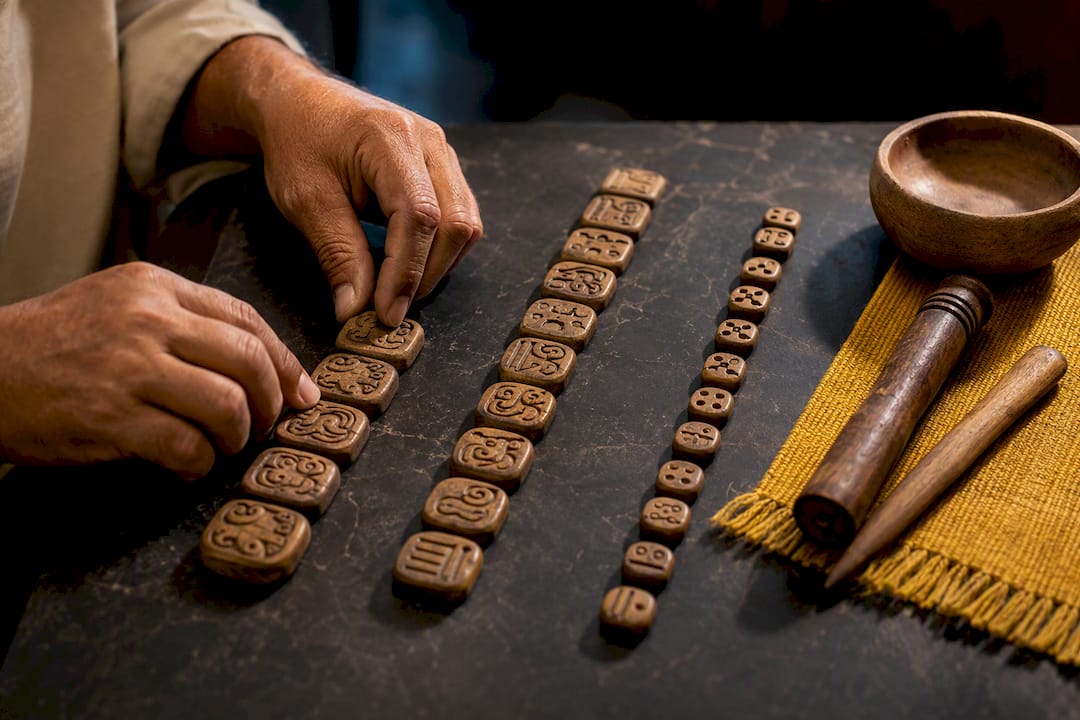
Your “day keeper meaning” is your Mayan birth Kin, the pairing of a day sign and a Galactic Tone drawn from the ancient 260-day Tzolk’in count. The day sign describes your core nature. The tone shapes how that nature moves through the world. A Tzolk’in calculator can locate the exact pairing from your birth date in seconds.
TL;DR:
- Your Mayan day sign reflects your core nature, while the Galactic Tone influences how that nature manifests in your life.
- The exact pairings are calculated from your birth date using a fixed 260-day cycle, independent of birth time or location.
- The tone from 1 to 13 shapes the energetic stage, with different combinations producing unique personality trajectories.
- Understanding your specific Kin, including its position in the cycle, can help you track patterns for self-discovery over time.
- Using a calculator requires only your birth date, providing a quick personalized reading that can be expanded into deeper interpretations.
Table of Contents
- What Is a Mayan Day Sign, and What Does Kin Mean?
- How Is Your Day Sign Calculated From Your Birth Date?
- Why Does the Galactic Tone Matter So Much?
- How Can You Use Your Mayan Day Sign for Self-Discovery?
- How Do You Find Your Day Sign With a Calculator?
- Where Did the Day Keeper Role Come From in Mayan Society?
- What Do Specific Day Sign and Tone Combinations Mean?
- A Grounded Take on Reading Your Day Sign
- Get Your Full Mayan Kin Reading From Mymayansign
- Sources
What Is a Mayan Day Sign, and What Does Kin Mean?
Every Mayan birth identity rests on two pieces working together, not one symbol standing alone. The first piece is the day sign, one of 20 nawales such as Jaguar, Wind, or Seed. Each nawal carries an archetypal energy, a kind of personality blueprint the Maya believed shaped a person’s temperament and gifts. Think of the day sign as the what: the raw material of who you are.
The second piece is the Galactic Tone, numbered 1 through 13. Where the day sign gives you a nature, the tone gives that nature a mode of expression. This pairing of a day sign with a tone creates what’s called a Kin, the Tzolk’in’s word for a single, unrepeatable unit of the 260-day cycle. You might carry a Kin like “8 Jaguar” or “4 Sun,” and no other combination in the cycle reads quite the same way.
Here’s where this system parts ways from Western astrology. Instead of tracking planetary positions at your birth moment, the Tzolk’in works from a fixed count. There’s no rising sign, no moon phase, no birth chart wheel with twelve houses. Just two intersecting cycles, 20 day signs and 13 tones, producing 260 unique combinations that repeat in an unbroken rhythm the Maya tracked for centuries. Once you know your Kin, you have a stable reference point, not a floating one tied to the sky above a specific hour.

How Is Your Day Sign Calculated From Your Birth Date?
The math behind this is exact, not interpretive. According to the National Museum of the American Indian’s explanation of the calendar system, every Gregorian date maps to exactly one Tzolk’in position. There’s no ambiguity and no room for multiple readings of the same birthday.
The mechanics work like two interlocking wheels turning together:
- One wheel carries the 13 numbered tones, cycling 1 through 13 and starting over.
- The other carries the 20 named day signs, cycling through all 20 before repeating.
- Because 13 and 20 share no common factor besides 1, the wheels don’t realign until they’ve turned through all 260 possible pairings.
- That full rotation is the Tzolk’in itself, a 260-day count that has run continuously since long before the Spanish arrived in Mesoamerica.
A detail that surprises a lot of people: your birth time doesn’t change your day sign at all. The entire Gregorian day, midnight to midnight, maps to a single Tzolk’in position, so a baby born at 2 a.m. and one born at 11 p.m. on the same date share the same Kin. Online converters handle the conversion using what’s called an anchor correlation, essentially a known fixed point that lets the calculation run backward or forward across any Gregorian date without guesswork. Most Mayan-astrology calculators only ask for your birth date for exactly this reason.
Why Does the Galactic Tone Matter So Much?
If the day sign answers “what,” the tone answers “how.” Skip the tone, and you’re only getting half the story, sometimes less than half, because tone shapes the texture of everything the sign represents.
Galactic Tones describe stages of energetic development, running from Tone 1 (initiation, a spark of new intention) through Tone 13 (transcendence, a culmination point) before the cycle resets. These 13 tones also structure what practitioners call a Wavespell, a 13-day arc of related energy. A deep reading treats sign and tone as inseparable, not as a headline paired with a footnote. The tone doesn’t just accessorize the sign; it redirects how that sign’s core quality actually shows up in a person’s life.
Picture three people, each carrying the day sign Monkey, an energy tied to playfulness, creativity, and mischief:
- Monkey with Tone 1 tends to initiate new creative projects but may not finish them.
- Monkey with Tone 6 channels that same playful energy into building consistent rhythms and routines.
- Monkey with Tone 11 turns creativity toward dismantling what no longer works, clearing space rather than building.
Same nawal, three distinct trajectories. That’s the interpretive weight a tone carries.
How Can You Use Your Mayan Day Sign for Self-Discovery?
Knowing your Kin is the starting point, not the destination. What you do with it determines whether it becomes genuine insight or just a fun fact you mention once and forget.
- Journal against your sign’s core themes. If your nawal is associated with transformation, write about a recent change you resisted or welcomed. Let the archetype prompt reflection instead of dictating conclusions.
- Watch for tone-resonance days. Days when the current Tzolk’in tone matches your birth tone are worth noting in a simple log. Many people find these days carry a noticeable pull toward their natal themes.
- Track patterns across a season, not a week. One or two observations prove very little. A pattern across dozens of entries starts to mean something.
- Hold your sign’s challenges loosely. A nawal associated with restlessness doesn’t sentence you to restlessness forever; it names a tendency worth noticing, not a verdict to accept.
Pro Tip: Keep your tracking going for a full 260-day cycle if you can manage it. That’s the length of the entire Tzolk’in count, and it’s long enough to see whether a pattern is a real thread in your life or just a coincidence you noticed once.
How Do You Find Your Day Sign With a Calculator?
A Tzolk’in calculator needs exactly one input from you: your birth date. Feed it that, and it returns three things: your day sign, your Galactic Tone, and your Kin number, the specific position (1 through 260) your combination occupies in the full count.
Using one is about as involved as checking the weather:
- Enter your birth date, month, day, and year, into the calculator field.
- Review the day sign and tone the tool returns.
- Note your Kin number if you want to explore the wider 260-day count later.
Mymayansign’s Mayan Sign Calculator (Fast) handles this lookup in seconds if you just want your Kin right now. For a version with a bit more explanatory context alongside the result, the standard Mayan zodiac sign calculator walks through what each piece of your reading means as it appears.
A free calculator gives you the pairing. A personalized report goes further, typically expanding into your Tree of Life placement, deeper interpretation of how your sign and tone interact across different life areas, and calendar features tied to your specific Kin. Neither promises to predict your future. What both offer is a starting map for reflection, built from the day-sign framework rather than guesswork.
Where Did the Day Keeper Role Come From in Mayan Society?
The Tzolk’in count you’re using today isn’t a modern invention dressed up in ancient language. It’s a genuinely old system, one that Maya communities have used continuously for well over two thousand years, tracking the 260-day cycle alongside the longer 365-day solar calendar the Maya also kept.
Within traditional Maya communities, reading the Tzolk’in wasn’t something everyone did casually. It required training, memorization, and a role passed down through apprenticeship, often within families or communities, over years. That role carried responsibility for naming newborns’ day signs, marking auspicious dates for planting or ceremony, and interpreting the count for the community at large. It sat at the intersection of timekeeping, spiritual guidance, and civic function, closer to a blend of astronomer and counselor than to a fortune teller.
This piece matters for context, but it’s worth being precise about scope here. This article focuses on the personal side of the Tzolk’in: your individual day sign and tone as a tool for self-reflection, the way most people encounter Mayan astrology today through calculators and personalized readings. The traditional community role that once oversaw the calendar for entire villages is a distinct subject with its own depth, and conflating the two risks flattening both. What carries forward into modern personal readings is the calculation itself, the same 20×13 mathematics that has never changed, applied now to individual self-discovery rather than communal ceremony.

What Do Specific Day Sign and Tone Combinations Mean?
Abstract explanations only go so far. Seeing how the framework plays out with real combinations makes the whole system click.
Kin 1, 1 Imix (Crocodile). This opening position of the entire 260-day count pairs the primal, nurturing energy of Imix with Tone 1’s initiating force. People associated with this Kin often carry a strong instinct to start things, sometimes before they’ve fully thought them through.
Kin 260, 13 Ahau (Sun). The closing position of the cycle pairs Ahau, tied to enlightenment and radiance, with Tone 13’s culminating energy. This combination often shows up in readings as someone who arrives at clarity only after a long process, not immediately.
7 Batz (Monkey). Tone 7 sits at the cycle’s midpoint, associated with balance and channeling. Paired with Monkey’s creative, playful nawal, this Kin often describes someone who uses humor or artistry specifically to mediate tension between other people.
3 Chuen appears in some regional naming traditions as a variant reading tied to Monkey as well, a reminder that Tzolk’in terminology shifts slightly across different Maya-language traditions and modern transliterations. The core mathematics stays identical regardless of which naming convention a particular resource uses.
Each of these readings describes tendencies worth noticing, not fixed destinies. The value sits in the noticing.
A Grounded Take on Reading Your Day Sign
Working through this framework, one thing stood out: sign and tone genuinely can’t be separated without losing most of the meaning. Plenty of casual explainers treat the day sign as the whole story and mention tone as an afterthought. That shortchanges the reading.
It’s also worth naming directly what this article covers and what it doesn’t. The traditional Maya calendar-keeper, the community role passed through years of apprenticeship, sits outside this scope entirely. This piece stays with the personal Kin, your day sign and tone, as a tool for reflection. Treat it that way: a personal map worth exploring with curiosity, not a credentialed cultural verdict.
— Fatih
Get Your Full Mayan Kin Reading From Mymayansign
This calculation can be turned into a personal reading you can act on immediately, no manual chart-plotting required. Where a general explainer stops at definitions, some tools go straight to your specific day sign, tone, and Kin number, then build outward into deeper interpretation if you want it.

Start with the Mayan Sign Calculator (Fast) if you just want your Kin right now, birth date in, result out. If you’re ready to go further, the Mayan astrology explainer and reading gateway walks you from your basic sign and tone into a fuller personalized report, including your Tree of Life placement and how your specific combination plays out across different areas of life. For readers who want their day-sign insight to stay part of daily life rather than a one-time lookup, Daily Mayan Wisdom delivers ongoing guidance tied to the current Tzolk’in tone alongside your own.
Enter your birth date and see your Kin now.
Sources
- Mayan calendar system — National Museum of the American Indian (Smithsonian)
- Mayan astrology: Your day sign and Galactic Tone in the Tzolkin calendar — Celesian
- The Influence of Galactic Tones in Mayan Readings — Vedaayan
Recommended
- Tzolkin Explained: The 260-Day Calendar of the Maya
- The 260-Day Calendar (Tzolk’in): How It Works and Why It Mattered
- Mayan Numerology: Convert Birthdate to Tzolkin Kin, Read Layers
- Mayan Nahual: Find Your Day Sign and What It Means