
When most people hear the words “Mayan pictographs,” they picture something carved into stone. Beautiful, yes, but dead. A puzzle for archaeologists to decode with brushes and lamps. I understand why. For a long time that is exactly how the West treated these symbols. But the more time you spend with them, the more you feel what the Maya never forgot. A pictograph is not a fossil. It is a doorway. And one of these doorways has your name on it.
Let me show you what I mean.
What a Mayan pictograph actually is
The Maya built one of the only fully developed writing systems in the ancient Americas. Their glyphs, or pictographs, work on two levels at the same time. Some are logograms, where a single picture stands for a whole word. Others are syllabic signs that stand for sounds, so they could be combined to spell out anything the spoken language could say. This is why a Mayan inscription can look like a wall of tiny faces and still carry the precision of a legal document.
The script began taking shape around 300 BCE, reached its height in the Classic Period, and survived in carved monuments and in a small handful of bark-paper books we now call codices. For centuries no one alive could read a single line. The breakthrough came in the twentieth century, when scholars finally cracked the phonetic code and the stones began to speak again. Suddenly we knew the names of kings, the dates of wars, and the careful tracking of Venus across the sky. It is one of the great detective stories in all of human history.
That is the background, and it is worth honoring. But it is not why I sat down to write this. Because among those thousands of glyphs there is a small family of twenty that belongs to you personally.
The twenty pictographs that carry your energy
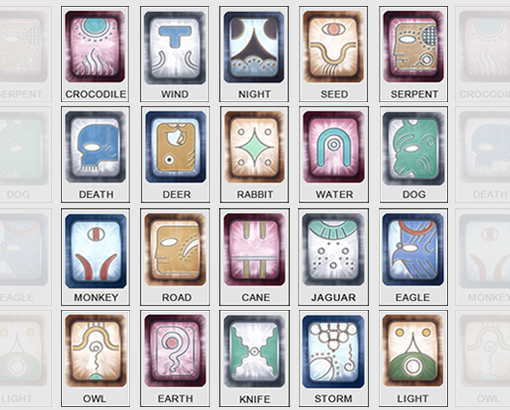
The Maya broke the sacred round of days into a 20-day cycle called the Uinal. Each of those twenty days has its own pictograph and its own ruling spirit, a Nawal. Crocodile, Wind, Night, Seed, Serpent, Death, Deer, and on around the wheel to Light. These are the day-sign glyphs, and in my work they are the heart of the whole system.
Here is the part that changes how you see them forever. You were born on one of these twenty days. That means one of these pictographs is the face of your core energy. Not a stamp pressed onto you from outside. A face you have always been wearing without knowing its name.
Now combine the twenty signs with the thirteen Galactic Tones, the number that rides in front of each sign, and you get 260 unique day-energies. That is the full Tzolkin, the sacred calendar the Maya day-keepers have counted without a break for about 2,500 years. And notice the numbers. Twenty amino acids build every protein in your body. Thirteen main joints let your body move through space. Two hundred sixty days is close to the length of a human pregnancy. The Maya folded the blueprint of a human being into a calendar, and then they gave every day a face you could look at.
A glyph is a mirror, not a verdict
This is where I have to slow you down, because the modern mind wants a glyph to behave like a horoscope. It does not. Your day-sign pictograph is not there to predict your future. It is there to remind you of something you already carry. As Socrates said, all learning is remembering. When you look at your glyph, you are not reading a fortune. You are looking into a mirror that helps you remember who you are underneath all the borrowed noise.
And please take this to heart, because in fifteen years of readings it is the thing people most need to hear. There are no good glyphs and no bad glyphs. There are only potentials. You are not your sign. The pictograph is a map, and the map is not the territory. It is a way out of the Matrix of inherited identity, not one more costume to put on.
A famous chart, read in glyphs
Let me make this concrete, the way I do when I sit with someone. Walt Disney was born on December 5, 1901. Run that date through the authentic Maya count and his day-sign glyph is Crocodile, carried on the fifth tone.
Crocodile is the very first of the twenty pictographs, the sign that opens the entire cycle. In my framework Crocodile is the creative initiator, the one so full of primal energy that its gift is to give life to others. Sit with that for a second. Here was a man whose whole genius was to take a drawing, a flat little pictograph of his own hand, and breathe life into it until it walked and sang and made children laugh. The first glyph, the life-giver, the one who begins things that never existed before. It is hard to imagine a cleaner match between a person and their sign.
His chart does not end at the center. To read anyone honestly I look at the signs standing around their birth day, the shape I call the Tree of Life. In Disney’s public, working life stands Eagle, the sign of vision, the one who flies highest and reads the whole map from above. That is the man who saw a theme park in an orange grove when everyone around him called it madness. In his private, tender space stands Deer, the generous host, the sign whose calling is community and making people feel at home. That was the entire promise of what he built. And guiding him from the road ahead stands Water at its strongest tone, pure imagination and dream. If you can dream it, you can do it. He was, quite literally, living his glyphs.
You carry a chart like this too. Your own first glyph. Your own hidden Eagle, or Deer, or Water, waiting quietly to be remembered.
How to meet your own pictograph
The wonderful part is that you do not need to learn to read carved stone to find yours. It takes about a minute. Enter your birth date into the free Mayan sign calculator and it will hand you your day-sign glyph and the tone that rides with it. If you want to understand what that number in front of your sign is doing, I wrote a whole guide to the thirteen Galactic Tones. And if you want to see how the full reading system fits together, start with how Mayan calendar astrology reads time rather than the stars.
Then do the thing the Maya actually did. Do not just learn your glyph. Live with it. Watch for the day it comes around again, every twenty days, and notice how the world seems to lean in your direction. That is when a pictograph stops being a symbol on a screen and becomes a living companion.
Frequently asked questions
Are Mayan pictographs the same as Aztec symbols?
They are cousins, not twins. The Aztecs built on Mesoamerican foundations the Maya helped lay, and they shared a 260-day sacred count. But the glyphs, the names, and the art belong to each people. When I read a chart I use the authentic Maya day-signs, not the Aztec system.
What is the difference between a Mayan glyph and a day sign?
Every day sign is a glyph, but not every glyph is a day sign. The Maya wrote thousands of glyphs for words and sounds. The day signs are a special family of twenty pictographs, one for each day of the Uinal cycle, and those twenty are the ones that describe your birth energy.
Can I really read these myself?
You can read the twenty that matter most to you, and that has always been my promise. It is a much simpler system than it looks, and you can become your own astrologer. Start with your own glyph, then your family’s, then follow the day-signs as they turn.
Why does my sign come out different on other websites?
Because some sites use a count invented in the 1980s rather than the real one the Maya day-keepers have tracked for about 2,500 years. Here is a quick tell. If a site names your sign with a color in front, like “Blue Monkey,” you are looking at the invented Dreamspell system, not the authentic pictograph tradition. MyMayanSign uses the true count.
Fatih Kecelioglu is the founder of MyMayanSign.com and the author of Sacred Teachings of Mayan Astrology. He has practiced Mayan astrology for over fifteen years.