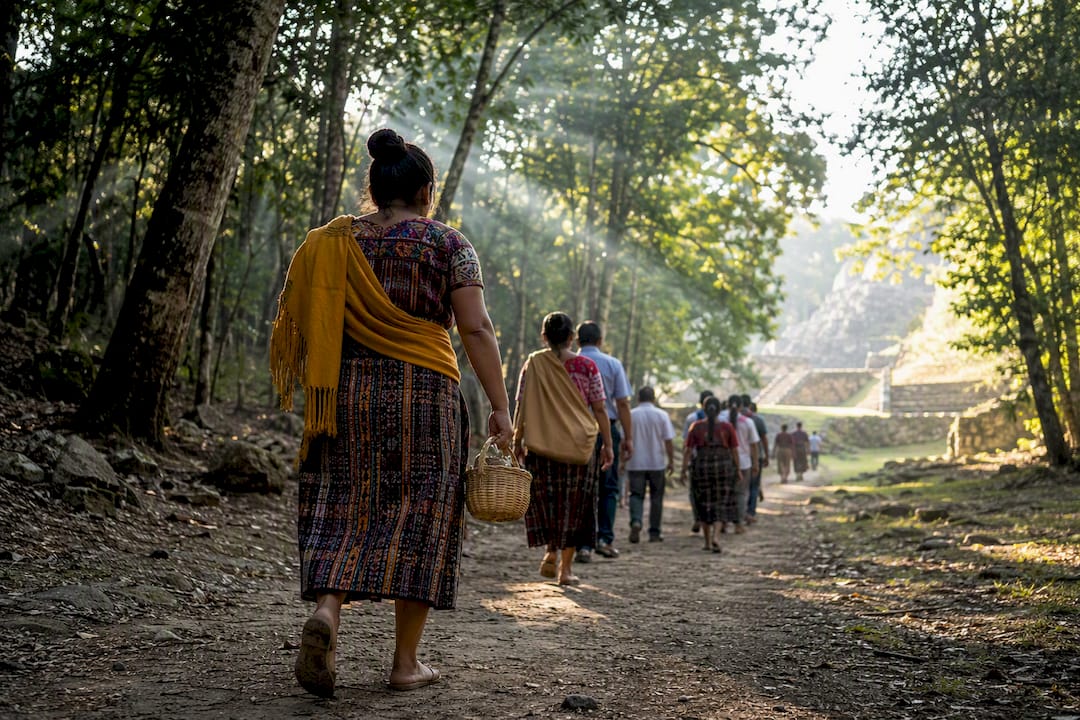
The Mayan New Year marks the start of a new Haab solar year, a solar year cycle, paired with the ceremonial renewal of land, community, and the year’s presiding day-sign, known as the Year Bearer. It falls near the end of the Wayeb period, a few days at the year’s end, not on January 1, and its exact date has always shifted with local calendar keepers rather than one fixed calendar square. Communities across the Maya world still mark it differently, because the tradition is cyclical and lived, not a countdown to an ending.
TL;DR:
- The Mayan New Year depends on the local calculation of the Haab and Wayeb, not a fixed date, and is tied to the completion of a 52-year Calendar Round cycle.
- Traditional ceremonies for the New Year involve fasting, extinguishing old fires, making offerings at sacred sites, and renewing household objects to seek renewal and rain.
- The Year Bearer, a Tzolk’in day-sign, influences community and agricultural expectations by signifying themes like rain or change, which vary regionally.
- Modern observances are diverse and often syncretic, blending indigenous practices with Catholic traditions, with no single fixed date across all Maya communities.
- Personal readings incorporate the Tzolk’in day sign and Year Bearer, offering insights into individual characteristics and yearly themes based on ancient calendrical logic.
Table of Contents
- What Is the Mayan Calendar System Behind the New Year?
- What Do Ancient Records Say About New Year Rites?
- How Did Traditional Maya New Year Rituals Work?
- What Is a Year Bearer and Why Does It Matter?
- How Is the Mayan New Year Celebrated Today?
- How Does This Calendar Knowledge Shape a Personal Reading?
- A Respectful Way to Approach a Living Tradition
- Discover Your Own Day Sign and Tone
- Sources
What Is the Mayan Calendar System Behind the New Year?
Three interlocking counts govern when and how the New Year arrives. Understanding them is the difference between reading a headline about “the Maya calendar” and actually grasping what changes when one year ends and another begins.
The Haab is the 365-day solar year, built from eighteen months of twenty days each, totaling 360 days. The remaining five days form the Wayeb (also spelled Uayeb), a liminal stretch traditionally treated as unstable and dangerous. According to the Smithsonian’s Living Maya Time project, Maya communities have long understood time as interlocking cycles rather than a single line running toward an end point. The Wayeb sits at the seam between those cycles, which is precisely why it carries so much ritual weight.
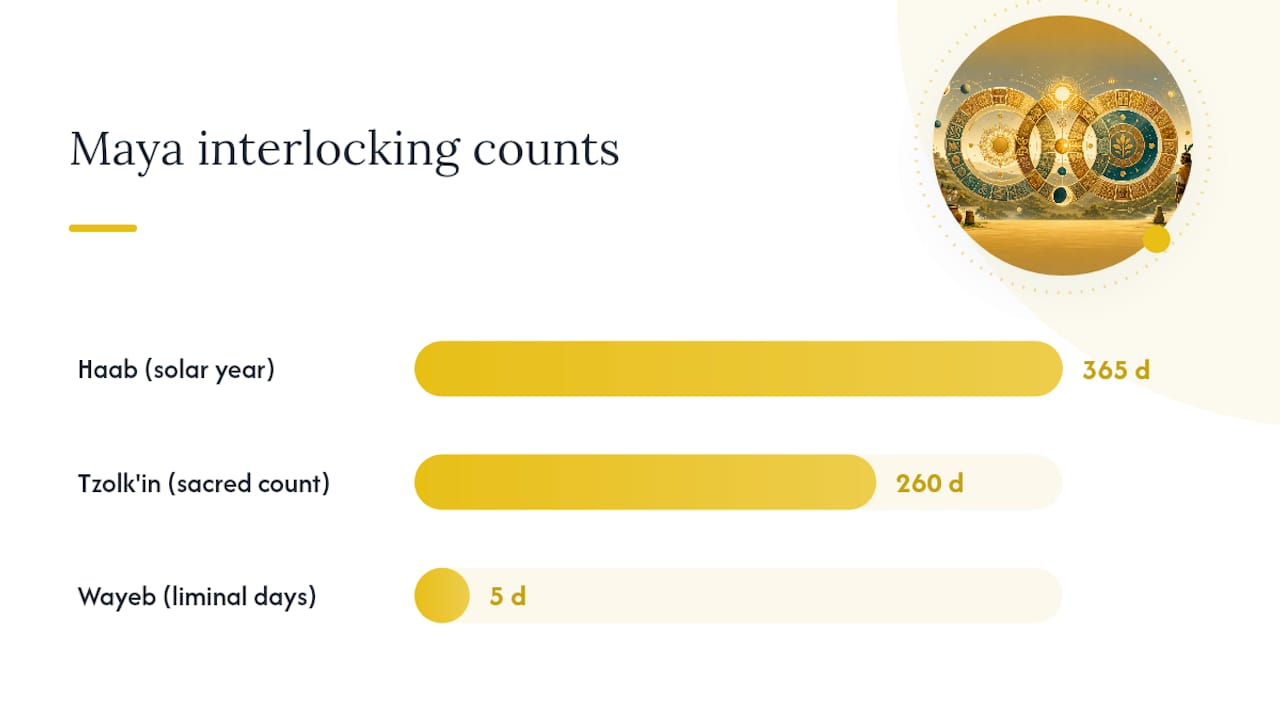
Running alongside the Haab is the Tzolk’in, a 260-day sacred count combining 20 day-signs with 13 numbered tones. It does not track seasons. It tracks something closer to spiritual rhythm, and it is the count that still shapes personal readings today.
When the Haab and Tzolk’in run together, they eventually realign. That full realignment takes 52 Haab years, a span called the Calendar Round. Every Haab New Year lands on a specific Tzolk’in day, and that intersection is what produces the Year Bearer.
A few points worth flagging before you read further:
- The New Year is not fixed to a single date like January 1; it depends on the Haab’s start point and Wayeb’s completion, which calendar keepers track locally.
- The Tzolk’in cycle and the Haab move independently, so the “flavor” of each New Year changes even though the ritual structure repeats.
- Modern claims of a fixed New Year date, such as July 26, generally trace back to the Dreamspell system, a 20th-century reinterpretation, not the traditional Haab and Tzolk’in counts documented in ethnohistoric and archaeological sources.
That last point matters more than it sounds. Confusing Dreamspell’s fixed date with the living, locally observed traditional calendar is probably the single most common error you’ll find repeated online.
What Do Ancient Records Say About New Year Rites?
Much of what scholars know about pre-colonial New Year practice comes from two very different kinds of evidence: painted books and colonial eyewitness accounts, each with its own blind spots.
The Madrid Codex, one of the few Maya books to survive Spanish book burnings, contains almanacs that researchers have connected directly to Wayeb ceremonies. Analysis published in Ancient Mesoamerica links specific almanac figures in the codex to rituals that closed one year and opened the next, including the symbolic transfer of a year’s patron deity to the incoming year.
The other major source is Diego de Landa, a 16th-century Spanish friar whose writings describe Wayeb preparations in detail: fasting, the kindling of new fire, and the ritual renewal of household objects. Landa’s account, later excerpted in colonial-era descriptions of Yucatán, remains one of the fullest surviving descriptions of these rites, even though it comes filtered through a colonizer’s perspective and his own campaign against Maya religious practice.
Colonial-era descriptions of the New Year record households extinguishing old fire, discarding worn utensils, and fasting in the days before the year turned, treating the transition as a moment when the world itself needed tending, not just marking.
That caveat about sourcing is not a footnote you can skip. Landa burned Maya manuscripts even as he documented Maya ritual life, so his descriptions are simultaneously the most detailed record we have and a document produced by someone actively working to erase the culture he was describing. Scholars read him carefully for that reason, cross-checking his claims against codex evidence and archaeological findings wherever possible.
The 52-year Calendar Round gave these ethnohistoric rites their largest frame. Completing that cycle was treated as a milestone significant enough to warrant its own ceremonies, distinct from the annual Wayeb rites that recurred every single year.
How Did Traditional Maya New Year Rituals Work?
Ritual practice around the New Year centers on one idea: the world needs active renewal, not passive celebration. Peer-reviewed research on world-renewal rituals among the Postclassic Yucatec Maya and the contemporary Ch’orti’ Maya describes this as an ongoing petition to rain and earth deities30004-6), carried out through specific, repeatable acts rather than a single festival day.
Typical elements included:
- Fasting and preparation in the days leading into Wayeb, treated as a period requiring caution and restraint rather than festivity.
- New fire ceremonies, where old household fire was extinguished and fresh fire kindled to mark the year’s turn.
- Burning copal incense as an offering meant to carry petitions upward, a practice still visible at ceremonies today.
- Food and drink offerings, often maize-based, placed at altars or carried to sacred locations.
- Renewal of household ritual objects, including utensils and tools, which were replaced or ceremonially cleansed to start the year unburdened.
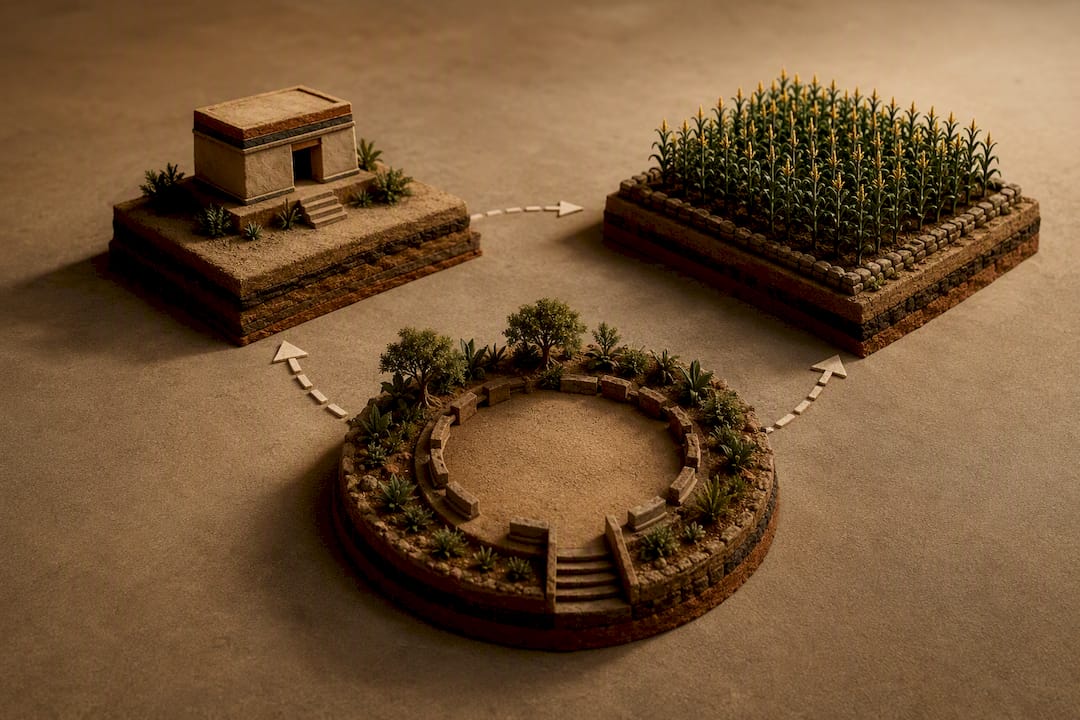
Pilgrimage extended these household acts outward into the landscape. The Smithsonian’s research on corn and calendar traditions documents offerings made at sacred springs, lakes, and coastal sites, explicitly tied to securing rain for the coming maize crop. Water was not incidental to these rites; it was the point. A New Year without rain assurance was a year the community could not yet trust.
Ethnographic work on Maya pilgrimage frames this movement as a form of what researchers call “ambulatory knowing,” where the physical act of walking to a sacred place, and sometimes undergoing self-sacrifice or bloodletting along the way, functions as a kind of embodied cosmological renewal, not just symbolic performance. The Brea Project’s research on Maya New Year pilgrimage describes this bodily participation as central to the ritual’s power, distinct from simply watching or reading about it.
Foundation acts, ritually marking the start of a structure, a field, or a community cycle, appear in both historical and contemporary practice, generally framed as acts of gratitude and reciprocity with the earth rather than displays of violence. It’s worth resisting the urge, common in popular writing, to sensationalize this history. The sources describe careful, repeated maintenance between people and their environment, not spectacle.
Pro Tip: If you ever have the chance to observe a New Year ceremony in a Maya community, ask a local guide or Day Keeper what is appropriate before you photograph or participate. Many rites are open to respectful observers, but some moments are reserved for initiated practitioners only, and asking first is the simplest way to honor that boundary.
What Is a Year Bearer and Why Does It Matter?
A Year Bearer is the Tzolk’in day-sign that falls on the day the Haab year begins. Because only four of the twenty Tzolk’in day-signs can mathematically occupy that starting position in any given calendar system, each year carries one of a limited set of presiding signs, and that sign colors how the community reads the year ahead.
Traditional calendar keepers use the Year Bearer as a kind of seasonal forecast crossed with a ritual assignment. A year bearing a sign associated with rain or maize might carry different agricultural expectations than one bearing a sign tied to movement or conflict. Leadership transitions, community ceremonies, and even the emphasis of daily ritual life can shift depending on which sign is presiding.
A few illustrative examples, not an exhaustive list:
- A year bearing the sign often linked to Deer tends to be read through themes of gentleness and abundance in agricultural forecasting.
- A year bearing a sign linked to Wind carries associations with change, breath, and communication, prompting different ritual emphasis than a more grounded sign.
- Regional calendar keepers may assign slightly different qualities to the same sign, which is part of why no single “meaning chart” for Year Bearers works everywhere.
This is the same logic behind a personal Tzolk’in day sign. Just as a year has a governing sign, so does an individual’s birth date, and the Tzolk’in birthday calculation works on the identical principle.
How Is the Mayan New Year Celebrated Today?
Contemporary observance varies enough across the Maya world that no single description covers it accurately. Highland Guatemalan communities often center New Year observance around Day Keepers (Ajq’ijab’), who calculate the Wayeb’s end and lead ceremonies that can include initiation rites for new calendar keepers alongside pilgrimage to sacred sites. The Smithsonian’s documentation of living ceremonies, including gatherings like Wajxaqib’, shows these roles are active positions within communities today, not historical reenactments.
Yucatec communities and other regional groups carry their own inflections, shaped by local ecology, colonial history, and, in many places, generations of blending with Catholic practice introduced after Spanish conquest.
A few things worth keeping straight:
- Syncretism is common, not accidental. In parts of the Maya world, New Year observance has folded into Holy Week or other points on the Catholic liturgical calendar, a blending that reflects centuries of coexistence rather than a loss of tradition.
- There is no single modern “Maya New Year” date that applies everywhere. Claims pointing to a fixed date like July 26 almost always trace back to Dreamspell, a modern system distinct from traditional Haab observance, which depends on local calendar tracking rather than a universal calendar square.
- Local observation outranks any calendar app. Where Wayeb falls, and how communities mark its end, still depends on the specific calendar keeper’s count in that region.
If you take one thing from this section, let it be that “the” Mayan New Year is really dozens of related observances, unified by shared calendar logic but never by a single script.
How Does This Calendar Knowledge Shape a Personal Reading?
Everything above, the Tzolk’in’s 260 days, the Year Bearer’s influence, the Wayeb’s liminal weight, feeds directly into how personal astrology readings are built. Your Tzolk’in day sign works like a personal Year Bearer: it’s the specific combination of one of 20 day-signs and one of 13 Galactic Tones present on your birth date, and it frames your own report the same way a Year Bearer frames a year’s themes.
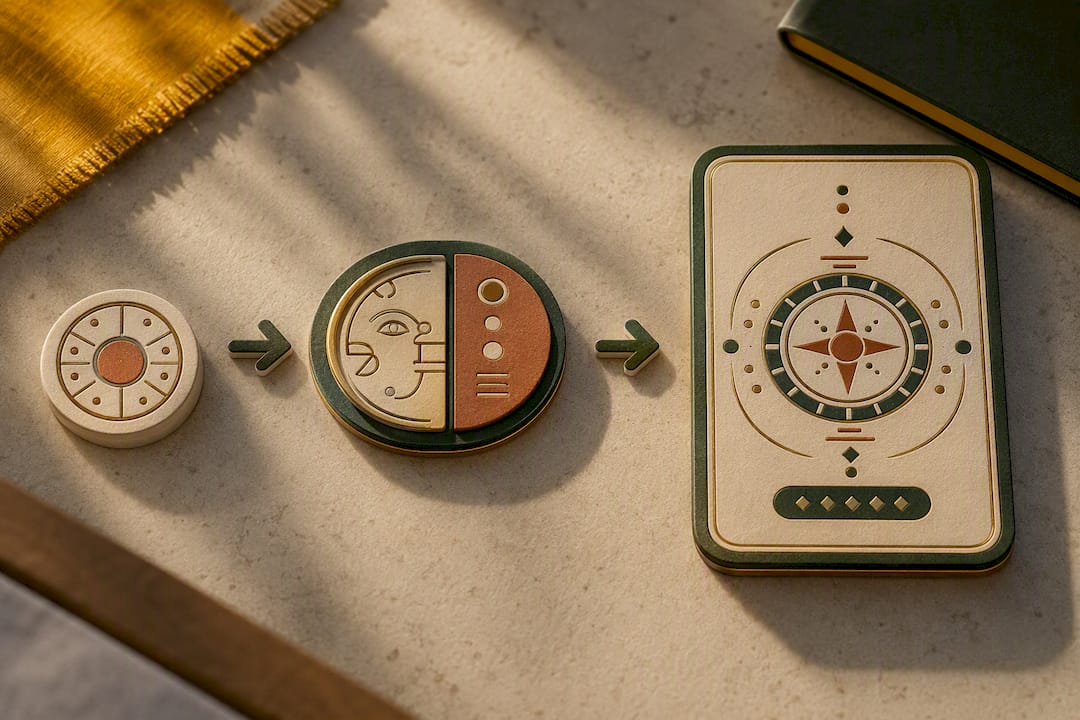
When New Year timing and your day sign intersect, whether your birthday falls during Wayeb, or your sign echoes a coming year’s presiding energy, that context adds real depth to how a reading gets interpreted. If you’re curious where you land, the free Mayan sign calculator is the simplest starting point, and it pairs naturally with ongoing resources like daily Mayan wisdom readings for anyone who wants to keep tracking the cycle beyond a single lookup.
A Respectful Way to Approach a Living Tradition
These ceremonies belong to Maya communities practicing them right now, not to a museum shelf. Curiosity is welcome, but it works best paired with humility: read the primary sources, ask before you photograph or join a ceremony, and let local calendar keepers, not internet infographics, define what a given year’s rites mean.
— Fatih
Discover Your Own Day Sign and Tone
Once you understand how a Year Bearer shapes a year’s meaning, the natural next question is personal: what sign governs your birth date? A free calculator returns your Tzolk’in day sign and Galactic Tone in seconds, using the same 260-day count that ancient calendar keepers used to read the character of a year. Personalized reports can expand into the Tree of Life, compatibility patterns, and a fuller interpretation than a free lookup can offer, delivered as a digital report or through an ongoing subscription for continued daily guidance rather than a one-time snapshot. Nothing here requires prior knowledge of Maya cosmology going in. Start with what your Mayan sign reveals about you to see exactly what a full reading includes, then run your own birth date through the calculator to get your day sign and tone.
Sources
- The Calendar System | Living Maya Time (Smithsonian)
- The relationship between early colonial Maya New Year’s ceremonies and some almanacs in the Madrid Codex | Ancient Mesoamerica (Cambridge Core)
- It’s the journey not the destination: Maya New Year’s pilgrimage and self-sacrifice as regenerative power (Brea Project PDF)
Recommended
- Tzolkin Explained: The 260-Day Calendar of the Maya
- The 260-Day Calendar (Tzolk’in): How It Works and Why It Mattered
- Long Count Explained: Units, Notation, and Conversions
- Mayan Numerology: Convert Birthdate to Tzolkin Kin, Read Layers