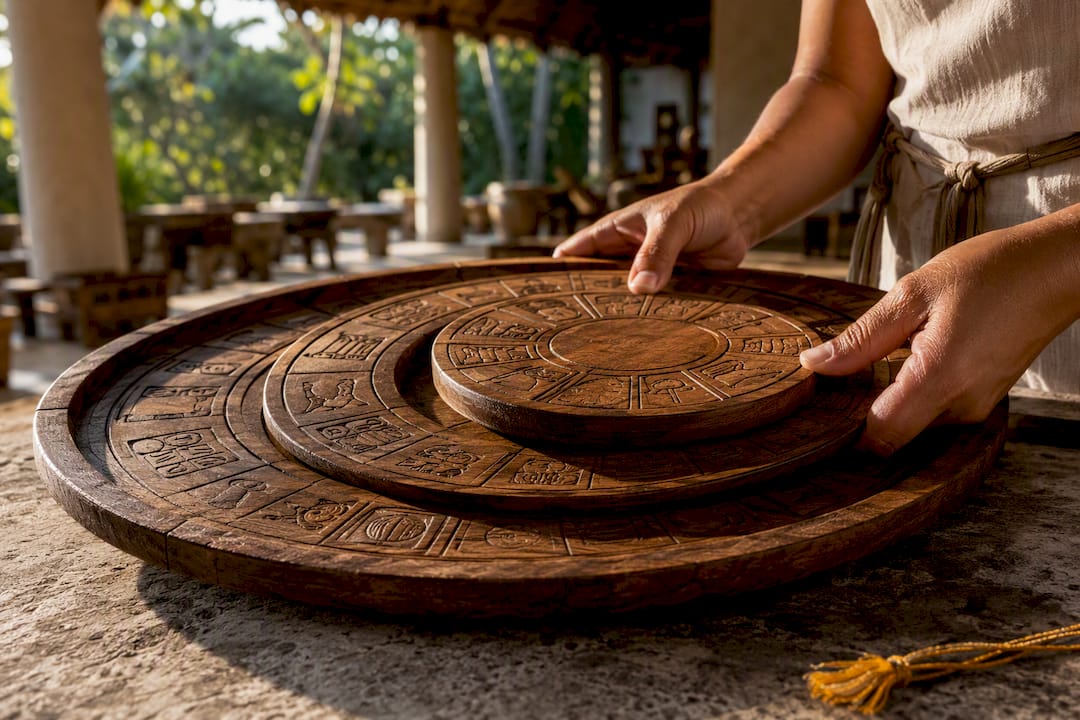
Your day lord is the Tzolk’in day-sign, one of twenty ancient patron energies, that governs the day you were born. It comes fixed with a Galactic Tone, a number from 1 to 13, that shapes how that energy actually moves through you. Because the Tzolk’in repeats on a 260-day cycle, this pairing is permanent. It was set the moment you were born, and it never changes again.
TL;DR:
- Your day lord is fixed by your birthdate, pairing a specific Maya sign with a Galactic Tone, which shapes how that energy manifests in your life.
- The Tone determines whether your sign’s traits act as initiatory sparks or endings, significantly affecting your leadership and decision-making style.
- Online tools help identify your day lord, but deeper understanding requires consulting trained Maya daykeepers or cultural practitioners.
- Each of the twenty sign carries distinct traditional meanings, with the tone adding nuance to how those traits show up in behavior and challenges.
- Knowing your day lord offers insights for better daily planning and self-awareness but should not be mistaken for fortune-telling or predictive judgment.
Table of Contents
- What Is the Tzolk’in and Why Does It Give You a Day Lord?
- How Do You Find Your Day Lord From Your Birth Date?
- How Does Your Galactic Tone Change What Your Day Lord Means?
- When Should You Consult a Traditional Daykeeper Instead of a Calculator?
- What Do Each of the 20 Day Lords Mean?
- How Does Your Day Lord Fit Into the Larger Maya Calendar System?
- How Can Knowing Your Day Lord Actually Change Your Daily Life?
- What Do People Get Wrong About Day Lords?
- How MyMayanSign Approaches Day Lord Readings
- Ready to Find Your Own Day Lord?
- Sources
What Is the Tzolk’in and Why Does It Give You a Day Lord?
The Tzolk’in is a 260-day sacred calendar built from two interlocking wheels: twenty day-signs called nahuales, and thirteen numbered tones. Think of it like two gears turning together. One gear has twenty teeth, each stamped with a different sign. The other has thirteen, each carrying a number. As they rotate in tandem, every combination of sign and number eventually lines up, and it takes exactly 260 days to cycle through all of them before the pattern repeats.
That math is not arbitrary poetry. Twenty signs multiplied by thirteen tones equals 260 distinct combinations, or kin, and no two days in the cycle share an identical pairing. The Maya Calendar Converter maintained by the National Museum of the American Indian lets you plug in any Gregorian date and watch it resolve into its Tzolk’in equivalent, sign and tone both. Because the cycle is fixed and repeating, the day-sign tied to your birth date never shifts. It is not like a horoscope that recalculates with planetary transits. It is closer to a fingerprint pressed into the calendar the day you arrived.
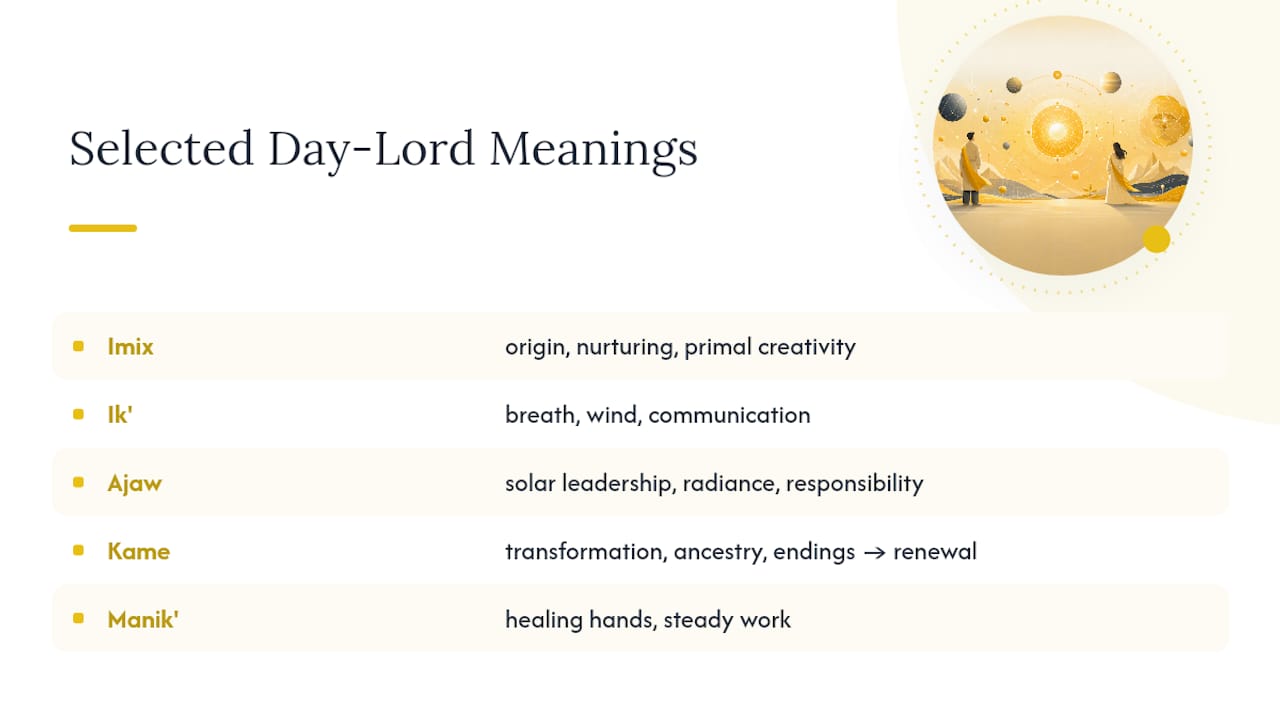
The twenty nahuales carry names like Imix, Ik’, Ajaw, and Kame, each rooted in Maya cosmology and tied to distinct qualities:
- Earth and beginning signs (such as Imix) that relate to origin, nurturing, and primal energy
- Wind and spirit signs (such as Ik’) associated with breath, communication, and clarity
- Solar and authority signs (such as Ajaw) linked to leadership, radiance, and responsibility
- Transformation signs (such as Kame) tied to endings, ancestry, and renewal
Scholars like Susan Milbrath have traced how this structure grew out of careful astronomical observation, not guesswork, giving the calendar’s ritual use a documented cosmological foundation. Your day-sign is not a label pulled from thin air. It is a fixed coordinate inside a system that has tracked time this way for well over two thousand years.
How Do You Find Your Day Lord From Your Birth Date?
Finding your day lord takes less time than reading this sentence twice. Here is the process:
- Gather your exact Gregorian birth date. Month, day, and year, no rounding.
- Enter it into a Tzolk’in converter. The museum’s calendar converter or the MyMayanSign calculator will both translate your date into its Tzolk’in equivalent.
- Read the two outputs together. You will see a nahual (your day-sign, such as Ajaw or Imix) paired with a number from 1 to 13 (your Galactic Tone).
- Note both parts as a single unit. Your day lord is not just “Ajaw.” It is “Ajaw, Tone 9,” or whichever pairing your birth date produces.
That gives you the bare skeleton. A free calculator tells you what your day lord is. It does not tell you much about what that means for your life, and that gap is exactly where a fuller reading earns its place.
A personalized report layers in context the quick lookup skips entirely: your Tree of Life placement, your trecana (the 13-day period your kin belongs to), compatibility with other signs in your life, and a narrative that connects your sign and tone to daily patterns rather than a static definition. If you want the free version first and the depth later, MyMayanSign’s birthday calendar guide walks through the same conversion with extra explanation along the way.
Pro Tip: Write down both your day-sign and your tone the moment you find them. People often remember the sign name and forget the number, but the number is half the reading. Without it, you’re only getting a partial picture.
How Does Your Galactic Tone Change What Your Day Lord Means?
A day-sign without its tone is a sentence missing its verb. The tone is not decoration sitting next to the sign. It is what tells you how that sign’s energy actually behaves, whether it moves fast or slow, whether it pushes outward or holds inward. Practitioners are consistent on this point: reading a sign’s name alone, without its numbered tone, produces an incomplete picture of what that day carries.
Picture two people, both carrying the Ajaw sign, the day-sign tied to leadership and radiance in traditional day-name collections documented by museum researchers. One carries Ajaw with Tone 1, the tone of origin and initiation. Their leadership tends to show up as the spark that starts something new, the person who launches the idea before anyone else sees it. The other carries Ajaw with Tone 13, the tone of completion and transcendence. Their leadership looks different: less about starting, more about carrying something across the finish line, closing a chapter with authority rather than opening one.
Same sign. Same core traits. Two very different expressions, because the tone is doing real interpretive work.
When you sit with your own day lord, four questions tend to surface the most useful reflection:
- What strength does my day-sign traditionally carry, and where do I already see it in my life?
- What challenge or friction does this sign tend to warn against?
- What kind of action or decision does my tone suggest I lean into?
- Are there specific days in the cycle, tied to my sign, worth treating as reflective or ceremonial?
Those four prompts turn a static definition into something you can actually use.
When Should You Consult a Traditional Daykeeper Instead of a Calculator?
A calculator gives you the mechanics. It cannot give you what a trained Ajq’ij, a Maya daykeeper, carries: the lived, communal context these signs have held for generations. Daykeepers like K’iche’ Maya daykeeper Hermelinda Sapon Pu describe the day sign’s role in fostering personal balance and community-oriented meaning, something a free online tool was never built to replicate.
An online reading works well for personal reflection, curiosity, or a starting point into Maya cosmology. It works less well as a stand-in for ceremonial guidance, major life decisions rooted in tradition, or questions about your specific community’s practices. If you find yourself wanting that deeper layer, a trained practitioner or cultural center is the better next step, not a bigger website.
A few habits keep your exploration respectful:
- Credit where information comes from rather than presenting a personal reading as settled cultural fact.
- Treat online tools as an entry point into the tradition, not the final word on it.
- Recognize that day-sign meaning has always been communal knowledge, held and taught by people, not just data on a screen.
What Do Each of the 20 Day Lords Mean?
Each of the twenty nahuales carries its own traditional character, and knowing where your sign sits among them helps the reading land with more weight. A few illustrate the range well.
Imix opens the cycle and carries associations with origin, nurturing, and primal creative force, the energy of a beginning before it has taken shape. Ik’ relates to breath, wind, and communication, often read as the sign of ideas moving between people. Ajaw, mentioned above, carries solar and leadership associations, tied to radiance and responsibility. Kame governs transformation and ancestry, read traditionally as the sign of endings that clear space for renewal.
Others carry equally distinct character: Kan ties to growth and generative energy, Chikchan to instinct and life force, Kimi (sometimes rendered Kame in variant spellings) to release, and Manik’ to healing hands and steady work. Lamat carries associations with abundance and star energy, while Muluk relates to emotional depth and purification.
Rather than memorizing all twenty in isolation, the more useful approach is contextual: look up your specific sign through a resource like the NMAI’s collected day meanings and read it alongside your tone. The sign tells you the character. The tone tells you how that character shows up.
How Does Your Day Lord Fit Into the Larger Maya Calendar System?
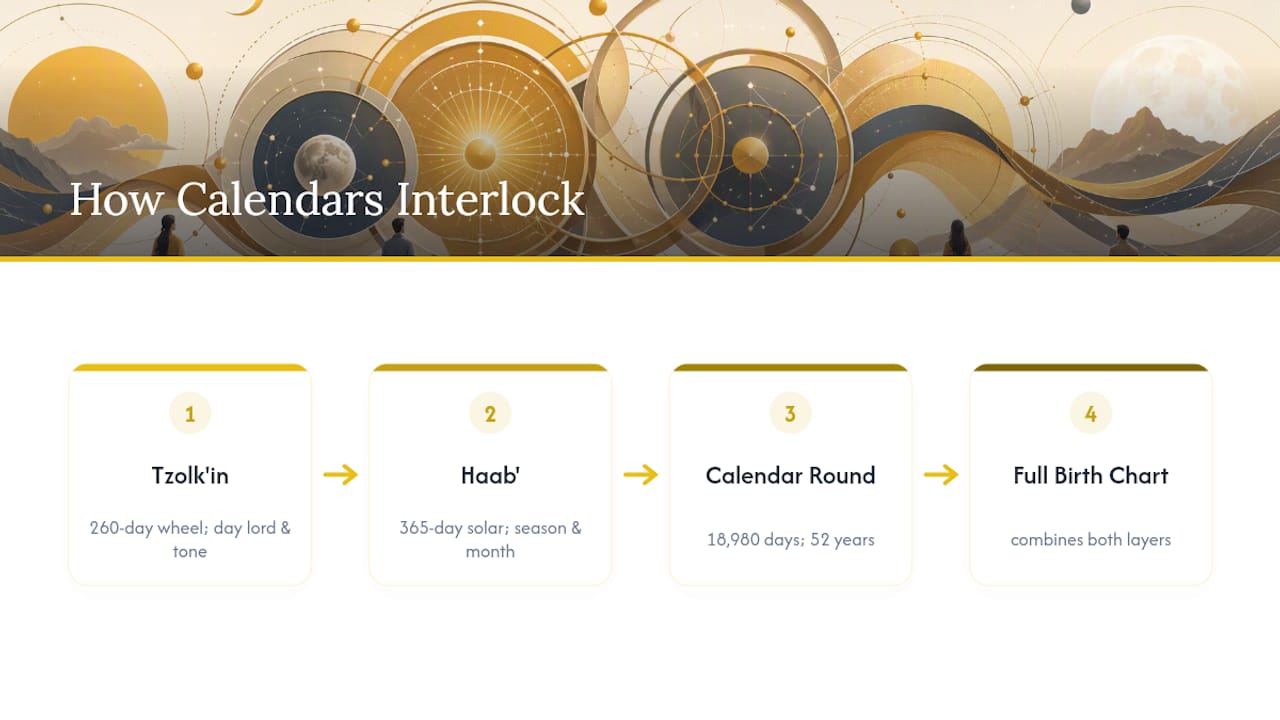
The Tzolk’in never operates alone. Maya timekeeping ran on a parallel system called the Haab’, a 365-day solar calendar tracking agricultural and seasonal cycles. Where the Tzolk’in gives you your day lord, the Haab’ gives you the season and civil month you were born into.
The two calendars interlock into what scholars call the Calendar Round, a combined cycle that takes 52 years to fully repeat, since a specific Tzolk’in date only realigns with a specific Haab’ date once every 18,980 days. Your day lord is your fixed sign within the shorter 260-day wheel, but your full birth chart in traditional Maya cosmology also accounts for where that day fell within the solar year, adding a second layer scholars have traced through lunar series and patron-deity glyphs in the historical record.
For most personal reflection, your day-sign and tone carry the bulk of the practical meaning. The Haab’ and Calendar Round matter more for readers going deeper into the tradition’s full architecture, particularly anyone curious about how ancient timekeepers tracked both spiritual and agricultural time simultaneously.
How Can Knowing Your Day Lord Actually Change Your Daily Life?
Knowing your day lord is not about predicting Tuesday’s weather. It works more like a lens you hold up to patterns you probably already sense in yourself but have never had language for.
If your sign leans toward instinct and quick decision making, that knowledge might explain why slow, committee-style planning drains you. If your tone carries completion energy, you might notice you are the person who always finishes what others start, and that noticing alone can reframe how you plan your week. People use their day lord to pick better days for launching projects, to understand recurring friction with certain personality types, or simply to feel more anchored in a lineage of meaning older than their own biography.
None of this replaces practical judgment. It supplements it, offering a reflective structure for questions you were already asking about yourself.
What Do People Get Wrong About Day Lords?
The most common misconception treats a day lord like a horoscope sign, something that predicts fortune or dictates fate. Traditional Maya cosmology frames it differently: as a map of tendencies and inherent character, not a forecast of outcomes.
A second myth: that the sign alone tells the whole story. As covered above, the tone carries roughly half the interpretive weight, and skipping it produces a flattened reading that misses real nuance.
A third misconception assumes every source agrees on translations and meanings. Variant spellings (Kame versus Kimi, for instance) and slightly different traditional emphases exist across regions and lineages, which is exactly why crediting a specific source matters more than treating any single website as the definitive cultural authority.
How MyMayanSign Approaches Day Lord Readings
Personalized readings are built around three connected pieces: your day-sign, your Galactic Tone, and your Tree of Life placement. The goal has always been educational reflection rooted in respect for where this knowledge comes from, not fortune telling dressed up in Maya imagery.
A reading here is meant to work as a mirror, a way to see patterns already present in your life, rather than a verdict on what will happen next. Nothing on this site substitutes for the guidance of trained Maya daykeepers or for legal, medical, or financial decisions. Treat your day lord as a starting point for self-reflection, grounded in a real tradition, not a shortcut past it.
— Fatih
Ready to Find Your Own Day Lord?
You have the mechanics now: sign, tone, and how they combine into a fixed kin. The fastest way to see your own is the free Mayan Sign Calculator, which returns your nahual and Galactic Tone the moment you enter your birth date, no waiting, no guesswork about which converter to trust.
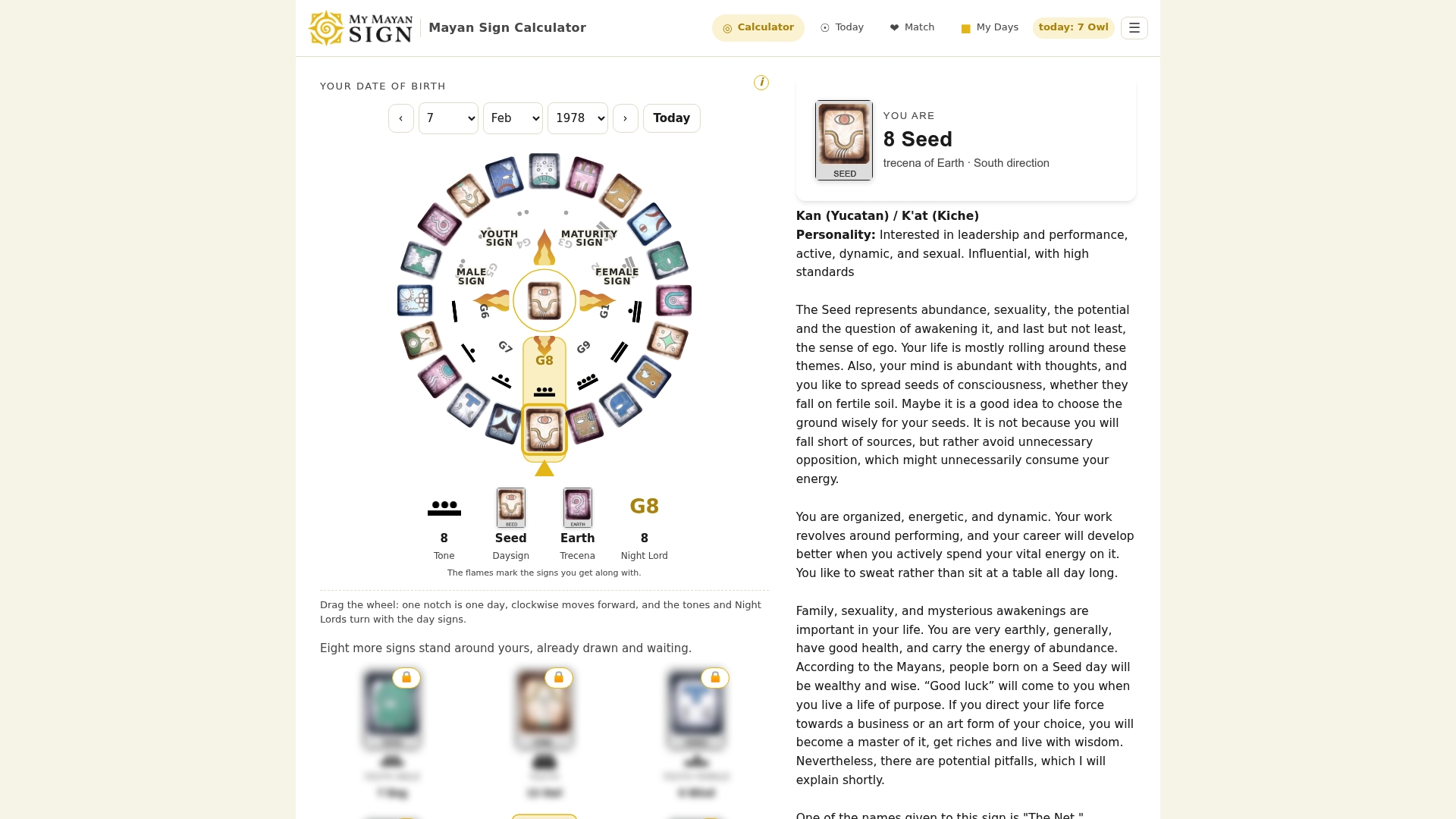
That free result gives you the skeleton. What it cannot give you is the full body of interpretation: how your sign and tone interact with your Tree of Life placement, how your kin compares with someone else’s for compatibility, or an ongoing narrative that connects your day lord to actual daily decisions. MyMayanSign’s personalized reports build that out in detail, and the Daily Mayan Wisdom product extends it further with ongoing guidance tied to your specific sign. Start with the Mayan astrology overview if you want to see the full range of what a personalized reading includes before you commit to one.
Sources
Recommended
- Find Your Day Keeper Meaning in Seconds With the 260 Day Tzolk’in
- Find Your Daily Focus: 13 Galactic Tones Meaning, Code Words & Prompts
- Mayan Numerology: Convert Birthdate to Tzolkin Kin, Read Layers
- What Is My Mayan Sign? Find It From Your Birth Date