
How to convert your Gregorian birthdate to the Mayan birthday calendar
Your Mayan birthday calendar sign is already encoded in the date you were born. The key that unlocks it is the Goodman-Martínez-Thompson correlation constant 584,283, the universally accepted calibration that aligns Gregorian dates to the Mayan calendar system. From that anchor, every birthdate maps to a specific position in the Tzolk’in sacred cycle, revealing your day sign, your tone, and your kin number.
Here is how the conversion works, step by step:
- Take your Gregorian birthdate and convert it to a Julian Day Number (JDN), a continuous count of days used in astronomy.
- Subtract the GMT constant (584,283) from your JDN to get your position in the Mayan day count.
- Divide that result by 260 and take the remainder. That remainder is your kin number, a value from 1 to 260 marking your exact position in the Tzolk’in cycle.
- From the kin number, calculate your tone (1–13) and your day sign (one of 20 named archetypes).
- Cross-reference with the Long Count calendar to find your baktun, katun, tun, uinal, and k’in values.
Pro Tip: The Mayan day begins at sunset, not midnight. If you were born after sunset, your true Maya day sign may belong to the following day. Early morning births before sunrise can correspond to the previous day’s sign. Always factor in your birth time for the most accurate Tzolk’in reading.
Key conversion essentials at a glance:
- GMT constant: 584,283 (the standard calibration for all Gregorian-to-Mayan conversions)
- Tzolk’in cycle: 260 days, combining 20 day signs and 13 tones
- Kin number: your unique position (1–260) within the Tzolk’in
- Long Count: five nested time units that place your birth in cosmic history
- Day start: sunset, not midnight
What are the Tzolk’in and Long Count calendars?
The Maya did not use a single calendar. They used interlocking systems, each measuring time at a different scale, the way a clock tracks seconds, minutes, and hours simultaneously.
The Tzolk’in is the sacred 260-day ritual calendar. It pairs 20 named day signs with 13 numerical tones, producing 260 unique combinations. No two consecutive days share the same pairing, and the full cycle resets only after all 260 positions have passed. Your birthday falls on one of those positions, and that position is your spiritual signature.
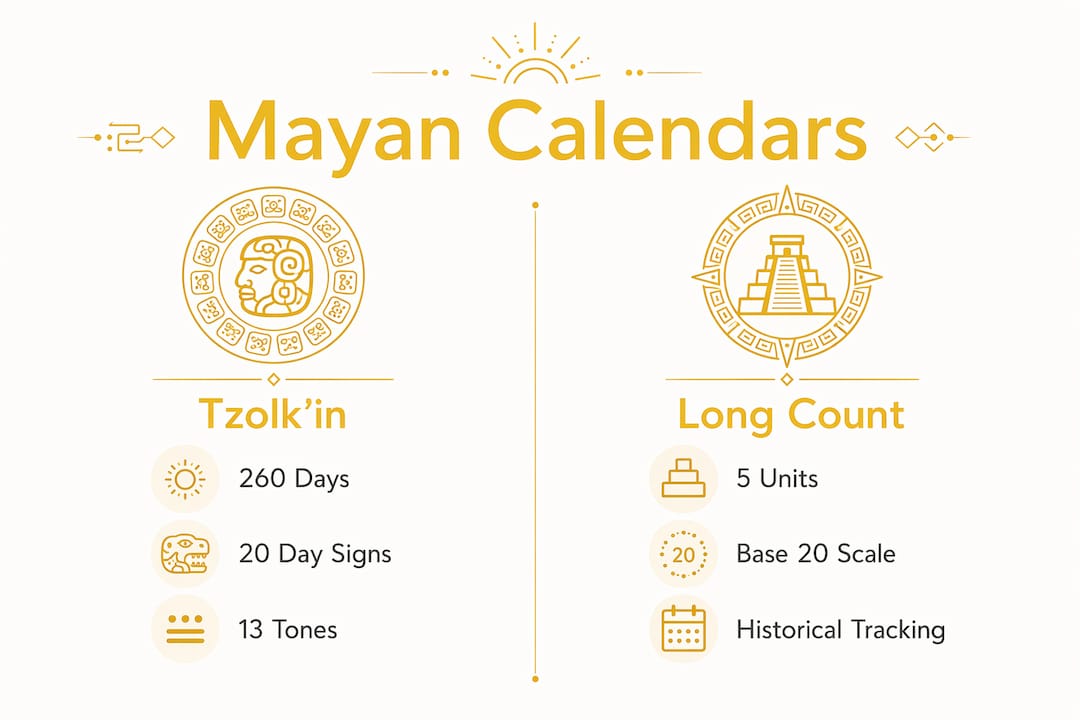
The Long Count calendar operates on a grander scale, tracking time in five nested units. One complete Long Count cycle spans 5,125 years, beginning from the Maya creation date of August 11, 3114 BCE. Think of it as the Maya equivalent of a cosmic timestamp, placing your birth not just in a week or a year but within a vast arc of civilizational time.
| Unit | Equivalent |
|---|---|
| K’in | 1 day |
| Uinal | 20 days |
| Tun | — |
| Katun | — |
| Baktun | — |
Together, the Tzolk’in and Long Count create a date that is both spiritually resonant and historically precise. Your Tzolk’in position tells you who you are in the sacred cycle. Your Long Count position tells you when you arrived in the larger story of time.
What does your Mayan day sign actually mean?
The 20 Tzolk’in day signs, called Nawals in K’iche’ Maya tradition, are not personality labels. They are archetypal energies, each rooted in nature, animals, and the full range of human experience. Your Nawal is the lens through which your life force expresses itself.
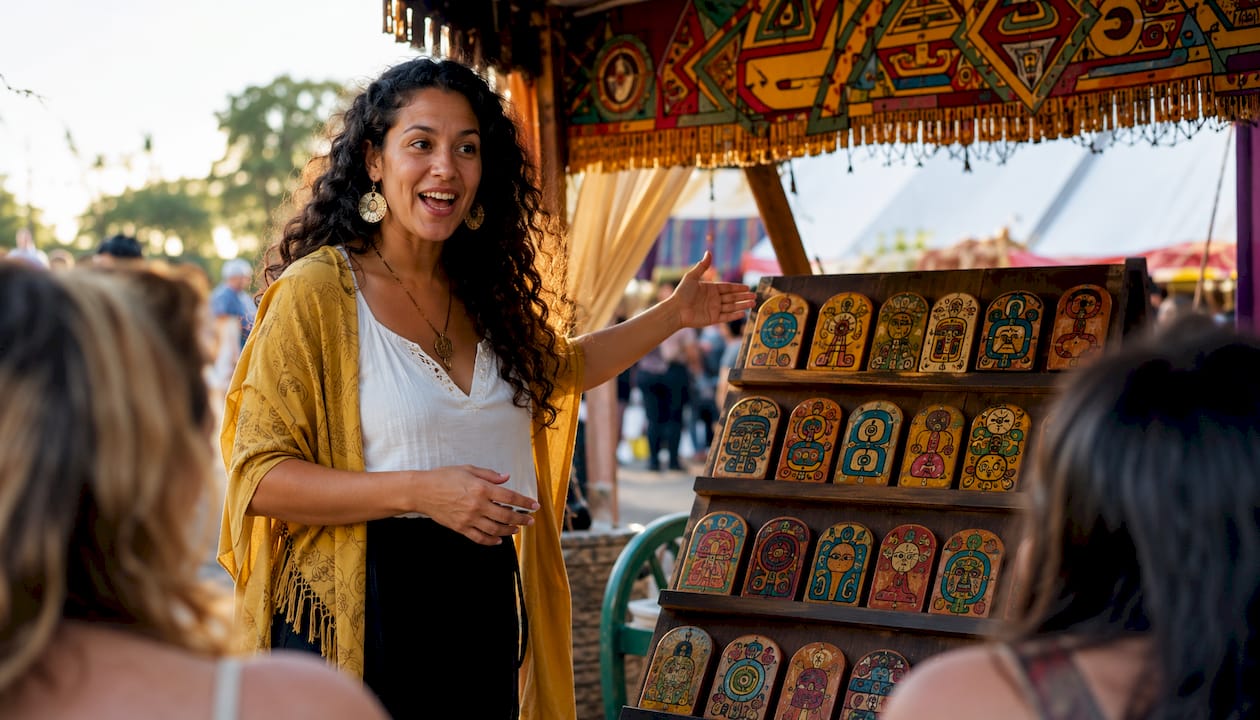
The 13 tones work differently. Where the day sign describes the quality of energy you carry, the tone describes its intensity and impulse. Tone 1 carries the energy of initiation; Tone 13 carries transcendence. Every combination of sign and tone creates a unique spiritual imprint that repeats only once every 260 days.
A sample of the 20 Nawals and their core qualities:
- Chikchan (Serpent): instinct, life force, Kundalini energy
The Mayan birthday meaning encoded in your day sign and tone is not a verdict on your character. It is a map, one that shows you the terrain of your strengths, your challenges, and the deeper purpose you carry into the world.
“The sacred calendar links animals, humans, land, and cosmos to guide daily energies and one’s purpose of creation. Each day relates to spiritual energy influencing behavior and destiny.”
— Hermelinda Sapon Pu, K’iche’ Maya daykeeper, via the Smithsonian National Museum of the American Indian
Cultural context and expert insights on Mayan astrology
The Smithsonian National Museum of the American Indian has worked directly with living Maya daykeepers to document and share these traditions, and their perspective reframes what most Westerners assume about Mayan astrology. This is not fortune-telling. It is a living cosmological system, still practiced in highland Guatemala and southern Mexico, that reads the relationship between a person’s inner energies and the rhythms of the natural world.
Hermelinda Sapon Pu, a recognized K’iche’ Maya daykeeper, describes the sacred calendar’s purpose as understanding the “purpose of creation,” the reason a soul chose to arrive on a particular day and what that arrival asks of them. That framing shifts everything. Your Mayan birthday is less a prediction and more an invitation to self-awareness.
One common misconception worth addressing here: many people assume the Mayan day begins at midnight, the way the Gregorian calendar does. It does not. The Maya day starts at sunset, which means a birth at 9 PM on a Tuesday technically belongs to Wednesday’s sign in the Mayan system. Getting this detail right changes your reading.
How to perform the date conversion accurately
The most reliable path to your Mayan sign is a dedicated online calculator that applies the GMT correlation automatically. Manual calculation is possible but requires working with Julian Day Numbers, modular arithmetic, and lookup tables for all 20 day signs. A single arithmetic error shifts your entire reading.
When choosing a conversion tool, look for these qualities:
- GMT correlation applied: the tool should explicitly use the 584,283 constant, not an alternative correlation
- Birth time input: the best tools ask for your time of birth to account for the sunset-start rule
- Full output: a complete reading includes your day sign (Nawal), your tone (1–13), your kin number (1–260), and ideally your Long Count date
- Cultural grounding: tools built with input from Maya scholars or daykeepers tend to produce more contextually accurate interpretations
The Tzolk’in birthday calculation is the foundation of any Mayan astrology reading. Once you have your kin number, every other layer of interpretation builds from it.
How to read your baktun, katun, tun, uinal, and k’in
Your Long Count date is written as a sequence of five numbers separated by dots, for example 13.0.11.4.2. Each position corresponds to one of the five time units, read from largest to smallest: baktun, katun, tun, uinal, k’in.
The baktun position places you within a roughly 394-year era of Maya history. The current baktun began on December 21, 2012, the date that marked the end of the 13th baktun and the opening of a new great cycle. Your katun position narrows that to a roughly 20-year period. The tun, uinal, and k’in positions then locate you within a specific year, month, and day of that cycle.
For personal interpretation, the k’in (your individual day) and the uinal (your 20-day period) carry the most direct relevance to your birthday reading. The katun and baktun provide generational context, the larger wave you were born into rather than the specific note you carry. Reading all five together gives you a sense of both your personal energy and the historical moment your soul chose to enter.
Pro Tip: The Maya Calendar Converter at the Smithsonian National Museum of the American Indian displays all five Long Count units visually alongside your Tzolk’in and Haab dates, making it one of the clearest reference tools for understanding how your birthday sits within the full Maya system.
Common myths about the Mayan birthday calendar
Several persistent myths cloud how people understand their Mayan birthday. Here are the ones worth correcting directly.
Myth: The Mayan calendar ended in 2012. The Long Count reached the end of its 13th baktun on December 21, 2012, which the Maya understood as the close of one great cycle and the opening of another. The calendar did not end. It reset, the way an odometer rolls over.
Myth: Your Mayan sign is equivalent to a Western sun sign. The Tzolk’in day sign is not a monthly zodiac. It changes every single day, cycling through all 20 signs over 20 days. Two people born a week apart can share the same Western sun sign but carry entirely different Nawals.
Myth: One calculator gives the same result as any other. Different tools use different correlation constants. The GMT correlation (584,283) is the scholarly standard, but some popular online tools use alternative correlations that shift the result by several days. Always verify which constant a tool applies.
Myth: The Mayan calendar is purely astronomical. The Tzolk’in has no direct astronomical basis. Its 260-day length likely reflects the human gestation period and the agricultural cycle of highland Mesoamerica, not a planetary orbit. The Long Count tracks astronomical cycles, but the sacred calendar operates on a human scale.
How knowing your Mayan birthday can shape your daily life
Your Mayan astrology signs are not meant to be read once and filed away. The Tzolk’in is a living cycle, and your day sign returns every 260 days, bringing with it a concentrated version of the energy you were born under. Many people who work with the Maya calendar use these return days as natural checkpoints for reflection, intention-setting, or ceremony.
Practically, knowing your Nawal can inform how you approach decisions. A person born under Ix (Jaguar) tends to access wisdom through solitude and earth-based practice; pushing them into high-visibility leadership roles against their nature often produces friction. A person born under B’en (Reed) carries natural authority and thrives when given structure to uphold. These are not limitations. They are invitations to work with your nature rather than against it.
The Galactic Tone adds another layer. Your tone number describes the style of your energy, whether you initiate, refine, activate, or complete. Pairing your tone with your day sign gives you a two-dimensional map of how your personal energy moves through the world.
Mymayansign brings your Mayan birthday reading to life
Your birthdate holds more than a number. Mymayansign translates it into a full personal portrait rooted in authentic Maya cosmology.
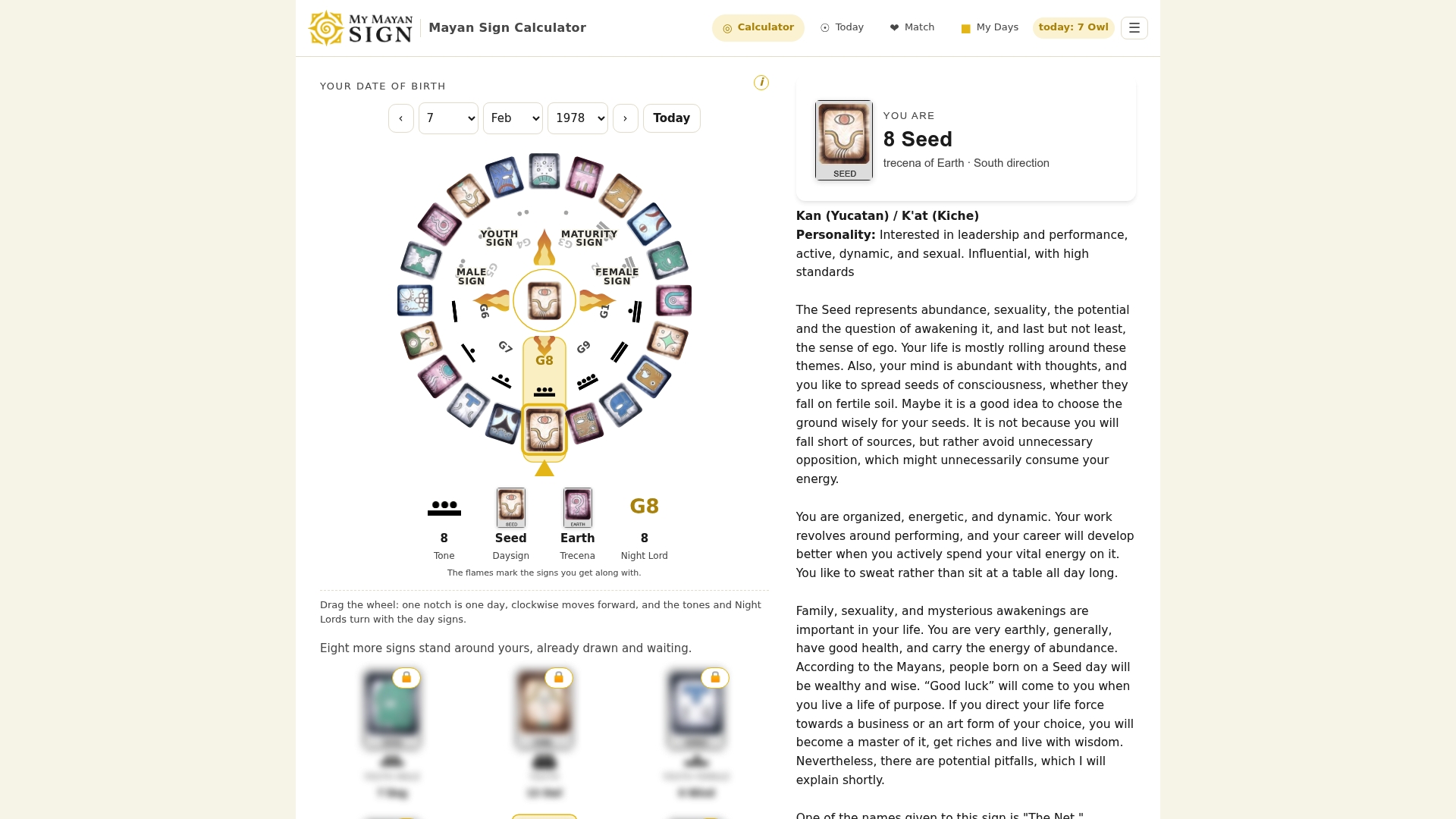
At Mymayansign, you can run a free Mayan sign calculation in seconds, then go deeper with a detailed paid report covering your Nawal, Galactic Tone, Trecena, and Tree of Life. The platform also offers a Daily Mayan Wisdom subscription that delivers personalized calendar insights each day, so the 260-day cycle becomes a living practice rather than a one-time lookup. For those who want to go further, the Sacred Teachings of Mayan Astrology eBook offers a thorough grounding in the cosmological framework behind every sign and tone. Every reading on Mymayansign is built on the GMT correlation and informed by the same daykeeper traditions the Smithsonian has documented.
Key Takeaways
Your Mayan birthday calendar sign is determined by the GMT correlation constant 584,283, which maps your Gregorian birthdate to a specific Tzolk’in day sign and tone within a 260-day sacred cycle.
| Point | Details |
|---|---|
| GMT correlation | The constant 584,283 is the standard for converting any Gregorian date to a Mayan calendar position. |
| Tzolk’in structure | The sacred 260-day cycle combines 20 day signs and 13 tones, producing 260 unique spiritual signatures. |
| Sunset day start | The Mayan day begins at sunset; births after sunset belong to the following day’s sign. |
| Long Count units | Five nested units (k’in, uinal, tun, katun, baktun) place your birth within a 5,125-year cosmic cycle. |
| Mymayansign | Offers a free Mayan sign calculator plus detailed paid reports covering your Nawal, Galactic Tone, and Trecena. |
Recommended
- What Is My Mayan Sign? Find It From Your Birth Date – MyMayanSign
- Mayan Sign Calculator | MyMayanSign
- Mayan Zodiac Sign Calculator | Free Day Sign & Tone
- Mayan Nahual: Find Your Day Sign and What It Means – MyMayanSign
Article generated by BabyLoveGrowth