
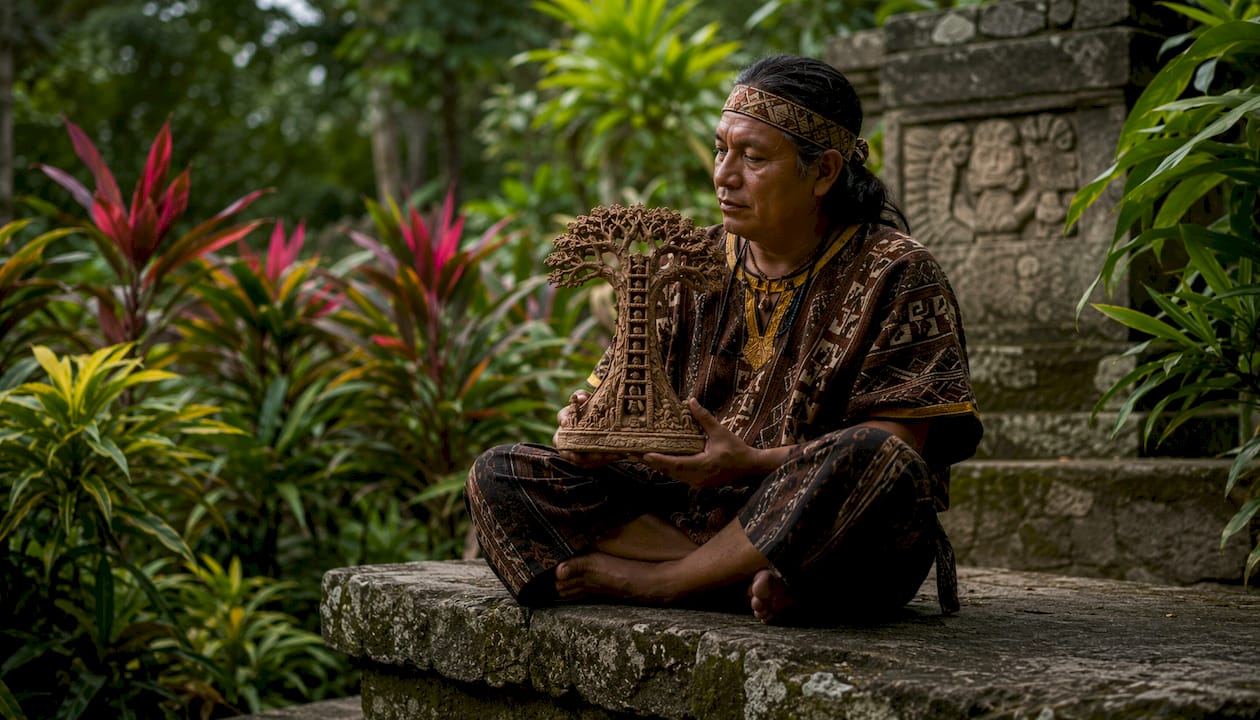
The mayan tree of life is defined as the cosmic axis mundi connecting three realms of existence: the underworld, the living world, and the heavens. Known in ancient Maya as Yax Che (“First Tree”) or Yaxche, it takes its most powerful physical form in the sacred Ceiba tree, a towering giant that the Maya regarded as the spine of the universe. This symbol carries two distinct roles that most readers never separate: a mythological pillar holding the cosmos together, and a personal astrological chart mapping your spiritual heritage from birth. Understanding both layers changes how you read the symbol entirely.
What is the symbolism and mythological significance of the Mayan Tree of Life?
The Mayan Tree of Life organizes the entire cosmos into three vertical layers, each with its own spiritual character. The Maya did not see these as abstract ideas. They built their cities, conducted their ceremonies, and told their most sacred stories around this three-part structure.
The three cosmic realms are:
- Xibalba (the underworld): Nine descending layers ruled by death lords, where souls travel after death and where the tree’s roots draw their nourishment
- The middleworld: The surface of the earth where living beings exist, represented by the trunk of the Ceiba
- The thirteen heavens: Ascending celestial layers where gods and ancestors reside, supported by the tree’s canopy
The Popol Vuh, the K’iche’ Maya creation text, places the World Tree at the center of the Hero Twins narrative. The twins Hun Hunahpu and Xbalanque descend into Xibalba, die, and are reborn. Their story mirrors the tree’s own function: roots feeding on the underworld to nourish the heavens above. Death does not end the cycle. It powers it.
“The Tree of Life carries souls upward while drawing nutrition from the underworld, embodying the paradox that life and death are not opposites but partners in a single, unbroken cycle.”
The Ceiba’s red resin deepened this symbolism. The bleeding sap tied the tree to blood sacrifice rituals, the acts the Maya believed sustained cosmic order. Ancient Maya architects placed Ceiba trees at the centers of plazas and oriented entire city plans around this axis. Tikal, Palenque, and Chichen Itza all reflect this cosmological ordering in their spatial design.
Pro Tip: When you visit a Maya archaeological site, look for the central plaza. That open space was intentionally aligned to represent the middleworld, with temple pyramids on each cardinal direction representing the four cosmic trees that supported the sky.
Why does the Ceiba tree embody the World Tree so completely?
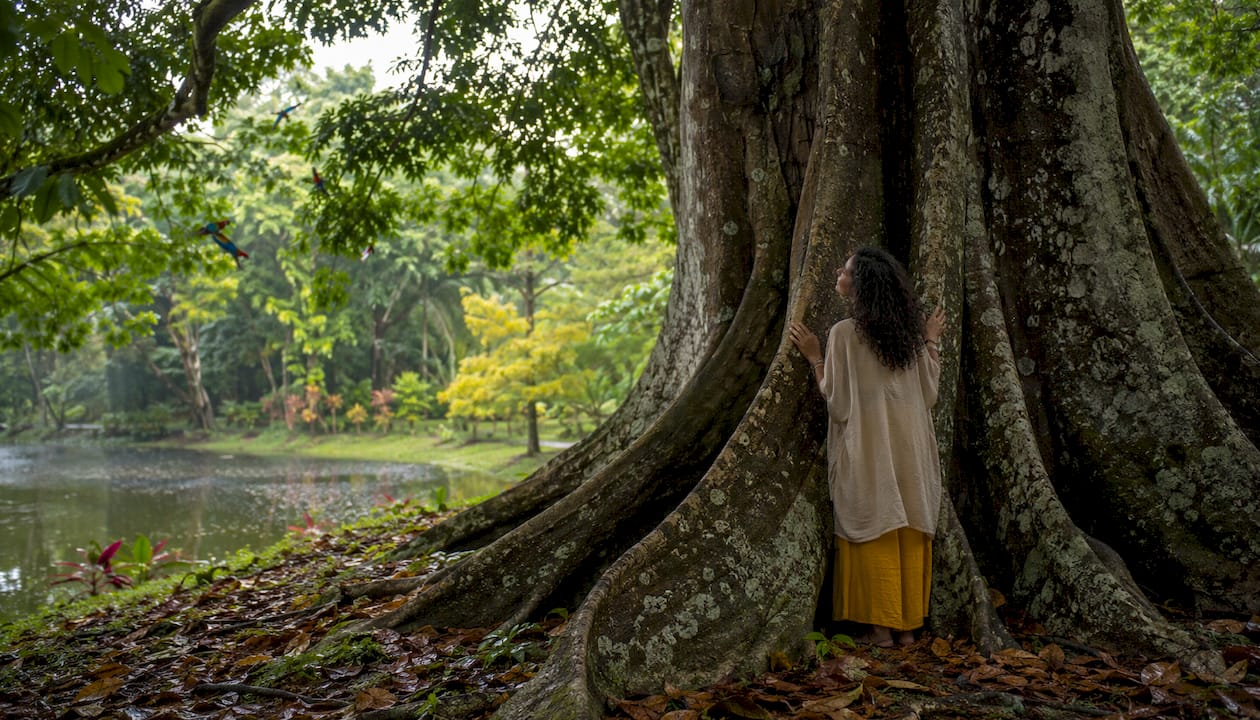
The Ceiba’s biology makes it an almost perfect physical metaphor for the cosmic axis. The tree can exceed 200 feet in height and grows faster than nearly any other tropical species. That combination of speed and scale gave the Maya a living demonstration of cosmic power.
| Ceiba feature | Symbolic meaning in Mayan cosmology |
|---|---|
| Deep, spreading roots | Connection to Xibalba, the nine-layered underworld |
| Massive, straight trunk | The middleworld axis linking earth to sky |
| High, wide canopy | The thirteen heavens, sheltering all living things |
| Protective thorns (sapling stage) | Spiritual protection; the sacred cannot be approached carelessly |
| Red bleeding resin | Cosmic blood sustaining the universe’s life force |
| Kapok fiber from fruit | Practical life woven from sacred ecology |
The thorns on young Ceiba saplings carry a specific teaching. They disappear as the tree matures, just as a person’s spiritual defenses shift from reactive to integrated over a lifetime. The Maya read this biological fact as a direct cosmological lesson.
Ceiba kapok fibers were used for clothing and pillow stuffing across Maya communities. That practical use was never separate from the sacred one. The Maya did not divide the spiritual from the material. The same tree that held up the sky also clothed the living.
Pro Tip: If you want to see a living Ceiba, many botanical gardens across the American South and in Florida cultivate them. Standing beneath one gives you an immediate, physical sense of why the Maya chose this tree as the center of their universe.
What is the Mayan Tree of Life in astrology and how does it map personal charts?
The astrological Tree of Life is a distinct concept from the mythological World Tree, though both share the same symbolic roots. This distinction matters. The World Tree is a universal cosmic structure. The personal Tree of Life is a map of your individual spiritual heritage, calculated from your birth date.
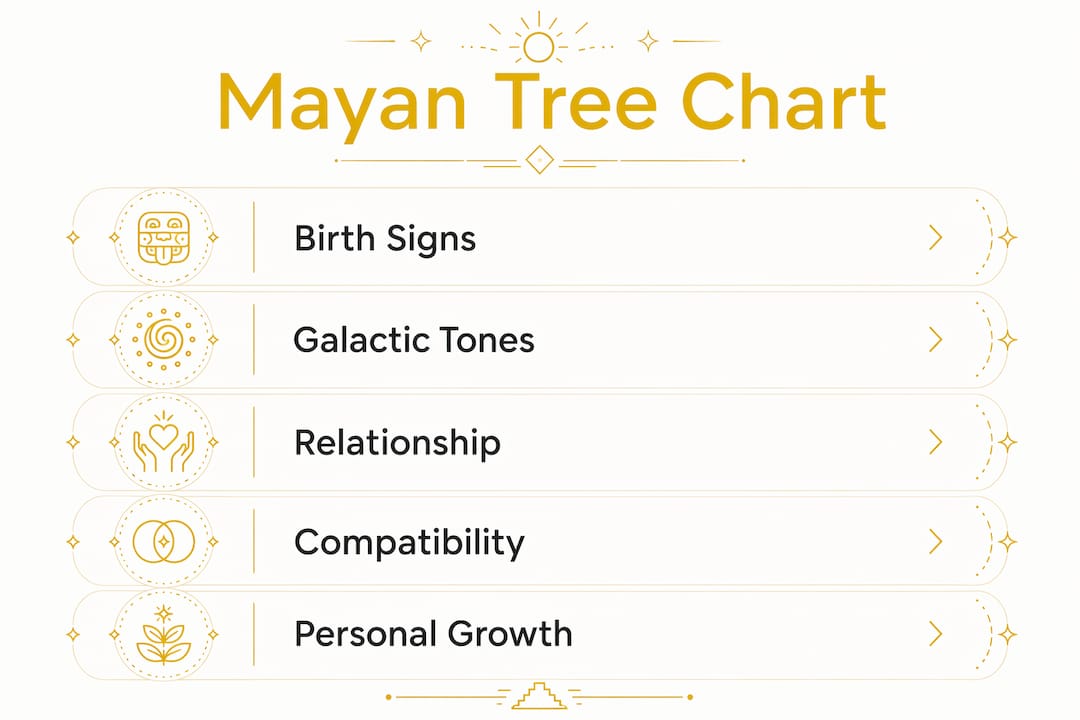
A Mayan Tree of Life birth chart contains nine unique signs, each occupying a specific position in the chart’s structure. Each sign corresponds to a different aspect of your character, your spiritual gifts, your challenges, and your purpose. Think of it less as a verdict and more as a mirror showing you energies you already carry.
The nine positions in a personal chart include:
- Your core day sign (the Nawal governing your soul’s essence)
- Your Galactic Tone (the energy frequency of your birth)
- Signs governing your mind, body, spirit, and relationships
- Signs that reveal your past life influences and future direction
- A sign representing your hidden or shadow self
The relationship Tree of Life chart works differently. Relationship charts combine the signs and tones of two individuals to generate a third, distinct chart. That third chart does not describe either person alone. It describes the relationship itself as its own energetic entity with its own character and guiding forces. This approach treats every partnership as something genuinely new, not just the sum of two personalities.
The Mayan compatibility analysis goes beyond the question “Are we compatible?” It asks, “What is this relationship here to teach us?” That reframing is one of the most useful things Mayan astrology offers modern readers.
How is the Mayan Tree of Life alive in contemporary culture?
The Tree of Life is not a relic. Seven million Maya people continue practicing traditions rooted in its symbolism today, from Guatemala and Mexico to Belize and Honduras. The symbol has never stopped working.
Contemporary expressions of the Tree of Life include:
- Ceremonial planting: Maya communities still plant Ceiba trees at village centers as a living reminder of the cosmic axis
- Textile art: Weavers in highland Guatemala incorporate the inverted tree image into traditional huipiles, representing roots reaching toward the sky as a sign of spiritual aspiration
- Daily calendar practice: Maya day keepers (Ajq’ij) consult the Tzolk’in calendar daily, reading each day’s sign as a branch of the living cosmic tree
- Healing ceremonies: Ceiba bark and leaves appear in traditional medicine, where their use is inseparable from prayer and cosmological intention
- Astrological birth readings: Families in some Maya communities still consult a day keeper at a child’s birth to read their Tree of Life chart and understand the child’s spiritual path
The inverted tree image in Maya textiles deserves special attention. Roots pointing upward and branches pointing downward represent the idea that what nourishes life comes from above, from the heavens, while what grounds it reaches into the earth. This reversal is not an error. It is a deliberate cosmological statement about the direction of spiritual growth.
Key Takeaways
The Mayan Tree of Life is both a universal cosmic map and a personal spiritual chart, making it one of the most layered symbols in any indigenous tradition.
| Point | Details |
|---|---|
| Cosmic axis structure | The Tree connects Xibalba (underworld), the middleworld, and thirteen heavens in a single vertical axis. |
| Ceiba as living symbol | The Ceiba tree’s biology, its height, roots, thorns, and resin, directly mirrors its cosmological role. |
| Personal birth charts | A Mayan Tree of Life birth chart contains nine unique signs mapped to specific aspects of your spiritual identity. |
| Relationship charts | Two people’s signs combine to create a third chart describing the relationship as its own spiritual entity. |
| Living tradition | Seven million Maya people maintain Tree of Life ceremonies, art, and calendar practices today. |
What the tree taught me that no textbook could
When I first studied the Mayan Tree of Life seriously, I made the same mistake most Western readers make. I treated it as mythology. A beautiful story, yes, but a story. What shifted my understanding was spending time with the astrological charts.
The nine-sign birth chart is not decorative. Each position holds a specific tension, a quality you are born with and a quality you must develop. The “shadow sign” position alone contains more psychological insight than most personality frameworks I have encountered. It names the energy you resist in yourself, the part of your character that operates below your awareness.
What modern seekers often miss is the Tree’s central teaching about death. The Maya did not fear death because the tree showed them that death feeds life. The roots of the Ceiba reach into Xibalba not to escape it but to draw from it. That is a genuinely different relationship with mortality than most American spiritual traditions offer. You do not transcend the underworld. You metabolize it.
The relationship chart insight surprised me most. Treating a partnership as its own living entity with its own Tree of Life chart changes every conversation about compatibility. You stop asking whether two people match and start asking what the relationship itself is built to accomplish. That question produces far more useful answers.
If you have not yet read your own nine-sign birth chart, start there. The tree is not a symbol you observe from a distance. It is a map you carry inside you.
— Fatih
Your personal Tree of Life chart is waiting
The Mayan Tree of Life becomes most meaningful when you see it reflected in your own birth date. Mymayansign translates this ancient cosmological system into clear, personalized readings built from your exact date of birth.
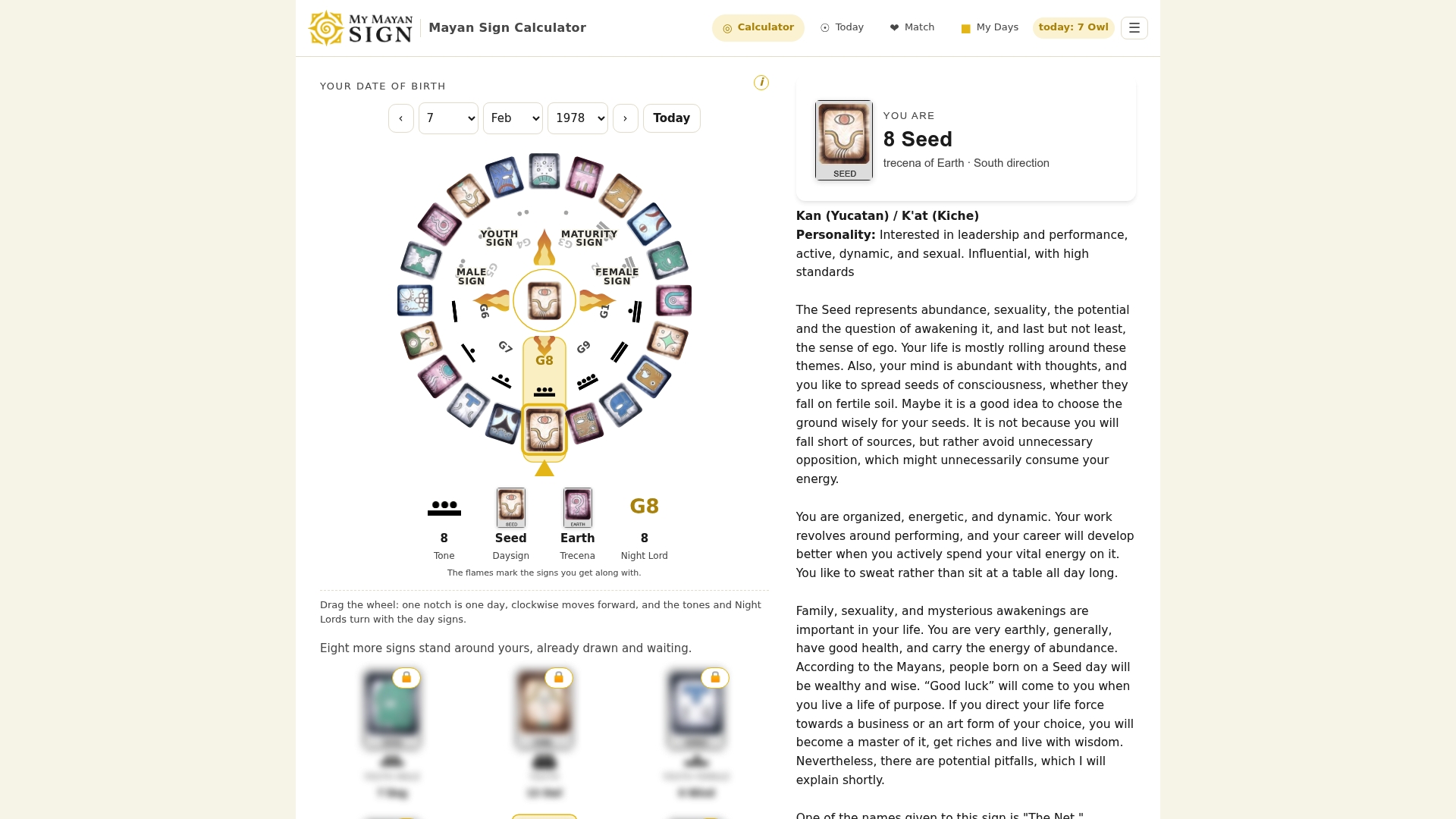
Start with Mayan astrology explained to understand the full system, including the Tzolk’in calendar and the twenty-day signs that form the foundation of every chart. From there, use the Mayan sign calculator to generate your nine-sign Tree of Life birth chart and see which energies govern each area of your life. Mymayansign also offers a relationship compatibility analysis that builds a full Tree of Life chart for you and a partner, revealing the spiritual character of your connection. For daily guidance rooted in the living calendar, the Daily Mayan Wisdom product brings the tree’s teachings into your everyday practice.
FAQ
What does the Mayan Tree of Life represent?
The Mayan Tree of Life represents the cosmic axis connecting the underworld (Xibalba), the living world, and the thirteen heavens. Its physical embodiment is the sacred Ceiba tree, which the Maya placed at the center of their cities and ceremonies.
How many signs are in a Mayan Tree of Life birth chart?
A personal Mayan Tree of Life birth chart contains nine unique signs, each governing a different aspect of your spiritual identity, from your core soul energy to your shadow self.
What is tree of life compatibility in Mayan astrology?
Tree of life compatibility combines two individuals’ signs and Galactic Tones to generate a third, distinct chart describing the relationship itself as a unique spiritual entity, not just a measure of how well two people match.
Why is the Ceiba tree sacred to the Maya?
The Ceiba is sacred because its biology mirrors the cosmic structure: deep roots reaching the underworld, a towering trunk spanning the living world, and a high canopy touching the heavens. Its red resin, protective thorns, and rapid growth all carry specific cosmological meanings.
Is the Mayan Tree of Life still used today?
Seven million Maya people continue practicing traditions connected to the Tree of Life, including ceremonial Ceiba planting, Tzolk’in calendar readings, and astrological birth chart consultations with traditional day keepers.
Recommended
- Mayan Astrology Blog | Day Signs, Tzolkin & Calendar
- Mayan Astrology Explained: Signs, Meanings & Tzolk’in
- Daily Mayan Wisdom – MyMayanSign
- Mayan Sign Calculator | MyMayanSign
Article generated by BabyLoveGrowth