

Mayan glyph meanings are encoded in a logosyllabic writing system where each symbol can represent a sound, a word, or an entire concept. The ancient Maya developed one of the most sophisticated scripts in the pre-Columbian world, recording everything from royal bloodlines to cosmic calendars on stone monuments, temple walls, and folded bark-paper books called codices. Scholars estimate over 800 glyphic elements exist within this system, and only a portion have been fully deciphered. That gap makes every new reading feel like opening a sealed room. If you want to understand what these symbols actually say and why they still matter, this guide walks you through the structure, symbolism, and cultural depth behind ancient Mayan writing.
What do Mayan glyph meanings actually represent?
Mayan glyphs are not a simple alphabet. Glyph blocks contain a main sign plus smaller attached elements called affixes, which modify or extend the meaning of the central symbol. Think of each block as a small sentence compressed into a single visual unit. One block might combine a logogram for a deity’s name with phonetic affixes that spell out a grammatical ending.
Glyphs serve four distinct functions in Maya inscriptions:
- Phonetic syllabograms: Represent a consonant-vowel syllable sound, similar to Japanese kana.
- Logograms: Represent a whole word or concept, like Egyptian hieroglyphs.
- Calendar and number signs: Record dates, cycles, and astronomical events.
- Symbolic or ritual markers: Signal sacred events, offerings, or cosmological states.
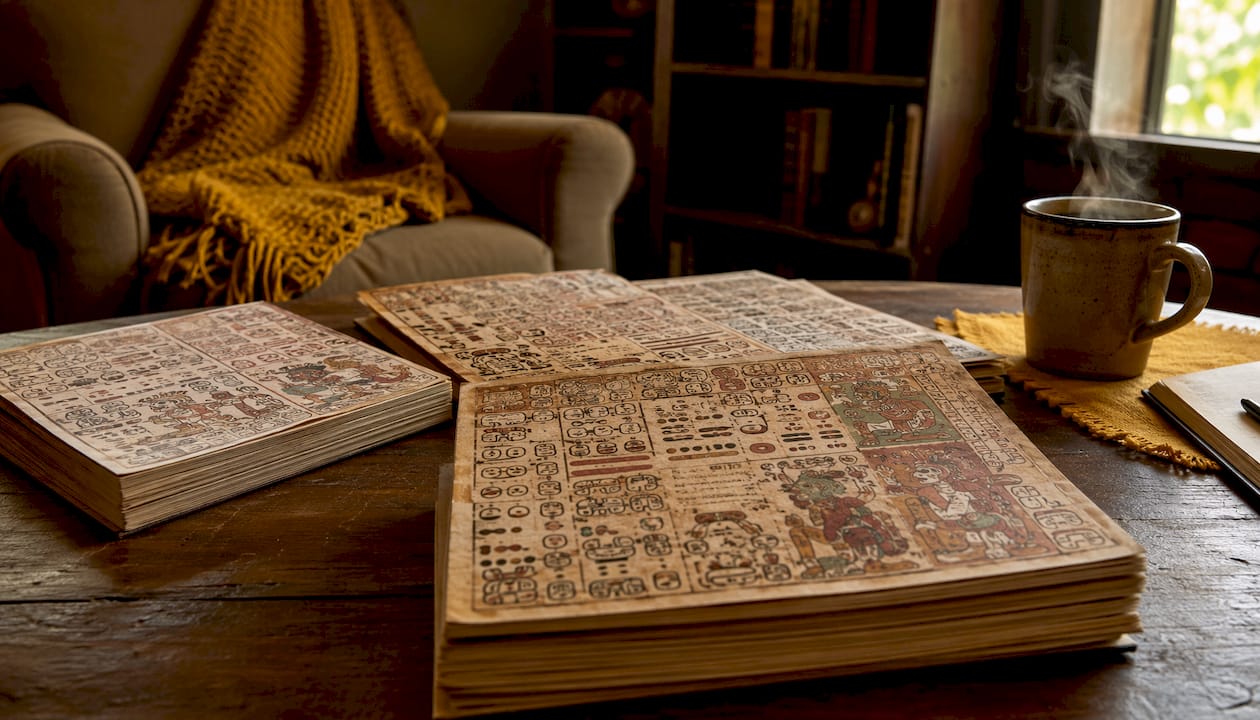
The Dresden Codex is the clearest example of how these functions combine. This pre-Columbian manuscript contains sacred almanacs, planetary tables tracking Venus, and divination instructions, all written in thousands of interlocking glyphs. A single page can record a god’s name, a calendar date, a ritual action, and a prophecy at once.
Pro Tip: When you first look at a glyph block, identify the largest central sign first. That main sign carries the core meaning. The smaller affixes around it refine pronunciation or add grammatical detail.
Numbers in Maya script follow a base-20 system. Bars represent five, dots represent one, and a shell shape represents zero. The Maya were among the first civilizations to use a true zero in mathematics. These numerical glyphs connect directly to the Long Count calendar and the 260-day Tzolkin cycle, which governs the twenty Mayan day glyphs you may recognize from Mayan astrology.
How do you read Mayan glyphs?
Reading Mayan glyphs follows a specific spatial logic. Glyph blocks are arranged in a grid and read from left to right and top to bottom, moving through paired columns. You read the left block of a pair, then the right, then drop to the next row and repeat. Once you internalize that pattern, the visual chaos of a carved stela starts to resolve into ordered sentences.
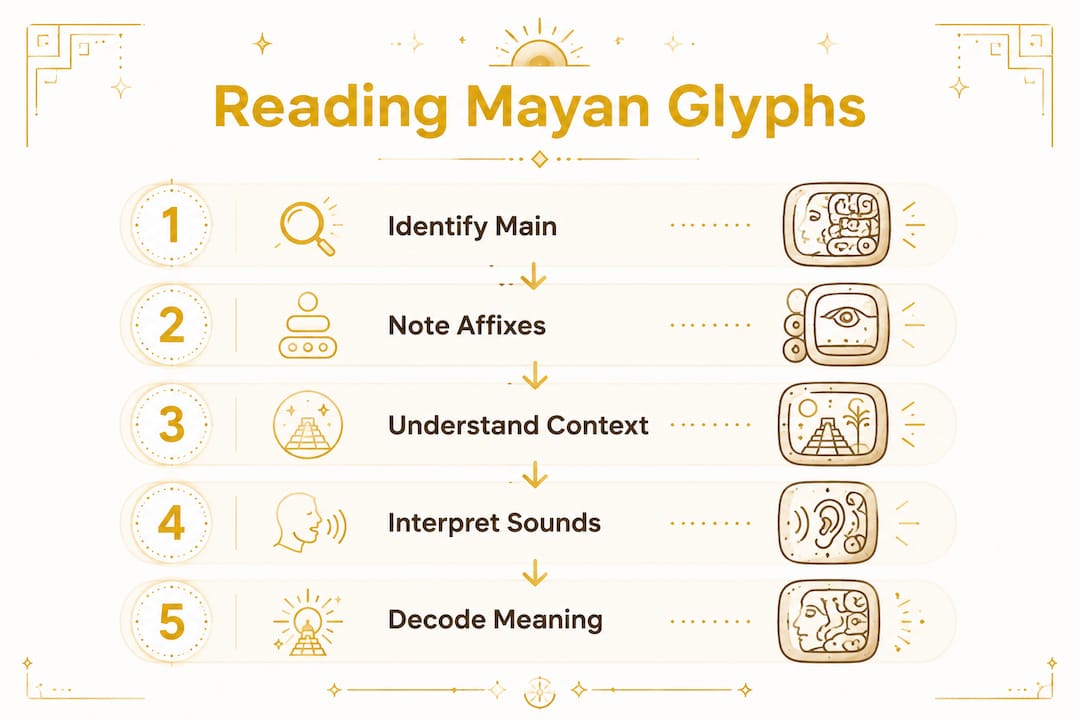
The key methodological steps for reading glyphs are:
- Identify the main sign. The largest element in the block carries the primary meaning, either as a logogram or as the base of a phonetic spelling.
- Read the affixes. Prefixes appear above or to the left; suffixes appear below or to the right. They add phonetic syllables or grammatical markers.
- Determine logogram or syllabogram. Some signs represent whole words; others spell out sounds. Context and repetition help distinguish them.
- Check for substitution. The same word can be written as a logogram, spelled phonetically, or written as a combination of both. Scribes chose based on artistic preference.
- Account for wordplay. Many glyphs carry layered meanings through homonyms and puns, which means pure pattern-matching fails without knowledge of the underlying language, Yucatec or Ch’LTI’ Maya.
The biggest conceptual breakthrough came from Soviet linguist Yuri Knorozov. Knorozov demonstrated that Maya script is logosyllabic, meaning glyphs represent syllables as well as whole words. Before his work in the 1950s, many Western scholars assumed the script was purely ideographic, a collection of symbols with no phonetic component. Knorozov’s phonetic approach cracked open the system.
The dual forms of main signs add another layer of complexity. Any given sign can appear as an abstract geometric shape or as a naturalistic head, depicting a deity, a human, or an animal. Both versions carry identical meaning. Scribes chose the form that best fit the artistic composition of the monument. This duality gave Maya writing a visual richness unmatched by any other ancient script.
Pro Tip: Learning the 20 Mayan day glyphs from the Tzolkin calendar is the fastest entry point for beginners. Each day sign has a fixed visual form and a known meaning, giving you 20 confirmed glyph-to-meaning anchors to build from. Mymayansign’s Mayan calendar blog covers each day sign in depth.
What are some common Mayan glyph symbols and their meanings?
The twenty day glyphs of the Tzolkin calendar are the most widely recognized Mayan glyph symbols. Each carries a distinct name, visual form, and spiritual meaning. Here are eight of the most significant, with their core associations:
| Day Glyph | Name | Core Meaning |
|---|---|---|
| 1 | Imix | Primordial water, creation, the crocodile |
| 5 | Chicchan | The serpent, vital force, sky energy |
| 12 | Eb | The road, human destiny, the stairway |
| 16 | Cib | The owl, ancestral wisdom, forgiveness |
| 19 | Cauac | Storm, thunder, purification |
| 20 | Ahau | The sun lord, completion, enlightenment |
| 3 | Akbal | Night, the underworld, inner vision |
| 9 | Muluc | Water, the moon, offerings |
Beyond the day glyphs, Maya inscriptions include event glyphs that record specific moments in royal history. Tatiana Proskouriakoff identified that certain glyphs mark life events of rulers, including birth, accession to the throne, and death. The “upended frog” glyph likely signals a birth event. A glyph scholars nicknamed the “toothache” glyph marks a ruler’s accession. These event glyphs transformed our understanding of Maya inscriptions from abstract religious texts into readable historical records.
Deity glyphs carry equally rich symbolism. Ek-Chuah, the merchant god, appears in glyphs alongside sky serpents and cosmic cycle markers. His glyph incorporates a black-painted face and a distinctive eye marking, both of which are direct visual references to his mythological role. The artistic features are not decorative. They are the meaning itself.
Common symbolic categories in Mayan glyph symbols include:
- Celestial bodies: Sun, moon, Venus, and star glyphs tied to astronomical observation.
- Animals: Jaguar (rulership and the night sun), deer (sacrifice), and turtle (the earth’s surface).
- Natural forces: Rain, wind, fire, and maize, each linked to specific deities and ritual cycles.
- Social events: War, sacrifice, tribute, and marriage, recorded on stelae and lintels.
You can explore how these symbols connect to your own birth date through the Mayan day sign calculator at Mymayansign, which maps your birth date to a specific day glyph and its meaning.
How has the decipherment of Mayan glyphs evolved?
The decipherment of Mayan glyphs is one of the great intellectual stories of the 20th century. For centuries after the Spanish conquest, the script was treated as undecipherable or dismissed as purely priestly symbolism. That changed through the work of three key figures:
- Yuri Knorozov (1950s): Proved the script is logosyllabic, not purely ideographic. His syllabic grid gave scholars a phonetic key to match glyphs to spoken Mayan languages.
- Tatiana Proskouriakoff (1960): Showed that date patterns in inscriptions correspond to human lifespans, proving glyphs record real historical events, not just mythological ones.
- Linda Schele and David Stuart (1970s–1990s): Expanded the phonetic decipherment and identified hundreds of specific glyph readings through collaborative workshops known as the Maya Meetings at the University of Texas.
The shift from viewing the script as ideographic to recognizing it as logosyllabic was the single most important conceptual change in Maya studies. It meant the glyphs were not just symbols of ideas. They were a written form of a spoken language, and that language could be reconstructed.
Current estimates suggest that a significant portion of the more than 800 glyphic elements remain only partially understood. The gaps are not random. They cluster around rare ritual contexts, regional script variants, and glyphs that appear only in damaged or incomplete codices. The three surviving pre-Columbian codices, the Dresden, Madrid, and Paris, each contain unique glyph forms not found in stone inscriptions.
The cultural stakes of decipherment are high. Every glyph read correctly restores a fragment of Maya history that colonial destruction nearly erased. Bishop Diego de Landa burned thousands of Maya manuscripts in 1562, calling them works of the devil. The irony is that his own written account of Maya culture, the “Relación de las Cosas de Yucatán,” preserved the syllabic chart that Knorozov later used to crack the code.
Key Takeaways
Mayan glyphs form a logosyllabic writing system where each block combines a main sign and affixes to encode sounds, words, calendar dates, and historical events with layered cultural meaning.
| Point | Details |
|---|---|
| Logosyllabic structure | Each glyph block contains a main sign plus affixes representing syllables, logograms, or both. |
| Over 800 glyphic elements | Authorities estimate only a portion of these elements have been fully deciphered. |
| Knorozov’s breakthrough | Proving the script is phonetic, not purely ideographic, opened modern decipherment. |
| Event glyphs record history | Glyphs like the “upended frog” mark real royal life events, not just mythology. |
| Day glyphs carry spiritual meaning | The 20 Tzolkin day signs each encode a distinct cosmological and personal significance. |
Why glyphs are more than ancient writing
The thing that strikes me most about Mayan glyphs is not their complexity. It is their intimacy. Every carved stela was a public statement, yes. But it was also a deeply personal one. A ruler’s birth glyph, accession glyph, and death glyph tell a human story compressed into stone. When Proskouriakoff realized those date patterns matched human lifespans, she was not just solving a puzzle. She was hearing a voice that had been silent for centuries.
What I find underappreciated is how the dual forms of glyphs, abstract and naturalistic, reveal the Maya worldview directly. The same meaning expressed as a geometric shape or as a deity’s face tells you that the Maya did not separate the abstract from the living. A number was also a god. A day was also a force. That is not primitive thinking. That is a different and coherent philosophy of reality.
For anyone learning to read Mayan glyphs, my honest advice is to start with the Tzolkin day signs. They are the most documented, the most visually consistent, and the most personally relevant. Your birth date maps to one of these twenty signs. That sign is not a horoscope in the Western sense. It is a mirror, showing you the energetic pattern the Maya believed you carry. Understanding the glyph behind your sign connects you to a living tradition, not a dead one.
— Fatih
Your Mayan sign is written in glyphs, too
The glyphs carved on ancient temples are the same symbols that define your personal Mayan day sign, Galactic Tone, and Tree of Life. Mymayansign translates that ancient script into a personalized reading based on your birth date.
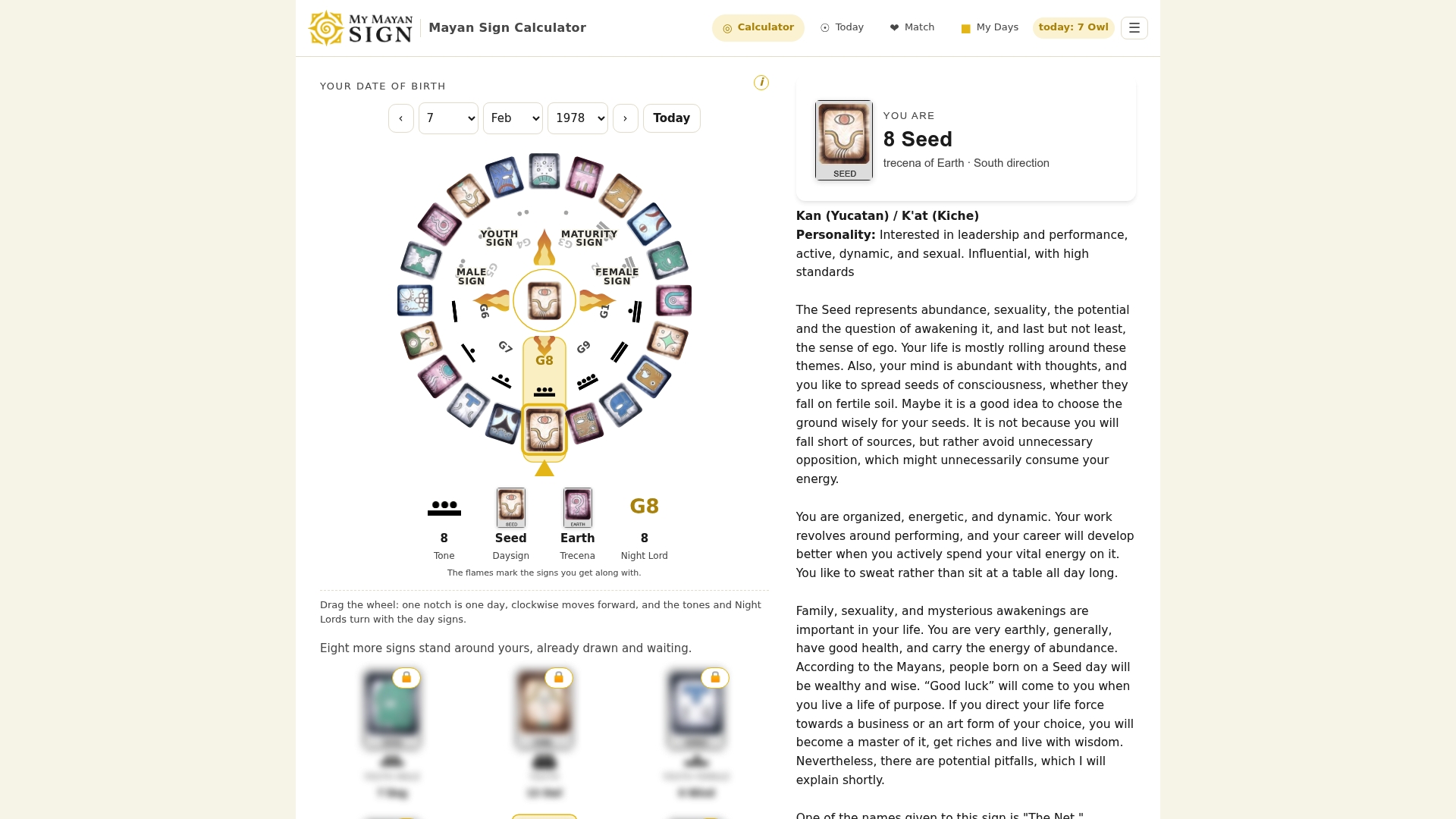
You can use the Mayan sign calculator to find your day sign in seconds. For a deeper reading, the full Mayan astrology guide at Mymayansign explains the cosmological meaning behind each of the twenty day glyphs, the thirteen Galactic Tones, and how they combine to form your unique profile. If you want daily context, the today’s Tzolkin page shows which glyph governs the current day and what it means for you.
FAQ
What is a Mayan glyph?
A Mayan glyph is a written symbol from the ancient Maya logosyllabic script, where each block combines a main sign and smaller affixes to represent sounds, words, calendar dates, or ideas. The script contains over 800 distinct elements.
How do you read Mayan glyphs?
Glyph blocks are read left to right and top to bottom in paired columns. Each block contains a main sign read first, followed by affixes that add phonetic syllables or grammatical meaning.
What do the 20 Mayan day glyphs mean?
The 20 day glyphs of the Tzolkin calendar each carry a specific name and spiritual meaning, ranging from Imix (primordial water and creation) to Ahau (the sun lord and completion). Each glyph corresponds to a day in the 260-day sacred cycle.
Who deciphered Mayan glyphs?
Yuri Knorozov made the foundational breakthrough by proving the script is logosyllabic in the 1950s. Tatiana Proskouriakoff later showed that inscriptions record real historical events, including the birth and death of Maya rulers.
Are all Mayan glyphs translated?
No. Authorities estimate that a significant portion of the more than 800 glyphic elements remain only partially understood, particularly those found in rare ritual contexts or damaged codices.
Recommended
- Mayan Astrology Blog | Day Signs, Tzolkin & Calendar
- Mayan Calendar Today: Today’s Tzolkin Day Sign, Tone & Meaning
- Daily Mayan Wisdom – MyMayanSign
- Sacred Teachings of Mayan Astrology – eBook – MyMayanSign
Article generated by BabyLoveGrowth