
Do you remember where you were on December 21, 2012?
I do. For years before that date, the world had worked itself into a quiet panic. There were movies about tidal waves swallowing the Himalayas, magazine covers asking if this was the end, and a steady stream of documentaries promising that an ancient people had marked the last day of history on a stone wheel. Then the morning came. The sun rose the way it always does. People went to work. And the great Mayan doomsday simply did not happen.
So what was the 2012 prophecy really about? The short answer is that the living Maya never predicted the end of the world at all. What ended was a cycle. And in their way of seeing time, the end of a cycle was never something to fear. It was something to honor.
Let me walk you through what actually happened, because the real story is far more beautiful than the one Hollywood sold you.
I learned this from the Maya themselves
In 2011, the year before the famous date, I traveled to Guatemala. I had the privilege of meeting Don Alejandro Cirilo Oxlaj, known as Wandering Wolf, the head of the National Council of Mayan Elders, and his wife Elizabeth Araujo, a day-keeper in her own right. I even translated some of her lectures. These are people who have carried the calendar in an unbroken line, grandparent to grandchild, for more than two thousand years.
Not once did they speak about an apocalypse. When I asked, the answer was always the same gentle correction. The Maya never argued that there would be a catastrophe, or the end of the world. A great cycle was closing, and a new one was opening. That was all. The fear belonged to us, not to them.
So when you read frightening things about 2012, remember that the people who actually keep the calendar were never afraid. The panic came from outside the tradition, not from inside it.
What the 2012 date actually was
The date came from one specific Maya calendar called the Long Count. Think of the Long Count as an odometer for civilization. Instead of counting miles, it counts days, and it rolls over in larger and larger units: 20 days make a uinal, 360 days make a tun, and 144,000 days make a baktun, which is roughly 394 years.
The Maya tracked great ages of 13 baktuns each, a span of about 5,125 years. On December 21, 2012, the odometer reached 13.0.0.0.0. The thirteenth baktun completed and clicked over to zero, the way a car odometer rolls from 99,999 back to 00,000. The car does not explode. It simply starts counting again.
The Long Count was only one of several Maya calendars running at the same time. There was also a 365-day solar calendar called the Haab and the sacred 260-day Tzolkin, and they turned together like gears. If you are curious how those pieces interlock, I explored it in this piece on the Haab signs.
Here is the part most people miss. The exact end date was not handed down by living day-keepers. It was reconstructed by archaeologists matching the ancient Long Count to our Gregorian calendar. The Maya themselves left almost no carving describing what would happen on that day. The one monument that does mention it, found at Tortuguero, simply says a deity would descend. No fire. No flood. No ending. Just a turning.
The calendar everyone pictured was not even Mayan
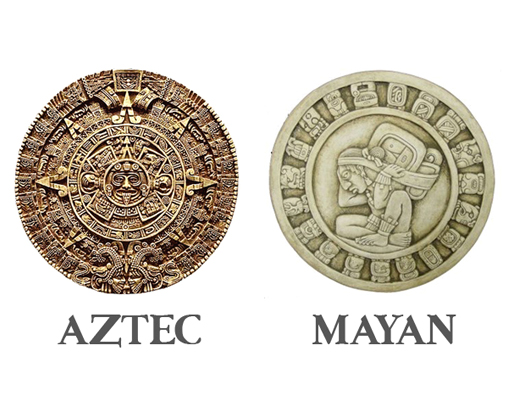
Here is a detail I love, because it shows how thin the panic really was. Picture the Mayan calendar in your mind. Most people see a round stone with a stern face in the center and a ring of symbols around it. That famous wheel is not Mayan at all. It is the Aztec Sun Stone, carved by a different people, in a different language, centuries later.
The world spent years frightened of a prophecy printed on the wrong calendar, from the wrong civilization. When the very symbol at the heart of a global fear turns out to be a case of mistaken identity, you can relax a little about the fear itself.
The day that was supposed to end everything carried the sign of completion
Now let me show you something only the Tzolkin, the sacred 260-day calendar I work with, can reveal. Every single day carries one of 20 day-signs and one of 13 tones. December 21, 2012 was not a blank square on a wall. It had its own energy, its own name.
That day was 4 Ahau. In my system I call this sign Light, the sign of the ancestors. Ahau is the twentieth and final day-sign, the one that completes the cycle of all 20. It is the sign of poets, singers, dancers, and elders, the energy that gathers a whole journey and hands it back as wisdom.
Sit with that for a moment. Out of 260 possible combinations, the cycle did not close on the sign of conflict, or destruction, or fear. It closed on Light. On completion. On the ancestors passing the torch forward. The Maya did not arrange this on purpose. The count simply landed there. But to me it reads like a quiet poem written into the calendar itself, a great age ending on the exact sign that means a graceful ending.
This is the kind of thing you start to notice once you read your own days instead of fearing them. If you have never met your own day-sign, you can find it in a minute with the free calculator. Most people are surprised by how closely their sign describes them.
An ending is a transformation, not a death
To really understand why the Maya were so calm about 2012, you have to understand how they see endings in the first place. In the Tzolkin there is a day-sign called Death. When I tell people their core sign is Death, their face usually falls. But Death in this system is one of the luckiest signs there is. It does not mean dying. It means transformation, the caterpillar becoming the butterfly, the old self released so a truer one can step forward.
Think of Freddie Mercury, whose chart I have written about before. He was born on a Death day, 9 Death to be exact. He did not live a small life and quietly fade out. He transformed himself, transformed his music, and transformed everyone who heard him, and his influence only grew after he was gone. That is what the Death sign does. It ends one form so a larger one can begin.
2012 was a Death-sign moment for the whole planet, even though the calendar dressed it in the gentle robe of Light. One great age loosened its grip so the next could be born. Nothing was destroyed. Something was reborn.
The real prophecy: the shift of the ages
So if 2012 was not the end of the world, what is the prophecy actually pointing at? The elders call it the shift of the ages. It is not a single date and not a single disaster. It is a long, slow turning in human consciousness, and we are living inside it right now.
The teaching is simple, and a little uncomfortable. We live in an age of contamination. Our water, our air, our food, and very often our minds and our relationships have been polluted. And in the Maya view, every great contamination is followed by a great purification. The shift is that purification, the moment a critical number of us remember that we are not separate from the Earth, or from one another.
There is a beautiful image at the center of this teaching, the prophecy of the Eagle and the Condor. The Eagle represents the mind, the north, the analytical Western world. The Condor represents the heart, the south, the intuitive indigenous world. For five hundred years the two were severed. The shift of the ages is their reunion, not only between continents but inside each one of us. As one of my teachers used to say, the longest journey you will ever walk is the one from your mind to your heart.
That is the real prophecy. Not the end of the world. The end of a way of living that forgot the heart.
What 2012 means for you, personally
Here is where it becomes practical, because Mayan astrology was never meant to be admired from a distance. It was meant to be lived.
The Maya saw the close of a cycle as a hiatus, a gap in time, like the dark space between two frames of a film. In those gaps you can change direction. A baktun ending is one of those gaps on a civilizational scale, but you have small ones all the time: birthdays, new moons, solstices, and especially your own Tzolkin birthday, the day your exact sign and tone return every 260 days.
You do not have to wait for a once-in-5,000-year date to begin again. Your own calendar gives you these turning points constantly, once you know how to read it. That is really what the detailed report and the daily calendar on my site are for, to show you your personal version of December 21, 2012, the days when your own age quietly turns over and you get to choose a new direction.
So the next time someone tells you the Maya predicted doom, you can smile. The Maya predicted renewal. They built an entire calendar to help us catch the moment of renewal and step through it awake.
Frequently asked questions
Did the Mayan calendar predict the end of the world in 2012?
No. The living Maya never taught that. December 21, 2012 marked the end of a 5,125-year Long Count cycle, the thirteenth baktun, and the start of a new one. The elders described it as a turning, not a catastrophe.
What happened after the 2012 cycle ended?
A new great cycle began, and the long process the elders call the shift of the ages continued. It is understood as a slow change in human consciousness rather than a single event on a single day.
Is the famous round stone calendar Mayan?
The round stone with a face in the center that most people picture is the Aztec Sun Stone, not a Maya calendar. The Maya and the Aztec were related but separate civilizations, and much of the 2012 imagery actually came from the Aztec artifact.
What was the Mayan day-sign of December 21, 2012?
In the authentic Tzolkin count, that day was 4 Ahau, a sign I call Light, the energy of the ancestors and of completion. It is the final day-sign in the cycle of 20, a fitting note for the close of a great age. You can find your own day-sign with the free calculator.
If you want the full mechanics behind that 13.0.0.0.0 reading, here is the Maya Long Count calendar explained, the great clock that frames every world age.
The 2012 turning is really one chapter in a much larger story, the quiet way this ancient calendar keeps shaping how people search today. I followed that thread in how Mayan astrology influences modern spirituality.
Fatih Kecelioglu is the founder of MyMayanSign.com and the author of Sacred Teachings of Mayan Astrology. He has practiced Mayan astrology for over fifteen years.